

Pakistan is one of those many countries which fall in the outer circle of Kachru’s (1985) three concentric circles, where outer circle depicts the countries having English as their second language. The importance of English in Pakistani learning/teaching perspective could be evident with the fact that English in Pakistan has been taught right from the kindergarten till the graduation level not only as a compulsory subject but all the other subjects are also taught in English. Pakistan being a third world country and a multicultural society has diversity in many aspects of life. As it is an agricultural based country, therefore more than 70% of Pakistan comprises of the rural area, rest of the 30% consists of metropolitan cities like Karachi, Islamabad and Lahore and small towns like Mirpurkhas, Gujranwala and Chaman. The diversity seeps not only in culture, but in the regional languages and in education level as well. In most of the areas of Pakistan the regional languages are the first language (L1) and Urdu is their L2 which makes English L3.
Though English is an official language and every subject is taught in it but because of various educational systems prevailing in the country at the same time has different policies regarding English. In the urban elite setting, English is the only language used inside the school environment and Urdu (L1) is only taught as a subject whereas in other urban schools, Urdu and English are used equally but in an ELT class, it is a compulsion to use the Target Language (TL). On the other hand, in rural setting and especially Madrasa (religious) schools the use of L1 to teach L2 is much higher. The educational policy is another issue in Pakistan as the federal government has devolved the power to the provinces to make their own educational policies which in turn has created confusion amongst the educational fraternity. Nevertheless, the ELT classrooms in Pakistan are always comprised of mixed ability groups because learners shifting from rural to urban areas become a major problem for the teachers as their proficiency level is quite low and they are not acquainted to an environment where the main language of communication is English. This in turn becomes a challenging task for the teachers to maintain pace in their teaching and keep these children having weak language skills in loop as well. Keeping in mind Pakistan’s complex educational scenario, the purpose of this study is to find out the perspective of ELTs regarding the use of Urdu (L1) in their classroom. It is fairly expected that the response from the teachers of different educational systems, urban/rural settings and areas would vary as their circumstances are so different from each other.
There has been an in-depth research on the use of L1 in L2 classrooms and it has been a controversial issue in this field. Researchers have strived to explore the teaching approaches regarding the use of L1 to teach L2. Many approaches endorse the use of L2 for the instructions in an L2 class and even if L1 has been used, its use should be minimized (Turnbull, 2001).
According to De La Campa (2009), L2 should be used primarily by the instructor because the use of L1 might decrease the quantity of L2 comprehensible input. However, there are researchers who advocate the use of L1 in the L2 classroom as they furnish their reasons with cognitive and sociolinguistic aspects of learning (Butzkamm, 1998; Cook, 2001). Therefore, according to Littlewood & Yu (2011), the issue of the balance between the use of L1 and L2 in an L2 classroom is controversial and in Pakistan’s educational perspective it has to be seen examined in various settings. The current study needs to explore the teachers’ perspective in the light of their experience about the use of L1 in the L2 classrooms.
The use of L1 in L2 classrooms has always been a controversial issue in the domain of L2 learning and teaching. Even though the use of L1 is increasing more support from few researchers of L2, there are several who have argued that the use of L1 should be reduced in L2 instruction. These opponents of L1 usage bring up several assertions to support their position. They argue that the use of L1 may have detrimental effects on the instructors’ use of L2 because if instructors use L1, the quantity of comprehensible L2 input decreases, which is thought to hamper learners’ L2 learning. They argue that adult L2 learning should take place in the same fashion as child L1 learning and that the L2 should be ‘largely acquired rather than consciously learned, from message oriented experience of its use’ (Mitchell, 1988; Chambers, 1991). These arguments may stem from beliefs in naturalistic approaches to language teaching that emphasize a focus on immersion of the learner in the L2 and providing abundant opportunities for exposure to the target language (Krashen & Terrell, 1983). Therefore, these people may view the use of L1 as characteristic of the old-fashioned grammar translation method, which largely focused on translating from L2 to L1 as a way of learning the L2 all the students and colleagues not to use L2 in the classroom as the only way in which language should be taught and hence consider ‘ no L1 use’ an undisputed premise (Chambers, 1991; Franklin, 1990).
There are, on the other hand, researchers who argue that L1 should not be abandoned in L2 classrooms, and they provide both cognitive and sociolinguistic reasons for their position. From a cognitive perspective, they contend those learners who have mastered their L1 to make sense of the world, new concepts and a new language (Butzkamm, 1998; Cook, 2001). Thus, the use of L1 would provide them with a valuable cognitive tool (Artemeva, 1995; Hinkel, 1980). Banning L1 from the language classroom, on the other hand, would ignore the cognitive reality that connecting new concepts to preexisting knowledge creates better chances for language learning success. In addition, L1 can be a valuable socio-cognitive tool to collect ideas that can in turn help mediate the learning of L2 and promote interaction among learners in the L2 environment (Storch & Wigglesworth, 2003; Wells, 1998). Furthermore, as the use of L1 is a sign of learners’ sociolinguistic expression of their emerging bilingual status, it bridges their
identity as speakers of L1 with the creation of a new self in the L2 (Liebscher &Dailey-O’Cain, 2004)
Due to the debate surrounding the use of L1, a number of studies have examined the use of L1 in L2 classrooms (Edstrom, 2006; Polio & Duff, 1994). These studies have explored the degree to which L1 is used in L2 classrooms and have also examined the attitudes and perceptions of instructors and students regarding the role of L1 in different contexts (Mpras, 2003). They have generally found that although instructors acknowledge the importance of teaching in L2, most of them still use L1 to a certain degree in their classrooms (Macaro, 1995; Levine, 2003). Studies have also found a large variability of L1 use among instructors. Duff and Polio (1990) examined the use of L1 in foreign language classes taught at the University of California and found L1 use ranging from 0 to 90%. They also found that instructors used L1 for a range of purposes, from administration to grammar instruction and classroom management. Similarly, in a Chinese university English as a foreign language (EFL) context, Tang (2002) found that the most common purposes for which L1 was used were giving activity instructions and explaining abstract or culturally specific words, while Kaneko (1992) found in a Japanese secondary school EFL context that instructors used L1 to provide explanations and activity instructors, manage the lesson, and build rapport with the students. Rolin-Ianziti and Brownlie (2002) examined the use of L1 at a university in Australia. These researchers found an average of 8.8% and a range from 0 to 18.1% L1 use in five first-year French courses. In a case study of six student teachers of French with teenage students across four state schools in southern England, Macaro (2001) found a low amount of L1 use, between 0 and 15.2%, with an average of 6.9%. on the other hand, in studying the use of L1 in L2 English classes at a Japanese high school, Kaneko (1992) found that instructors and students used L1 51 to 74% in senior classes and 64 to 83% in junior classes. These studies suggest that teaching context may have an important influence on L1 use in L2 classrooms.
Although a number of studies have examined L1 use, few have investigated the exact thoughts of the instructors when they use L1 in the classroom. The present study investigated use of L1 (Urdu, the national language in urban settlements of Pakistan and regional languages in rural areas) in English as a second language classroom and at the same time explored instructors’ reasoning at those moments they used L1. The study also examined the extent as well as the purposes for which instructors used L1.
Research Question
What is the Pakistani ELTs’ perspective and attitude towards the use of L1 in the L2 classroom?
Methodology Participants:
A total of 15 Pakistani English language teachers (9 female and 6 male) from six different areas of Pakistan namely Karachi, Peshawar, Mirpurkhas, Quetta, Multan and Daddu were taken into account. All the teachers had a vast experience of being for more than 10 years in an ELT classroom. 12 teachers are from k-12 schools and three are from adult learning classroom (teachers’ trainer). Some of them have acquired a post-graduation degree in Applied Linguistics or an ELT certificate whereas others have only a graduation degree and a fairly high proficiency level as compared to the other teachers of the same vicinity. Only four of them have Urdu as their L1 and the rest of the ten have various regional languages like Punjabi, Pushto, Baluchi, Sindhi and Hindco as their L1. Only one teacher has Swahili as her first language as she is a migrant from Kenya. Six of the teachers were friends and colleagues and nine were the students from the teachers training projects ‘Connecting Classrooms’ and ‘ETTE’ (English for Teaching, Teaching for English) conducted by British Council of Pakistan. Out of 15 teachers, 2 female teachers insisted to keep their identities hidden, as they belonged to the rural areas of Pakistan and culturally women folks avoid revealing their identities in public. It was further decided to assure false identities to these 2 participants and carry out the analysis with their pseudo names.
A qualitative research approach to collect data through a questionnaire was taken into account. Teachers were sent the questionnaire through email that was later being sent back in the form of a soft copy. The questionnaire comprised of statements that were to be marked on the Likert scale from ‘strongly disagree’ to ‘strongly agree’. Another set of questions were mentioned with the options to be selected by the teachers along with a section in which teachers were able to express their experiences/other opinions regarding the use of L1. A form was attached to take the detailed profile of the 15 teachers who volunteered for the study.
The data was primarily collected in order to find out the attitudes of Pakistani English language teachers regarding the use of L1 in their ESL classrooms. As it has been mentioned earlier that in Pakistan there are three different educational systems prevailing and the socio- economic and cultural divide in Pakistani society affects the quality of education especially in the context of language learning. To understand the details found in the data, it is essential to express the teachers’ profile. The following table gives an overview of the teachers’ educational settings and L1 background.
| Name | Gender | Age | L1 | Area | Educational System |
| Shahnaz | F | 37 | Sindhi | Rural | Matric |
| Mansoor | M | 53 | Urdu | Urban | Madrasa |
| Aliana | F | 45 | Urdu | Urban/elite | O-level |
| Jeevan | M | 41 | Sindhi | Urban | Matric |
| Shokat | M | 29 | Punjabi | Rural | Madrasa |
| Parveen | F | 61 | Hindco | Rural | Matric |
| Zubaida | F | 47 | Pushto | Urban/elite | O-level |
| Furqan | M | 32 | Urdu | Urban | Matric |
| Naima | F | 43 | Balochi | Urban | Matric |
| Vardah | F | 28 | Sindhi | For all three | Trainer |
| Saleem | M | 38 | Balochi | Rural | Madrasa |
| Fareed | M | 35 | Urdu | For all three | Trainer |
| Kishwar | F | 56 | Pushto | Urban/elite | O-level |
| Arwa | F | 44 | Swahili | Urban | Matric |
| Sadaf | F | 39 | Punjabi | Urban | O-level |
Since the educational context is so diverse in the Pakistani society, therefore it is indeed essential to know what ELTs’ perspective is regarding the requirement of the use of L1 in their ESL classroom. The teachers because of their proficiency level as well as their learners’ proficiency level might use L1 in the L2 classrooms. The questionnaire tried to churn out their perspective along with their comments upon the use of L1. Thus the hypothesis which could be drawn is that the use of L1 in the ESL classroom is a dynamic factor which would vary in ratio of its use in different contexts.
With respect to the research question of the study; what is the Pakistani ELTs’ perspective and attitude towards the use of L1 in the L2 classroom? The outcome could be seen in the form of two major classifications; one which endorses the use of L1 and the other which refuses the idea of using L1 in their L2 classrooms. Though some teachers’ response is beyond
expectations as the context in which they teach is quite challenging for minimizing the role of L1 in an L2 class but still they have managed to bring it to minimum. On the other hand, some ELTs draw attention towards the factors that are other than academic which influence the use of L1 in an L2 class.
The first classification which endorses the idea of the use of L1 is mostly from the rural setting and some from the urban setting. Most teachers in rural areas strongly second the use of L1 because of their learners’ weak background knowledge of L2, non-English speaking environment in which they live, and weak academic base. Though the teachers are professionally trained to use Total Physical Response (TPR) to support their L2 message but still sometimes they simply need to translate the vocabulary items or the whole sentences for their learners. They do admit their own issues of using L1 as they are comfortable to use their regional language with the learners in order to interact and convey messages. However, rural teachers having a degree in English or an ELT certificate had a different perception. Though they agreed that they use L1 in their L2 classrooms but they try to avoid using it as much as possible. They even put an effort in accommodating several strategies to avoid the use of L1 which include recast, negotiation of meaning and clarification. Schools situated in the remote areas of big cities and towns have a class of people who are less privileged therefore, their environment does not support young learners to acquire language from their milieu. Teachers from this kind of vicinity themselves have a weak knowledge of L2, as a teacher responded in her comments that;
‘I want to avoid L1 in my L2 class but my own language skills do not allow me to do so, after all I have done my Matric from the same school and my teacher taught me English in Urdu’
Teachers’ responses revealed other factors which encouraged them to use L1 in their classrooms; one of them being completion of the curriculum and policy of the school to focus on preparing a child to simply pass the examination. One of the teachers sarcastically called Curriculum a ‘hurriculum’. Two out of three madrasa teachers strongly endorsed the idea of using L1 in their L2 classrooms as they commented that;
‘When the purpose of learning English is to write the answer of a question, why should I bother to first learn to speak English and then teach my young lads. It’s a waste of time’
The response shows level of motivation as a major factor that influences teachers to either use or avoid L1 in an L2 classroom.
Nevertheless, teachers who do not endorse the idea of using L1 are mostly from the urban/elite and urban setting. Teachers from the urban/ elite schools highly condemn the use of
L1 as it could be understood through their target learners and their strong academic base. These learners are from well-educated families where the parents most of the times deliberately and sometimes in a flow speak in L2 with their children. On the other hand according to a teacher, elite schools charge high amount of money and are in competition with their contemporaries. These schools are bound to be selective for their teachers’ appointment and they sell themselves by claiming to prepare learners to be fluent in English. These schools usually by policy force teachers and learners to communicate only in English. The important aspect of the study is that even the teachers from the urban/elite have admitted that the importance of L1 in their L2 classrooms could not be denied. On the contrary, according to them, sometimes it is inevitable to use L1, especially when they have to quote a colloquial phrase or explain the meaning of a vocabulary item.
The Madrasas (religious schools) are being stereotyped to preach only religion and teaching other subjects is out of their focus. The perception in general has been proven by the majority of them but there are some people who have a progressive approach towards education and they do consider it equally important to learn all the subjects along with the Quranic studies. One of the Madrasa teachers had the same progressive approach and it reflected through his response. He endorsed the idea of learning English as a set of skills rather than a subject and he strongly agreed that the minimum use of L1 would allow learners to learn various functions of L2. The teachers’ trainers endorsed the idea of using only L2 in an ESL classroom and they claimed to witness the strategy to be useful in order to nurture L2 learning.

It could be noticed that teachers of the same country having English as their second language have a diverse attitude towards the use of L1 in the L2 classroom. In view of the responses, above mentioned graphic model has emerged which could help interpret the results. As it could be observed from the diagram that the use of L1 varies according to the social context and it gradually increases when you move from urban to rural areas.
In view of the teachers’ response generated from the questionnaire, the hypothesis could be proved correct because the amount of the use of L1 varies in different context. The data gives a detailed perspective of each teacher along with the reasons why or why not they use L1 in their
L2 classrooms. However, the learners’ response for the same investigation could add substantial value to the research, after all the ultimate beneficiary of the ESL class is the learner who has to learn L2 to communicate with the rest of the world. Though the teachers claim it to be useful or futile to use L1 in L2 classrooms but a detailed study should be done in order to evaluate the ratio of its usefulness.
Artemeva, N. (1995). The adult learner as incipient bilingual: The role of L1 in the adult ESL classrooms. Carleton Papers in Applied Language Studies, 12, 113–137.
Butzkamm, W. (1998). Code-switching in a bilingual history lesson: The mother tongue as a conversational lubricant. International Journal of Bilingual Education and Bilingualism, 1(2), 81-99.
Chambers, F. (1991). Promoting use of the target language in the classroom.Language Learning Journal, 4(1), 27-31.
Cook, V. (2001). Using the first language in the classroom. Canadian Modern Language Review/La Revue canadienne des langues vivantes, 57(3), 402-423.
De La Campa, J. C., & Nassaji, H. (2009). The amount, purpose, and reasons for using L1 in L2 classrooms. Foreign Language Annals, 42(4), 742-759.
Duff, P., & Polio, C. (1990). How much foreign language is there in the foreign language classroom? Modern Language Journal, 74, 154–166.
Edstrom, A. (2006). L1 use in the L2 classroom: One teacher’s self-evaluation. Canadian Modern Language Review, 63, 275–292.
Franklin, C. (1990). Teaching in the target language: Problems and prospects. Language Learning Journal, 2, 20–24.
Hinkel, R. (1980). Gegen das Prinzip der strikten Einsprachigkeit im Fremdsprachenunterricht [Against the principle of strict monolingualism in foreign language instruction].
Zielsprache Deutsch, 3, 14–25.
Kachru, B. B.(1985) Standards, codification, and sociolinguistic realism: the English language in the outer circle. RandolphQuirk and Henry. G. Widdowson (eds.), English in the World, 11-30.
Kaneko, T. (1992). The role of the first language in foreign language classrooms. Unpublished doctoral dissertation, Temple University, Philadelphia.
Krashen, S. D., & Terrell, T. D. (1983). The natural approach: Language acquisition in the classroom. Oxford, UK: Pergamon.
Levine, G. (2003). Student and instructor beliefs and attitudes about target language use, first language use, and anxiety: Report of a questionnaire study. Modern Language Journal, 87, 343–364.
Liebscher, G., & Dailey-O’Cain, J. (2004). Learner code-switching in the content-based foreign language classroom. Canadian Modern Language Review, 60, 501–525.
Littlewood, W., & Yu, B. (2011). First language and target language in the foreign language classroom. Language Teaching, 44(1), 64-77.
Macaro, E. (1995). Target use in Italy. Language Learning Journal, 11, 52–54.
Macaro, E. (2001). Analysing student teachers’ codeswitching in foreign language classrooms: Theories and decision making. Modern Language Journal, 85, 531–548.
Mitchell, R. (1988). Communicative language teaching in practice. London: Centre For Information on Language Teaching and Research.
Mpras, F. (2003). First language use in the classroom: A qualitative study of secondary teachers and administrators in a ‘‘best case’’ school (Doctoral dissertation, George Mason University, 2003). Dissertation Abstracts International, 64, 386-A.
Rolin-Ianziti, J., & Brownlie, S. (2002). Teacher use of learners’ native language in the foreign language classroom. Canadian Modern Language Review, 58, 402–426.
Storch, N., & Wigglesworth, G. (2003). Is there a role for the use of the L1 in an L2 setting?
TESOL Quarterly, 37, 760–770.
Tang, J. (2002). Using L1 in the English classroom. English Teaching Forum, 40, 36–43.
Turnbull, M. (2001). There is a role for the L1 in second and foreign language teaching, but…. Canadian Modern Language Review/La Revue canadienne des langues vivantes, 57(4), 531-540.
Wells, G. (1998). Using L1 to master L2: A response to Anton and DiCamilla’s ‘‘Socio- cognitive functions of L1 collaborative interaction in the L2 classroom.’’ Canadian Modern Language Review, 54, 343–353.
Appendix:
PAKISTANI TEACHERS’ PERSPECTIVE IN USE OF L1 IN AN ELT CLASSROOM
Read the statements and tick on the Likert Scale the option which suits your opinion best.
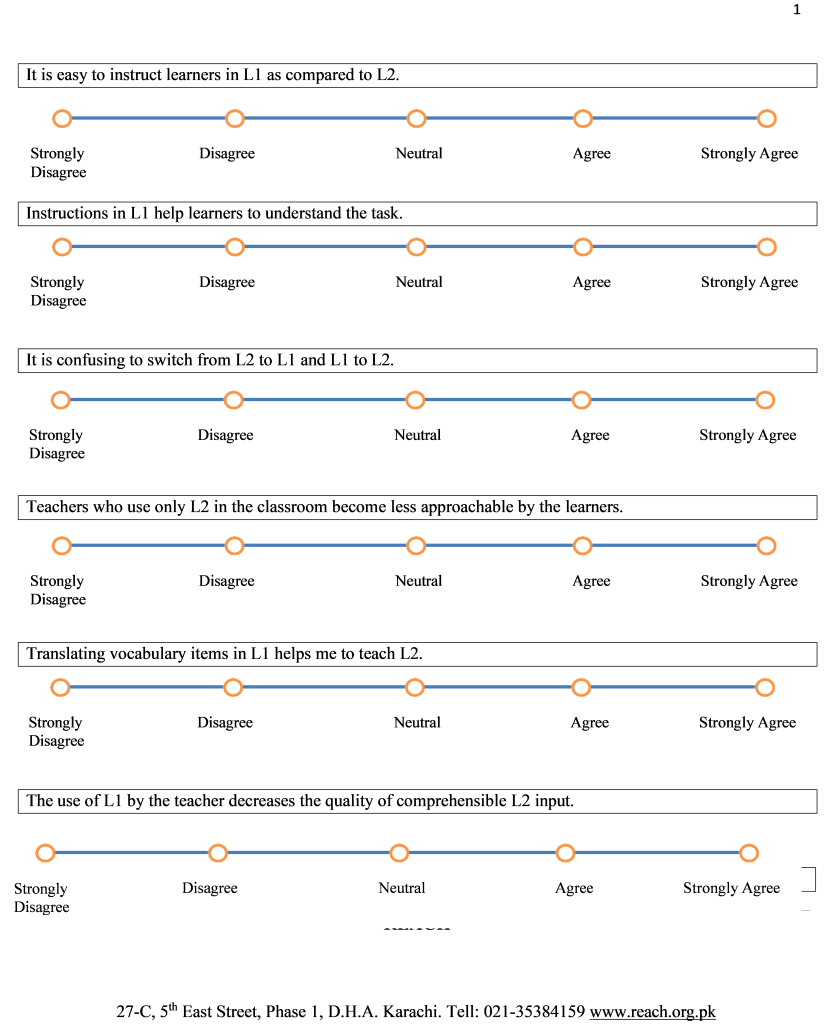
Tick the option which best suits you.
| How often do you use L1 in your ELT classroom? | Not at allSometimesAll the time | |
| For what purpose do you use L1? | Negotiation of meaningClarificationElicitationExplanation | |
| What strategies are used to avoid L1? | RecastParaphrasingNegotiation of meaningClarificationFeedback | |