Education is the basic right of every individual especially the children who are yet to discover the world they live in it with peace, integrity and harmony (Delors, 1998). Developing countries such as Pakistan has poverty and discriminated allocation of resources (Coiller & Dollar, 2002). The people in these developing countries are even deprived of the basic necessities of life and lack provision of basic human rights (Gleick, 1998). Education likewise is also a basic requirement and human right that has not been accessible to all. It is rather for a certain class that can afford to send their children to schools buy the books and are able to help them learn at home as well. Pakistan in the recent era has undergone tremendous changes in terms of awareness amongst common people (Islam, 2005). This is primarily due to the role of media and social media that even a common man is politicized and is raising its voice for their basic rights.
According to Bengali (1999), Pakistan’s Constitution has carried substantial policies for removing illiteracy and providing free and compulsory education in minimum possible period according to Article 37(b), 1973, but this article however remained an aspiration and was never implemented in full force and with a greater will (Stengos & Aurangzeb, 2008). The reason being the article 37(b) of 1973 was a policy principle but not a fundamental right according to the constitution. In the recent times, the federal government had empowered the provincial governments by devolving its powers and strengthening the provincial governments (Shah& Thompson, 2004). Provincial governments are now responsible for education. The 18th amendment of the Constitution has included Article 25(A), making the Right to Education (RTE) mandatory for every child age 5 to 16 (Ahmad, 2001). According to this new amendment every child of the mentioned age has a right to free quality education and it is state’s responsibility to provide it.
The Government of Pakistan has asserted education for All (EFA) as its prime precedence and implementation of Article 25(A) is its major challenge that has to be accomplished (Baurer, 2012; Mittler, 2012). This latest constitutional provision has become a source for making elementary education completely free and compulsory (Qureshi, 2004).
Making laws and constitutional amendments had been done in the past but due to feeble efforts in implementing; they caused no visible improvement in the additional enrolments as the figures are quite shocking. According to a survey report of PILDAT (2011), the recent surveys showed that more than 55 million people age 10+ could not read and write and 7 million children of age five to nine years were out of school. Pakistan as a welfare state has not been successful in reaching out children who were out of the school (Crozier & Davies, 2007). There has been an increase in the ratio of out of school children over the period of time. It is majorly because of a rapid growth of population and low enrolment of children in the schools which further resulted into an illiterate mass volume of people (Rhoads, 2013).
The Government of Sindh passed the Sindh Right of Children to Free and Compulsory Education (hereafter referred to as the RTE Act) in March 2013 in an attempt to translate right to education for children enshrined under the 1973 Constitution of Pakistan into codified law (Awan, Waqas& Aslam, 2011). Since then, the law has had mixed reviews by both educationists and legal experts, ranging from severe criticism to mild reservations about its applicability. The Government of Sindh was the first devolved province to pass this law in the
country after the first draft was prepared by the Federal Government in 2010 (Musarrat, Ali & Azhar, 2012). Subject-matter experts hold that in a race to be the first province to pass the law, many finer details of the law were not vetted for neutrality and fairness, while the rules that will determine the quality of its application are yet to be penned by a taskforce created for this purpose.
The province of Sindh has been marred with stunted progress in human development, particularly in the field of education for a myriad of reasons (Narayan, 2011). Neglect, poor infrastructure, pervasive corruption and lack of human and institutional capacity have kept progress slower than any forward-looking policies could hope to rectify. Factors behind efficient state-sponsored schooling programs have been compounded by wide-spread poverty, gender disparities and social exclusion, which have further reduced the ability of citizens to enjoy the fulfillment of their fundamental rights.
What is the perception of stakeholders regarding implementation gaps in the Sindh Right to Education Act of Pakistan?
Research is a source of multiple learning aspects as it provides you to learn about a certain topic/issue/statement/theory or problem further probing it to its deepest point. This probing makes you penetrate to its core and learn much more about relevant or irrelevant details. This research in particular has improved my knowledge about the Right to Education law and how and why it has been levied. The stakeholders’ perceptions regarding the issues of its implementation have also added up the ground reality of the actual situation. It also helped me to understand why laws have been made but are often not implemented. Of all these advantages, the most important advantage of this research to me was as an educationalist to understand the educational issues for poor and under privileged communities of Pakistan who have been deprived of their basic rights. As I work in the capacity of Education Manager in an NGO and am handling more than 18 different projects related to education for underprivileged communities of Pakistan, this research has been helpful in reaching out marginalized societies, teachers, parents, children, government officials and other state actors such as politicians to understand the hindrances to impose this law.
The topic was deeply rich and could not be covered with all its aspects in one go therefore, it has left several important points and rooms for researchers to probe it deeper and uncover other facts regarding ground realities. Researchers could be the stakeholders themselves who could take great interest in highlighting various other aspects to this law and its implementation. They could also include foreign stakeholders or non-state actors’ perception about it.
Government school teachers who are directly involved as the stakeholders were able to learn more about the perception of other stakeholders. They were also able to learn about the law and its details in a wider strength. Furthermore, teachers were able to realize their vital role in spreading the word amongst the learners and their parents so as to make it a common issue being valued by everyone involved. Teachers from private sector were able to understand the importance of this law as it has increased the chances of indirect stakeholders such as students in private sector to get benefitted by it. Teachers have realized that if they would not fulfill their duties with competence, they might be penalized for it.
The school administration benefited in understanding what the actual law was, who the stakeholders were and what were the implementation gaps? The research helped them to understand the ground realities of the situation and how and why the information about this law has not been reached the actual stakeholders. Because school administration can play an important role in communicating the significance of this law to their own teachers, students and parents, they had a comprehensive knowledge of the contents of this law through my research. The school itself is a place where right to education has been practiced and from here the record has been generated for further evaluation therefore, they received help to align and alter their
school policies, internal control and employees’ job description especially in the context of private schools.
Because parents and communities were directly involved in it as they are the main stakeholders who are poor, underprivileged and seek a financial help for their children’s
education, they were able to learn every aspect of this law and how significant their role could become in implementing this law. As it is understood that the more people know about it, the more government comes under pressure to implement it and give people their right. Parents were able to learn the ways they can communicate their demands to the concerned authorities. This research had been an important source for the communities to understand gaps found in implementation and how they could be rectified by joining hands with other stakeholders.
Because of a certain divide in Pakistan, many educationalists and academicians are unaware of the ground realities of underprivileged people. Most educationalists belong to urban areas and dwell in a society where the urban community is moderately educated and is able to earn a decent living for themselves and they often overlook a fact that Pakistan’s 80% of population belongs to poor class and their children are deprived of their basic right to education because of ignorance, poverty and sometimes political reasons. This research was a source of information for them to understand how vulnerable the situation is for such communities and because of lack of education these underprivileged communities have become nurseries to nurture violence, extremism and gender inequalities. They were also able to understand how significant their role could be in communicating the word amongst their own fraternity. They
were helped out in understanding the ground realities of how far the word is spread amongst the stakeholders and what the implementation gaps are and how much could have been done in this regard if the awareness regarding the law would have spread in due course of time.
The research was able to firstly alert the policy makers to an extent that the word about the law has spread so far and educational researchers have started taking interest in finding out the gaps in its implementation. The intensity of the situation has heated up for them as through the research they came to know what the perception of the stakeholder is and how they see the efficiency of the law implementers and policy makers. Through the gaps that have been identified in the research, the policy makers understood what alterations could be done in order to improve the law and make it easier to be implemented and materialized.
Many senior journalists have been working upon the Right to Education issue and this research facilitated them to understand the gaps in the implementation of this law and how those gaps could be bridged through taking vital steps. Since journalists are the opinion makers and media has an access to masses, it also has become a source of disseminating information and issues therefore, it can help spreading information about this law. It can also play a role of a pressure group that can pressurize the concerned authorities to materialize the law and give rights to education to the children.
Government officials are the duty bearers and are solely responsible in executing this law. This research assisted them in understanding the wider perspective of the stakeholders regarding the gaps that can or may become the hurdle in implementing it. However, it may also be a source of identifying government officials own shortcomings and incompetence. It may also be a source of looking into their areas of capacity building and ways to rectify their inefficiencies.
In Pakistan’s scenario the development sector has emerged as a strong component of the society because it tends to takes off the pressure from the government by taking several responsibilities and extending its services in various areas. Development sector comprises of Non-government Organizations (NGOs), social activists, and foreign donor agencies. They all work upon right to education advocacy components and are aware of its significance in our country. This research helped them to get the insight of the law and its issues of implementation. As advocacy is based upon gaps identification and its possible solutions and then generating a pressure group of all the stakeholders, therefore this study provided baseline evidence for their advocacy campaigns which will be benefitting the larger communities nationwide.
The study was conducted in the eight districts of Sindh, involving 680 respondents from 42 villages. A total of 72 FGDs were conducted, whereas twenty [20] Government schools were covered through representation of students, teachers (including head teachers) and School
Management Committees (SMCs). A majority FGDs were conducted in rural settings with few public schools, typical of the schooling landscape of Sindh.
A person or group that has an investment, share, or interest in Education.
Sindh Right to Education is a law made by the provincial government of Sindh in
February 2013. According to this law every child aging from 5 to 16 has a right to have free and compulsory education.
Person that cannot read and write.
People that implement educational laws and its provisions. They also have a share in decision making of the educational proceedings.
Education that is from class one to eight.
Non-government organizations that extend their services to help out government in
performing its duties and fulfilling its responsibilities.
Rights are the entitlement and they may exist as moral or legal entities. Moreover, rights are basically the freedom from being disadvantaged and discriminatory intent based on certain position (Blumstein, 1983). However, a moral right cannot be the foundation of finding relief through the legal system (Uslaner, 2002). There should be a certain law creating rights prior those rights can be administered the permissible procedure (Shestack, 1998).
Rights could also be defined as the social, legal or ethical rules of prerogative or autonomy, so much to say that rights are the primary normative principles regarding what is permissible to populace or allocated to people, as per a certain legal procedure, social agreement or ethical hypothesis (Doise, 2003). Rights are of indispensable significance in various disciplines as ethics, law, justice and logic of moral obligation (Finnis, 2011).
Rights are also considered structural to civilized societies, regarded as conventional and virtual support of the culture and society (Mutua, 2011). The idea could be supported by Stanford Encyclopedia of Philosophy that, because of rights government and the form of governments are structured, the contents of law are devised and the form of morality is perceived (Pincione, 2009).
Various groups and thinkers have defined rights in diverse ways and there is sometimes disagreement between their perceptions regarding what rights actually are (Engel & Munger, 2003). A good way to have an impression of the several understandings of the term is to reflect various ways it is used. There are several things that are called rights: For instance, a right to choose, right to work, right to education, right to life, right to vote, right to equality, right to
equal treatment before the law, right to exist, right to distinct genetic identity, a right to practice religion of your choice (Donnelly, 2013).
Likewise, there are various ways to classify rights, they could be rights of: employees, human, animals, children (Mitchell, 2003). Moreover, the states or objects and/or actions the proclaimed rights relates to: rights of privacy, right to remain silent, rights of free expression, property rights, rights to pass judgment, etc. nevertheless, the beholder of rights ostensibly has the right: legal rights originate from the laws of the society, moral rights launch from moral reasons, cultural rights are derived from local culture (Hollan, 2009). So much to say there are diverse ways to see what rights are, what its types are, what are the reasons to have rights and in how many ways it could be classified (Bowker & Star, 2000).
According to Nussbaum (1997) language of rights has been used by the government and international law making agencies when they address people’s fundamental economic and political entitlements. She points out that in the modern times, constitutions are structured by their creators aspire to focus a group of predominantly essential issues that deserve exceptional protection, it is indeed the language of rights that is particularly preferred.
Human Rights could be defined in various ways as diverse perceptions and viewpoints are floating having different ways of looking at what human rights are all about (Skutnabb- Kasngas, 2000). Human rights are frequently taken as entitlements that relates to all people simply because they are human (Niezen, 2003). Human beings deserve protection irrespective of from where they belong to or wherever they are situated. Human rights take into account all human beings including mentally impaired humans, physically crippled human irrespective of gender, cast, creed, culture and religion (Mohit, Pillai & Rungta, 2006). A group of thinkers extend the idea of rights and encompass animals as the right-bearers (Nussbaum, 1997).
Whereas, in opposition to the prior group of natural-rights philosophers, there are theorists that take all rights as objects of state action.
According to Messer (1993), UN has actively been working and codifying “human rights” through the Universal Decl2aration of Human Rights. It describes human rights as a logical concept signifying to the rational demands for personal security and fundamental well- being that all individuals can demand the rest of humanity by virtue of their fellow associates. UN on the foundation natural law, national and international instruments, humanitarian agreements and political principles, acknowledges that human rights are for all times and destinations, reasonable people, regardless of their political affiliation, behold a right of minimum standards of behaviour by governments towards their own inhabitants (Alston & Goodman, 2008).
However, what these rights are and who is sheltered under them, varies in accordance to historical and social context and political significance (Messer, 1993). The Western world beyond the remnants of World War II, lead the formal documentation of the UN Universal
Declaration of human rights and accentuated the ‘first generation’ of civil and political rights, that were enabled to provide protection to people (Moon, 2009). Later on, welfare state and
socialist conceptions improved and added a ‘second generation’ of cultural and socioeconomic rights that includes rights to standard of living that guarantees health and well-being of the populace, rights to employment and nondiscriminatory working conditions, rights to social security, participation in cultural life of the society, right to education along with special rights to women and children (Elson & Gideon, 2004).
Apart from what first world countries and nations have worked upon human rights, Third World nations, specifically Africa has added a ‘ third generation’ development and solidarity rights to peace, a much well defined, impartial socioeconomic directive and a justifiable atmosphere (Compa & Diamond, 1996). Many nations around the world along with the civil society and think tanks have markedly dismissed the Western human rights
conceptions as ethnocentric and emphasized that individuals’ rights could not be detached from their collective context (Edwards, 2009). People in developing countries aspire to add the ‘fourth generation’ of indigenous rights that will be able to protect people’s political right to self-autonomy and domination over socioeconomic development as currently these rights are endangered within the state framework (Messer, 1993; Hakken, 1993).
In today’s world persistent efforts have been made to establish a global human community based on progressing standards of human decency, dignity and morality (Ignatieff, 2001). This perhaps could be considered the largest social transformation of the current times as human rights are universally accepted around the world and no country or nation could become opponent to it (Castells, 2000). However, various countries having different religious, political, cultural and social traditions do have disagreements as for what rights have universal force and who has been protected under them (Donnelly, 201). Nevertheless, there are standards of behaviour and rights are considered to be acknowledged in all cultures and contexts, these include, limitations on sanctioned violence, food sharing and other necessary forms of social assistance to guarantee life for the members of the community living under customary environments (Fletcher & Weinstein, 2002).
Education signifies to the process or action of cultivating someone with knowledge and skills (Carr & Kemmis, 2003). It is the process of developing and improving human capacity regarding wisdom and intelligence in order to operate with grace and dignity in the world (Garmston & Wellman, 2013). Moreover, it is an act of acquiring and imparting general knowledge, developing the power of assessment and reasoning along with organizing oneself or others intellectually to lead a matured life. Education facilitates an individual to improve and
enhance its analytical skills along with critically investigate things in order to form one’s own autonomous opinion about it (Walker & Finney, 1999).
Education is not a onetime option that has a certain time in which it could be acquired; on the contrary, it is a life long journey for every individual with various experiences of practical application of all the theories that have been learnt (Long & Crookes,1992). These experiences also become a part of education as they add to an individual’s learning.
In the world of globalization today, development of nations is by and large connected with the education of their citizens and obtainability of professionally trained human resources for the economy (Mc Clenaghan, 2000). Education nurtures capacity and personality of individuals from the beginning of their childhood and prepares them to play the role of a responsible and able citizen of the community (Pildat, 2011). Education helps nations to empower their system of social justice, democratic institutions, nurture values of harmony, tolerance, peace, mutual respect amongst the generations. It also enables to understand their cultural values and transmit them to the next generation along with understanding beliefs of self and others and accepting the diversity of life in every aspect. Education is the basic right of all human beings, no society
can build itself if substantial percentage of its population is illiterate and an extensive number of children are not attending schools (Bellamy, 2002).
The indicators of human development index (HDI) of any country are the rates of literacy and participation of children in primary education as they are used to globally rank human development status of different countries on annual basis (Pildat, 2011). Education therefore empowers people, endorses individual freedom and is the most applicable instrument for upward social and economic mobility for the disadvantaged groups.
Education in Pakistan during the past 65 years has not been in the encouraging numbers and indicators do not reveal a considerable human resource development (Rudra, 2002).
Pakistan has not been able to increase child enrolment in school. Rapid growth of population and low rate of enrolment have led to gradual escalation in out of school children resulting in high illiteracy rates multiplying from 20 million during 1951 to 50 million in 1998. According to Pildat (2011), 55 million Pakistani children of 10+ ages cannot read and write and seven million children of age 5-9 years are out of school. In the rural areas of Pakistan, 52% of girls are not enrolled and 67% women are illiterate (PSLM Survey, 2009). According to Pildat (2011), for the last 20 years Pakistan is being positioned at lowest ranking of below 125th position in the Human Development Index (HDI) due to lowest rates of literacy. Low education indicators have adversely influenced all domains of life and developmental processes, including social evolution, political stability and economic strength.
Education in Pakistan has been operational under the ministry of Education of the Government of Pakistan in the past but now it also comes under the jurisdiction of the four provincial governments (Memon, 2007). The role of the federal government now is primarily
developing curriculum, research financing, and accreditation. Constitution of Pakistan’s Article 25-A necessitates the state to provide compulsory and free quality education to the children of age 5 to 16 years. Under this law all children belonging to age group 5 to 16 are the responsibility of the state in terms of education and it is the duty of the state to provide schools, teachers, books and other facilities across Pakistan so as to enroll the out of the school children and give them education from primary level to secondary level education. According to Majeed (2012), regardless of all the determinations and struggles, education remained a challenge for Pakistan because of the gaps between ‘performance’ and the ‘promise’. It resulted as hindrances in access, retention, relevance, quality and equity in education. The face of education in
Pakistan today is because of the ‘commitment gaps’ and the ‘implementation gaps’ from the government side as the enforcement of the compulsory primary education laws remained
ineffective in the absence of clear definitions of the terms ‘free’ and ‘compulsory’ (complete fee waiver, free textbooks, stipends and scholarships). Apart from all the facilities, the parents are required to pay for school shoes, uniforms, stationery, school bags, meals and transport.
The population of Dadu district is 1.5 million (Estimated 2010 population). Dadu is divided into 4 Talukas, which include Mehar, Khairpur Nathan Shah, Dadu and Johi. There are 52 union councils, out of which 15 are urban and 37 are rural.
The population of the district gender wise is given in the table below: Table 1: Population of Dadu
| DADU Population | Male | Female | Total |
| Total Urban Rural | 887 187 700 | 802 174 628 | 1,689 361 1,328 |
The overall literacy rate1 of District Dadu is 35.56%. There are 2,375 public schools in the district, comprising 2,135 Primary Schools, 93 Middle Schools, 102 High Schools and 45 Higher Secondary/ Inter Colleges/ Degree Colleges (XIII-XIV)/ Technical & Vocational Institutions and Deeni Madaris.
Enrolment in Dadu is said to be the second best in Sindh but an approximated 16.4 % children are out of school from which 11% are those who never enrolled in any type of school while the remaining 5.4% have dropped out of school. There are serious issues of the quality of education and attendance of enrolled children as many children only come to school during annual examination and do not attend classes throughout the year.
There are total 2,126 schools in Dadu district of which only 116 schools are for VI to X grades all others are primary schools. There are total 134 schools closed in SEMIS record, but there are majority of schools in rural areas, which are ghost schools. Dadu was ranked as highest in number of ghost schools in 2007.
According to a survey conducted by the National Commission for Human Development (NCHD), out of a total 2500 primary boys and girls schools in Johi, Mehar, Dadu and Khairpur Nathan Shah talukas, 400 are ghost schools. While literacy rate is approximately 36 percent, 74,000 children are out of school.
The major problems of education in Dadu district in terms of quality of school infrastructure are poor WASH facilities, dilapidated condition of School buildings, insufficient class rooms. The major problems of education in Dadu district in terms of availability and quality of education are teacher’s absenteeism, closure of schools, transport cost to schools.
Apart from that the major causes of dropout are child labor, lack of importance given to girl’s education and tribal system.
Hyderabad district is located in the south Sindh, with majority population residing in the urbanized parts if the district. The district is divided into four Talukas: three urban and one rural.
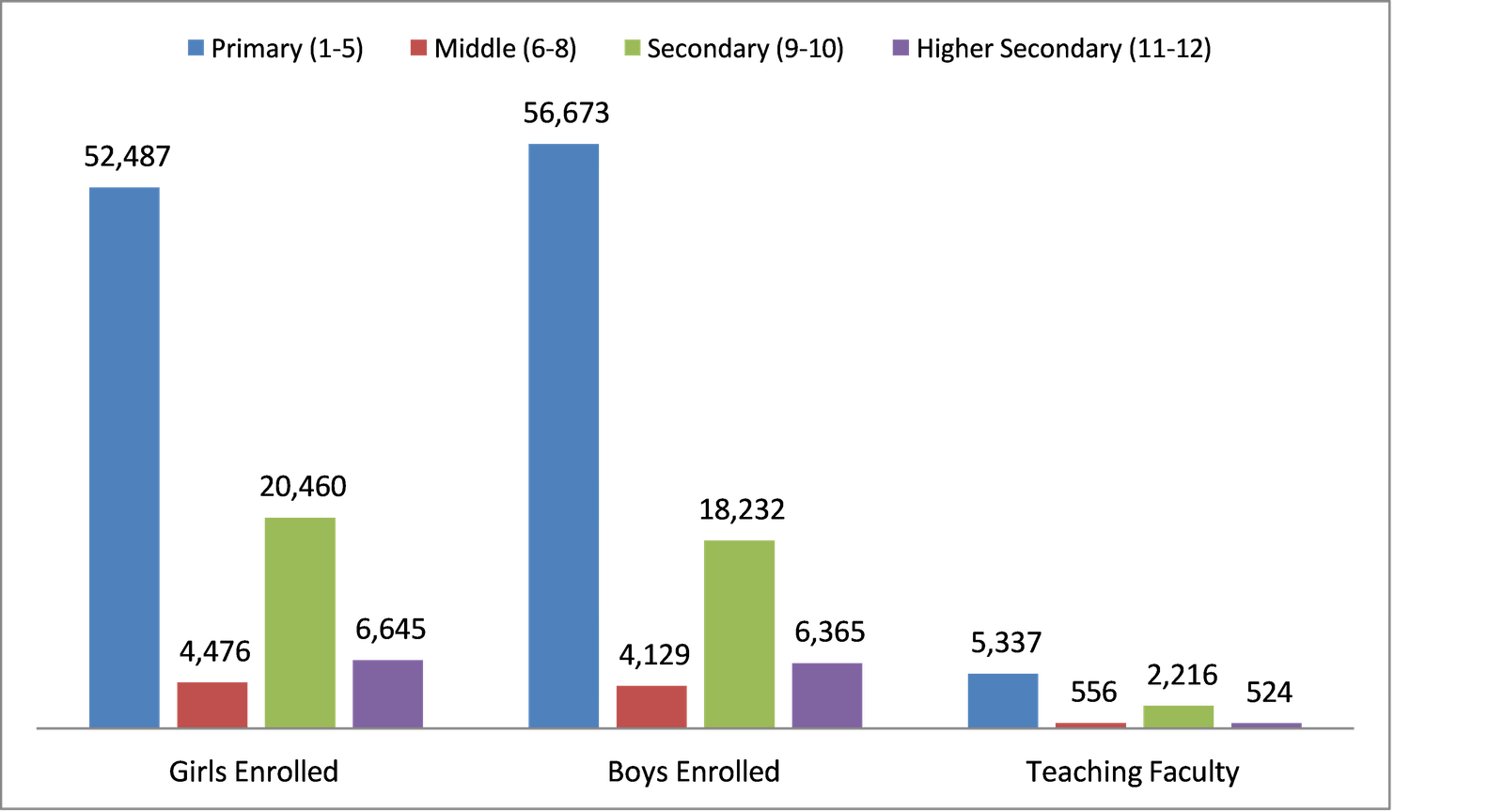
There are 263 boys’ and 235 girls’ public schools in Hyderabad, while another 582 are mixed schools. On average, there are about 8 teachers per school.
Figure1: Enrollment and Teaching Staff in Hyderabad Public Schoo
The major problems of education in Hyderabad district in terms of quality of school infrastructure are unavailability of safe drinking water, poor WASH facilities, dilapidated condition of school buildings and insufficient classrooms. The major problems of education in Hyderabad district in terms of availability and quality of education are teacher’s absenteeism, improper teacher student ratio (More Children and less Teachers in the rural areas of Hyderabad. The major causes of dropout are, child Labor and parents’ lack of understanding about education.
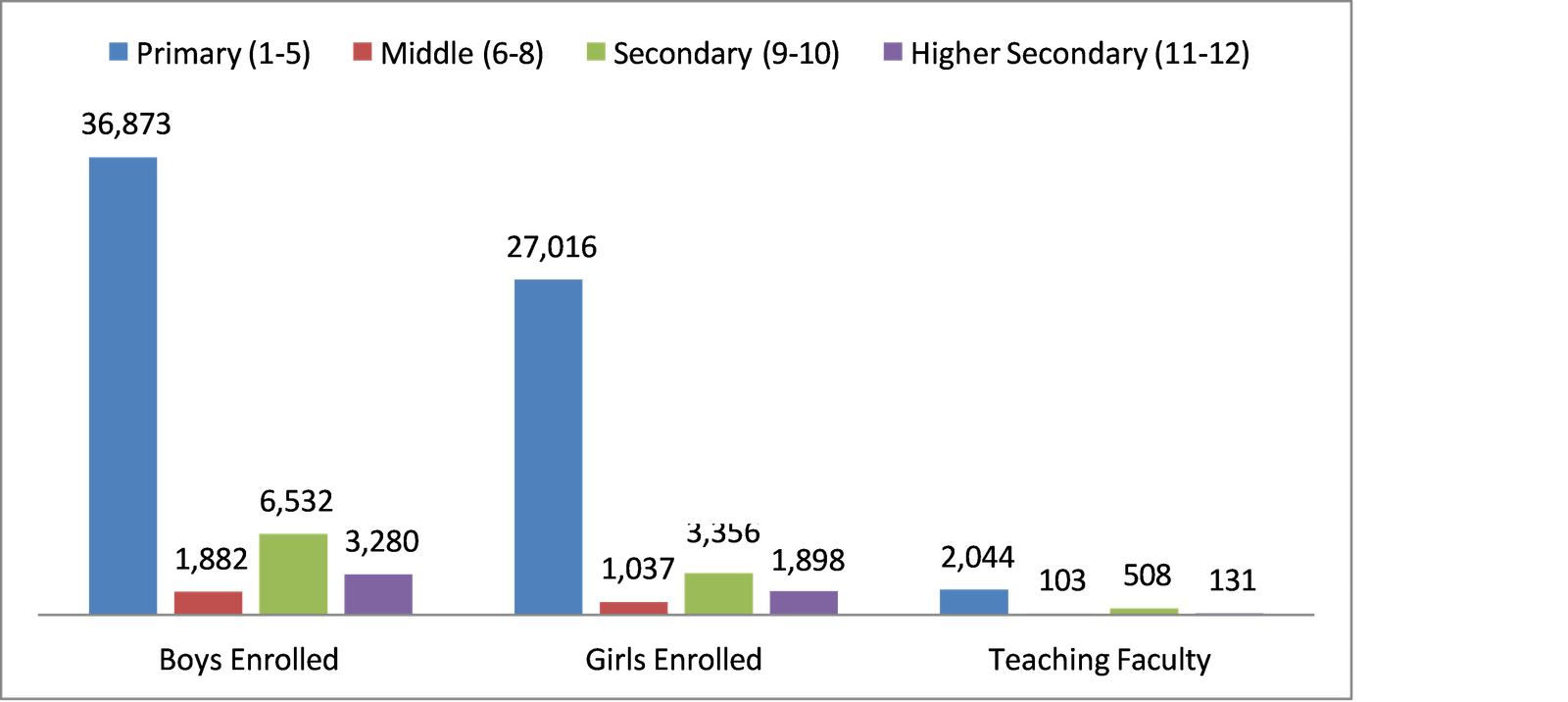
The total male enrollment of District Jamshoro is 48,567 while the total female enrollment is 33,307, whereas the total enrolment is 81,874. Out of total 2,786 teachers 2,068 are male and 718 are female teachers. This illustrates that one teacher is teaching an average of 29 students.
Figure 2: Enrollment and Teaching Staff in Jamshoro Public Schools
The major problems of education in Jamshoro district in terms of quality of school infrastructure are, unavailability of safe drinking water, dilapidated condition of washrooms, insufficient class rooms and no play ground in the schools. The major problems of education in Jamshoro district in terms of availability and quality of education are teacher’s absenteeism, lack of teachers’ commitment and long distance to schools for the students from rural areas Jamshoro, especially for higher education purposes. The major causes of dropout are child marriages and traditional occupations, farming fishing etc.
The total enrollment in public schools at district Sukkur is as follows:
Table2: Total enrollment in Sukkur’s public schools
| Level | Girls | Boys | Total |
| Primary Middle Secondary Higher Secondary Total | 43,153 1,711 4,411 5,742 63,102 | 64,404 1,335 3,596 6,694 93,458 | 107,557 3,046 8,007 12,436 156,5602 |
Number of public schools (total), with breakup of primary, secondary and higher education, at the district Sukkur are as follows:
Table 3: Enrollment Statistics of Sukkur public schools
| Variables | Boys | Girls | Mixed | Total |
| Primary: | 380 | 221 | 262 | 1,227 |
| Middle: | 9 | 11 | 16 | 36 |
| Elementary: | 10 | 12 | 16 | 38 |
| Secondary: | 28 | 15 | 20 | 63 |
| Higher secondary: | 3 | 4 | 2 | 9 |
| Grand total: | 1,373 |
Number of known functioning and non-functional schools at each level (primary, secondary and higher) at present at district Sukkur are provided in the table below:
Table 4: Functional and non-functional public school in Sukkur district
| Variables | Functional | Closed | Total |
| Primary: | 1,094 | 133 | 1227 |
| Middle: | 34 | 2 | 36 |
| Elementary: | 36 | 2 | 38 |
| Secondary: | 63 | 0 | 63 |
| Higher secondary: | 9 | 0 | 9 |
| Grand total | 1,236 | 137 | 1,373 |
The major problems of education at Sukkur district in terms of quality of school infrastructure are unavailability of safe drinking water, unhygienic environment at schools and no boundary walls. The major problems of education at Sukker district in terms of availability and quality of education are teacher’s absenteeism, delayed provision of text books and tribal culture is hindrance in opening of schools in rural areas. The major causes of dropout are traditional occupations, farming fishing etc, migration, poverty and lack of awareness for education.
The Khairpur district has a population of 1,515,000 and the total population under the age of 16 is 331,884 persons. The enrollment on gender segregation is given in the table below:
Table 6: Number of public schools in Khairpur District
| Primary Schools | Secondary Schools | High Schools |
| 3,370 | 195 | 97 |
The major problems of education at Khairpur district in terms of quality of school infrastructure are no sanitation facilities, poor school infrastructure and unavailability of electricity. The major problems of education at Khairpur district in terms of availability and quality of education are teacher’s absenteeism, cost of education (Transport, uniforms, stationary etc), delayed provision of text books and tribal conflicts. The major causes of dropout are girls’ early marriages, migration, and distance to higher schools after completion of primary level of education and child labor.
The total male enrollment of District Karachi’s public schools is 250,186 while the total female enrollment is 317,711. Out of total 27,037 teachers 8,412 are male and 18,625 are female teachers, with a student teacher ratio of 21:1
Table 7: Level- wise enrolment in public schools the Karachi District
| Level | Girls | Boys | Total |
| Primary | 168,707 | 154,447 | 323,154 |
| Middle | 34981 | 22,990 | 57,971 |
| Secondary | 101,947 | 64,651 | 166,598 |
| Higher Secondary | 12,076 | 8,098 | 20,174 |
Table 8: Level-wise public schools in district Karachi
| Level | Schools |
| Primary | 2,530 |
| Middle | 253 |
| Elementary | 203 |
| Secondary | 577 |
| Higher Secondary | 40 |
| Total Schools | 3,603 |
Table 9: Status of functional and non-functional schools in Karachi
| Level | Functional | Non-functional |
| Primary | 2,492 | 38 |
| Middle | 247 | 6 |
| Elementary | 203 | 0 |
| Secondary | 557 | 6 |
| Higher Secondary | 40 | 0 |
The major problems of education at Karachi in terms of quality of school infrastructure are lack of facilities (toilets, playgrounds, boundary walls, drinking water tanks, canteen etc), poor school infrastructure and unavailability of electric fans. The major problems of education at Karachi in terms of availability and quality of education are teacher’s absenteeism, cost of education (transport, uniforms, stationary etc), ghost schools, delayed and insufficient provision of text books and SMC funds, unjustified number of teachers and other staff in schools, poor monitoring by government, frequent transfers of teachers and acquisition of their services for non-academic duties (census, election etc) and poor standard curriculum. The major causes of dropout are child Labor, migration, security problems and due to excess of private schools, the government schools are not taken care of by the government.
The total boys’ schools of District Shahdadkot are 742, while the total female schools are 257 and mixed gender schools are 1,002. Thus the total number of schools is 2,001. This means that averagely every school has teaching staff of around 2.
Categories wise Reporting of Educational Institutions (by level and gender) Following is an overview of various categories of educational institutions with the focus on enrollment and teaching staff. Figure 3: Enrollment and Teaching Staff in Shahdadkot Public Schools
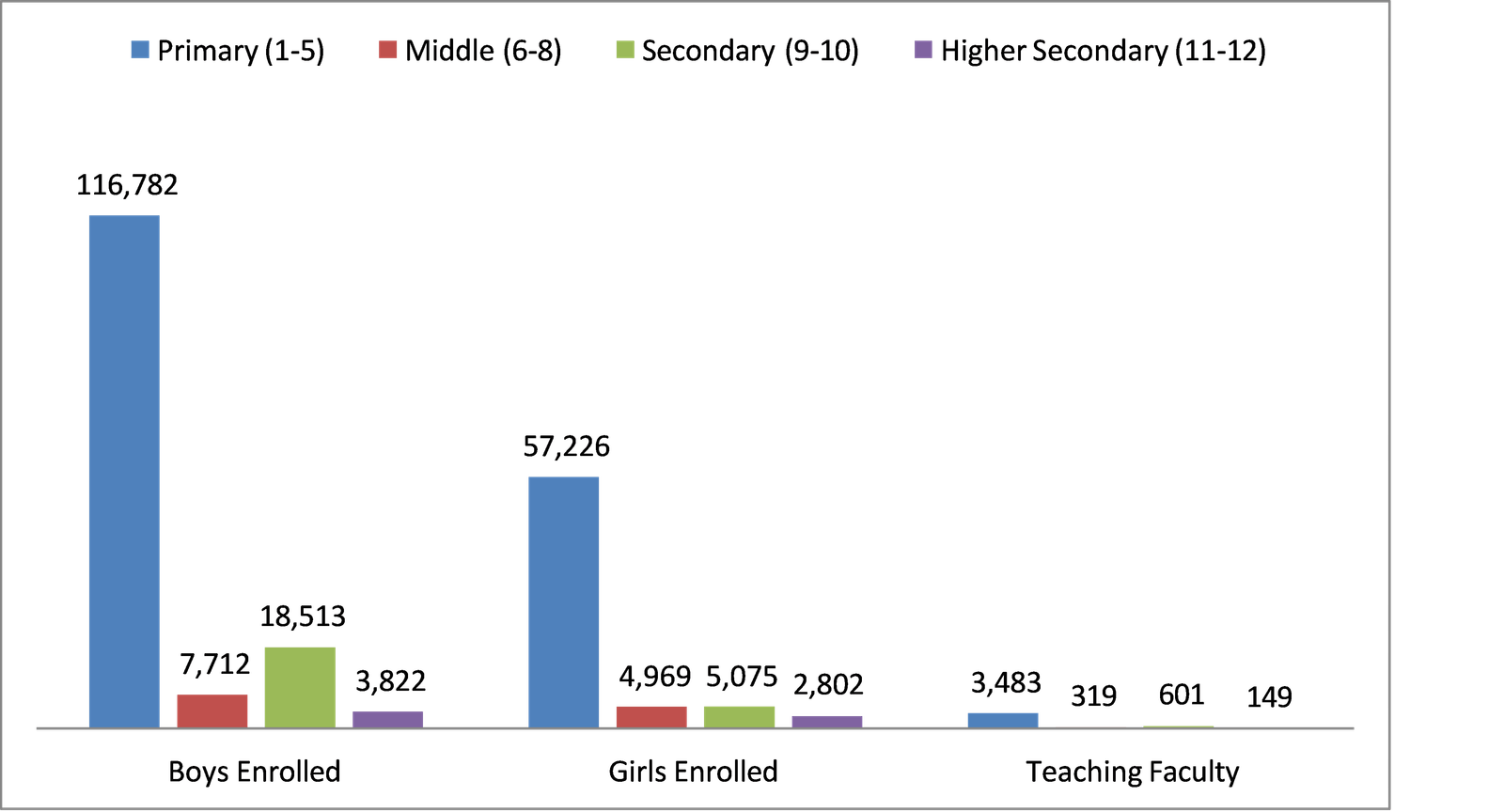
Ghotki district is located in upper Sindh, bordering with Rahimyar Khan in east, River Indus in north, Jaislamir in south and Sukkur in west. Ghotki received district status first time in 1993 and Mirpur Mathelo was designated as district headquarter town. Ghotki has four sub- districts namely: Ghotki, Mirpur Mathelo, Daharki, Khangarh and Ubauro. The district is
divided into 40 union councils, which homes to an estimated population of 1,418,648 as per figures of 2010.
Ghotki has an overall literacy rate of 29.1% with an estimated literacy rate of 44.1% among men and 11.85% among women. According to RSU data there are 1,866 primary, 85 middle, 13 elementary, 33 secondary and 4 higher secondary schools functioning in district.
Table 9: Level- and gender-wise breakup of public school enrollment in District Ghotki
| School Level | No. of Schools | Enrolment | ||
| Boys | Girls | Total | ||
| Primary | 1,866 | 116,782 | 57,226 | 174,008 |
| Middle | 85 | 5,913 | 4,145 | 10,058 |
| Elementary | 13 | 1,799 | 824 | 2,623 |
| Secondary | 33 | 18,513 | 5,075 | 23,588 |
| Higher Secondary | 4 | 3822 | 2802 | 6624 |
| Total | 2001 | 146,829 | 70,072 | 216,901 |
According to UNESCO report based on 1998 census shows that there are 170176 children within age group of 5 to 9 years are residing in district Ghotki, and of which only 41587 children are enrolled in primary schools of district Ghotki. The children participation rate of school going children in district Ghotki is 24.4%, of which 28.8% are boys and 19.7% are girls.
Despite having legislated on the subject of education, a staggering 7 million children remain out of school in the province. Absence of (qualified) teachers, corporal punishments, outdated syllabi, inactive school management committees and remote involvement of parents are some of the factors which remove or keep children from going to school, problems which may well not be solved by legislation alone, though it may a step in the right direction.
As cited in PILDAT’s report (2011), in 2010 under the 18th Amendment, Article 25A: Right to Education has been appended in the constitution of Pakistan in which state has held itself responsible in providing free and compulsory education to all the children of Pakistan aging 5 to 16 years. Moreover, Article 25A specifies four main policy actions are provision of free education, provision of compulsory education, age of the children is five to sixteen years and implementation of Article 25A is to be determined by law.
Under the constitution of Pakistan the age for the compulsory education is 5 to 16 years, whereas many other countries have set different age levels for the compulsory education depending on their economies and circumstances (Majeed, 2012).
According to National Education Policy (2009), the Early Childhood Education (ECE) comprises of 3 to 5 years and minimum one year of pre-primary education is to be delivered by the state and the official age for primary education is to be from 6 to 10 years. According to the procedure of NEP (2009) following is the classification of the levels of education and age groups:
ECE – 3 to 5 years
Primary – 6 to 10 years
Middle – 11 to 13 years
Secondary – 14 to 15 years Higher Secondary – 16 to 17 years
Constituting and declaring Article 25A for free and compulsory quality education on papers is not enough as indicators and surveys estimate that over 55 million children of age 10+ cannot read and write. The reason of increase in the number of illiterates in Pakistan is that the state has been unsuccessful in providing free education opportunities to all children of school going age. As a result out of school children of past years have become illiterate adults having knowledge and skills with them to be a part of a civilized society. Right to education is significant as it is linked with other rights, only literates have acumen to understand their fundamental rights, their responsibilities, difference between right and wrong and what is best in their interest and how to lead a secure and successful life. It is much evident through various surveys that people usually do not have a fair idea of their legal rights, the incentives, law has provided them and how accountable the government is for not providing good governance.
Education has a direct impact upon economic and social growth of a society as families economic condition is directly linked with formal education and technical education of skills.
Stipulation of free and compulsory primary education for all human beings has been declared by the world nations at UN General Assembly in 1948 (McDougal & Bebr, 1964) under the Universal Declaration of Human Rights as a fundamental right. It is said in the following words:
Everyone has the right to education. Education shall be free, at least in the elementary and fundamental stages. Elementary education shall be compulsory.
(Article 26 (1), United Nations Universal Declaration of Human Rights, 1948)
It is undeniably evident from the cited specification that education is the fundamental human right and important for exercising all other human rights. Convention on the Rights of the Child (CRC) implemented on November 20, 1989 by General Assembly openly recognized this right in the following way:
States Parties recognize the right of the child to education and with a view to achieving this right progressively and on the basis of equal opportunity, they shall, in particular: Make primary education compulsory and available free to all; Encourage the development of different forms of secondary education, including general and vocational education, make them available and accessible to every child, and take appropriate measures such as the introduction of free education and offering financial assistance in case of need.
(Article 28, Convention on the Rights of the Child, 1989)
Another encouraging step towards right to free and compulsory education was taken in April 2000 when around 1100 contributors from 164 countries came and assembled for the World Education Forum in Darkar, Senegal, and with one voice promoted the concept of Education for All. This declaration, famously known as Dakar Framework of Action (2000) signed and endorsed by them members including Ministers, Government officials, international community from 164 countries as they set six goals to be accomplished by the year 2015. One of the significant goals of Dakar Framework of Action is primarily related to elementary education to all children.
Ensuring that by 2015 all children, particularly girls, children in difficult circumstances and those belonging to ethnic minorities, have access to and complete free and compulsory primary education of good quality.
(Article 7, Goal No 2, Dakar Framework of Action)
Furthermore, in the same year, September 2000, Millinium Declaration of United Nations consisting of eight goals of Millennium Development (MGD) No 2, envisioned that by the year 2015, all the children in the world complete qualitative primary education. The actual article is mentioned below as:
Ensure that by 2015, children everywhere, boys and girls alike, will be able to complete full course of primary education.
The 1973 Constitution of Pakistan encompassed a clear vision for right to education in the form of Article 37-B. This Article clearly commits the state to be responsible for the eradication of illiteracy and stipulation of free education up to secondary level. The Article 37-B is mentioned in the section on principles of policy and it states:
The State shall: remove illiteracy and provide free and compulsory secondary education within minimum possible period.
(Constitution of Pakistan, Chapter No 2, Article 37-B)
Execution of the said Article remained ineffective and resulted in low literacy rate in Pakistan and marginalization of millions of children from the basic right of free elementary education. The democratic parliament of Pakistan deserves appreciation for giving recognition to free education as a constitutional right and agreeing upon the provision of free and compulsory education to all the children as a responsibility of the state.
The 18th Constitutional Amendment in its Chapter No 1 has added title of ‘Fundamental Rights’. These fundamental rights are for all the citizens of Pakistan and it has a specific provision famously known as Article 25-A and it states:
The State shall provide free and compulsory education to all children of the age of five to sixteen years in such a manner as may be determined by law”
(Article 25-A, Chapter No 1: Fundamental Rights
Article 25A is a newly constituted law that has to be executed in Pakistan (Baxi, Rai &Ali, 2006). The indicators are describing the most alarming situation of education and disinterest of masses for opting education as an option for their children. There are few pre- requisites that are significant to be considered. The foremost significant component is financial resources, as provision of free and compulsory education for millions of children calls for additional financial resources. Moreover, the poor people of Pakistan especially dwelling in rural and remote areas show reluctance in sending their children to school as poverty compels them to retain their children as a helping hand for work. It could be work at fields or other occupation and/or at home for household chores. The poor communities do get attracted with the added incentives such as free uniforms, food or stipends. Furthermore, extended work is to be done on the legislation to clearly define and expound various rules and procedures for the provision of free and compulsory education.
Understanding the perspective of the stakeholders regarding the newly implemented law of RTE in Sindh, it has been considered essential to record stakeholders’ narratives for further analysis. The document review of the RTE act, education policy and previous studies are also being taken under account so as to analyze the implementation gaps.
The research design selected for the study was qualitative in nature, in particular phenomenological approach was considered best for this particular study. Phenomenological research design was chosen to identify phenomena by seeing how they have been perceived by the stakeholders in this situation and the implementation gaps. This approach was preferred as it gathered deep information and perceptions through inductive, qualitative procedures such as
discussions, interviews and stakeholders’ personal observations, and further presenting it from the viewpoint of the participants. To look further, Phenomenological approach was pertinent in this study as it was related to the study of experience from the standpoint of the individuals. In addition to this, phenomenological research design was built in a pattern of personal knowledge and partiality. It accentuated the importance of an individual’s viewpoint and analysis upon a certain issue.
The detailed focused group discussions with the stakeholders regarding the nitty-gritty of the RTE law and the challenges in its implementation had given a thick description of issues according to the participants. The interviews individually done elaborated further the implementation gumptions for this law as one on one interview allows stakeholders to share their perspective with freedom. Observations of the researcher during the interviews and group discussions of stakeholders’ body language was an addition to the nonverbal communication.
Below are stakeholder-wise selection criteria to inform decisions related to the inclusion/ exclusion of individuals in FGDs and some basic interview guidelines for
enumerators. These criteria provided instructions to project staff across districts on how to select respondents, how many respondents to select and how to conduct the interviews.
Respondents under this category were selected randomly from the community, using the blocked randomization method, and included Parents of children studying in public schools, who were not civil society organizations’ representatives, members of CBOs, elected representatives or media professionals; and Parents whose child(ren) go to nearby public schools and not private schools.
Male and female FGDs were held separately. From every district, at least 20 and maximum 24 male and female respondents were to be selected amounting to a sample size of 160 community members across eight districts. Parents constituted the bigger part of the group. Respondents were approached wherever it was comfortable for them to respond to the questionnaire.
Respondents under this category were also selected randomly from the community, using the blocked randomization method, and included respondents were selected randomly from the list of teachers provided by the public schools targeted under the project in each district, teachers’ groups were be from classes 6-8; and head teachers, teachers, volunteer teachers were part of the group discussions, where available.
Two FGDs were conducted for teachers in each district: one for male teachers and one for female teachers. Where available, high schools, teachers from higher classes were also interviewed. Male and female teachers’ FGDs were held separately, expect in places where respondents were comfortable discussing jointly. At least 10 and no more than 12 teachers participated in each group, depending on availability, amounting to 160 –192 teachers across eight districts; District-wise clusters were made for teachers teaching in selected schools in the District (for example a group of 10 teachers, teaching in 15 different schools in Karachi).
Respondents included mid-management and top officials in the education department at the district level. From every district, one respondent was selected, depending on their availability and willingness to participate in the study.
Both male and female officers were approached for interviews, however, the study team succeeded in getting only one female respondent from district Khairpur.
Respondents were selected randomly from the classes 7 to 8. It was ensured that respondents in this cluster were not related, i.e., were not siblings, to get a variety of perspectives from the group and avoid unnecessary duplication.
A sample of at least 10 and not more than 12 boys and at least 10 and not more than 12 girls from each District, amounting to a sample of 160 to 192 children across eight Districts was considered for FGDs. Girls’ and boys’ FGDs were held separately.
Children were approached wherever and whenever it is most comfortable for them to respond. This was done during recess, or before or after school hours.
Children were randomly from the community in each District known to have a large number of out-of school children (combining both dropped-out and never-enrolled children).
Girls’ and boys’ FGDs are to be held separately. A total of 169 out-of-school were involved in a dialogue process across the districts, including both boys (100) and girls (69), aged between 12 and 18 years. As some children had gone to school at some time, while others had not, the questions are kept open-ended, where enumerators were given space to note all views emerging from the group by asking different questions for drop-outs and those who have never been enrolled.
The total 174 men and women from rural communities of 8 Districts of Sindh participated in the FGDs, including 92 males and 82 females. Among the male participants major occupational groups were laborers, farmers, government’s servants and shopkeepers, and most of the female participants were housewives with 20 percent working women. Participants had different literacy levels: 46 percent were literate and among the literate participants 76 percent were male and only 24 percent were female. The majority of participants belonged to 25 to 40 years age group.
A total of 155 teachers participated in the FGDs. Among these were 83 male and 72 female participants. About 40 percent were the High School Teachers (HSTs), 25 percent were Primary School Teachers (PSTs), 15 percent were Junior School Teachers (JSTs), and 20 percent were Head Masters of the schools.
A total number of 174 students participated in the discussions, including 96 boys and 78 girls. A majority of the students were from grade 7 to grade 9, aged between 12 to 16 years.
The total number of 169 out-of-school children participated in the discussions. Among these were 91 males and 78 females. Majority of the female children were engaged in household work and others worked with their parents in agri-farms. There was near-equal participation of female children from all the districts.
Eight district education department officials from the districts (one from each district) were also interviewed during the baseline study, of which only one was a woman. Key Informant Interviews were conducted mostly with Additional Directors Education and District Education Officers.
Questionnaires were put to approximately 680 participants through clustered Focus Group Discussions (barring officials in District Education Departments, for whom Key Informant Interviews were held in each district. The FGDs were gender representative, with half FGDs held with male and half with female respondents, where possible. Questionnaires sought to gather both quantitative and qualitative data and questions were divided according to themes closely linked to project output and outcomes.
Enumerators were responsible for identifying respondents, conducting focus group discussions and key informant interviews, and recording discussions. As communities are seldom or never homogeneous, possible differences reflected in their perceptions of problems and possible solutions were given special attention by minimizing diversity within groups.
Participants were roughly of the same socio-economic group and had similar backgrounds in relation to the issues under investigation. The age and gender composition of the group was controlled by breaking up sessions with men and women and imposing age limits during selection.
The study was held in eight research sites or districts in Sindh, namely Jamshoro, Hyderabad, Karachi, Dadu, Khairpur, Ghotki, Sukkur and Kambar-Shahdadkot. Primary data was collected from different stakeholders including teachers, students, district education officials, out-of-school children and communities at large, including parents. For secondary data, government reports.
After a thorough literature review, questionnaires were developed for each stakeholder group in accordance with their role in education. The questionnaires were initially designed in English and prior to their finalization, training and feedback session was held with enumerators from each district. The day-long session involved reading of all questions contained in each survey tool and feedback was solicited from enumerators against the relevance and appropriateness of each question contained therein, to on-ground realities.
Based on feedback, further refined the questionnaires, removing ambiguities while expanding on certain areas of inquiries. The questionnaires were revised and translated in Urdu and Sindhi and pre-tested at Jamshoro and Hyderabad. The tools were revised further based on group responses and observations contained in a pre-testing report prepared by the pre-testing team.
The FGDs with male community leaders and parents were held at the different schools and Otaq (a common place for community gathering) in the respective districts and FGDs with female community members were held at girls’ schools or at the homes of women where others also collected to participate. The community was accessed through the community leaders, teachers, SMC members and the community activists. Similarly, FGDs with students were held at their schools and FGDs with out-of-school children were held either at schools or Otaqs. A majority FGDs with teachers were held at schools, District Education Department offices and
Key Informant Interviews (KIIs) with District Education Department Officials were held at their offices.
The main instruments of primary data collection in the study were five stakeholder- specific questionnaires, to be administered on: school-going children or students; children who have dropped out of school or have never been to school; community members, including parents; teachers and District Education Department officials.
Secondary data was also collected from Government reports relating to the state of education services in Sindh. Most of the data related to the status of schools was taken from the following reports that are released annually the Statistical Bulletin, Annual Schools Census, SEMIS Reform Support Unit, Department of Education and Literacy, Government of Sindh.
Secondly Annual Status of Education Report, ASER Pakistan and District Education Profile, Sindh Education Management Information System (SEMIS).
RTE is a law beneficial to the underprivileged communities of Pakistan. The implementation of the law is highly significant to poverty elimination, economic growth, and having tolerant society within the country. The study was conducted to explore the issues and challenges faced by the government for RTE’s implementation. The stakeholders responses can best elaborate the gaps and identify the solutions to it. The study has taken the detailed responses through a qualitative research design that has further been elaborated.
The study was motivated to find out what perception of the stakeholders in implementing the act was and how did they see and foresee its implementation in the country. What were the possible gaps do they anticipate or speculate that will cause any hindrance in materializing this act. The stakeholders majorly include the learners, teachers, parents, concerned authorities, civil society and media. However the stakeholders had various angles to evaluate and anticipate the act, the challenges, confusions (being under provincial custody (only) or whether the federal government was also a stakeholder/responsible) and problems but their opinion was highly valuable to observe the implementation gaps for RTE and its problems.
All the participants have been given a written assurance of keeping their identities hidden by the researcher. Their responses in the form of recordings or written have presented with their pseudo identities so as to respect their perspectives and avoid any vulnerable situation for them.
The study research team had assured it in black and white that there would not be human rights violation during the interaction with the participants during FGDs and one on one interview. Their opinions and perspectives were given respect and no feedback or strong remarks were disembarked by the research team.
The participants were viable to leave the research proceedings at any point of time during the research. Their right to withdraw from the research was completely intact and no research team members ever strive to influence them to review their decision.
The researcher ought not to show any partiality towards any remarks, opinions; perspectives floated by the research participants and therefore keep her indifferent for the whole procedure. Any responses from the participants were indifferently documented analyzed and secured in the findings and outcomes chapter.
The study limitations included a reluctant participation of many group members as they do not have their personal interest in the matter. Their participation in the FGDs was a result of courtesy and community obligations. The other limitation of the study was the limited knowledge of the participants regarding the issue and their scant knowledge about the RTE law itself. This in turn left them spellbound in commenting about any such issues. Language was a barrier between the local communities and the researcher. Although the enumerators were natives and their help of translating the questions in the regional language (Sindhi) has made the questions easy for the participants to understand and respond but the researcher herself might face difficulty in understanding and transcribing the recordings.
A survey and other measuring tools were used. Following are the results:
| Table 1.1: Observations during school visits in eight districts | ||||
| School physical structure | Flood effected schools | No boundary walls | Unavailability of furniture | Number of schools visited |
| 70% | 75% | 80% | 62% | 47 |
The baseline study revealed that 70% schools’ infrastructure throughout the eight districts studied was not in a satisfactory condition. 75% of the schools were flood effected, 80% schools have no boundary walls and 62% schools do not possess appropriate furniture such as benches, chairs, lockers and tables. Due to this, significant levels of drop-outs were reported by teachers, as students were being compelled to sit uncomfortably on the floor for hours at end. In addition to dearth of furniture, small numbers of desks available were reported an unsafe to use by teachers (due to instability caused by dilapidation and termites). Schools do not have sufficient absorptive capacities to take in out-of-school children residing nearby (within a 5 KM radius). Indeed, most schools were found to unable to cater to students presently enrolled.
In addition to infrastructural woes, the study explored factors affecting the quality of education. The major factors amongst these were teachers’ absenteeism, delayed release of text books, shortage of text books and traditionally monotonous teaching methods.
A vast majority of children and the community members (over 88 percent) responded
that teachers’ absenteeism is the major reason affecting quality education. Children reported that teachers only come to schools two or three days in the week and spend just a couple of hours.
This results in the irregularity amongst students as well.
Similarly, when asked whether students and teachers are interested to be included in the formation of curriculum, over 92 percent of the teachers said they have no involvement in curriculum development but wanted to use their experience for improving the relevance of curriculum to what children wanted and needed to learn. Teachers also suggested that there was a need to revise teaching methodologies as traditional methods were not effective in achieving interest of student. They opined that diverse teaching methodology can help increase the interest and attendance of the students, and help reduce drop-out.
The survey was undertaken primarily to understand the implementation status of the RTE Act in 8 selected districts of Sindh. Questions were put to all stakeholders, including parents, students, teachers, district education Government officials, SMC members, and out-of- schools children to understand if and what they knew about the law and how well, if at all, it is being implemented.
Parents were found largely unaware of the Constitutional guarantee to free and compulsory primary education. Even fewer parents knew about the passage of the RTE Act or of its contents, despite there being punishments prescribed for parents not sending their children to school for ‘unjust cause’.
Table 1.2: Community FGD
Q: How many of you are aware of the children’s Constitutional right to be provided free and compulsory primary education in Pakistan?
| Yes | No | N | ||
| 2% | 98% | 174 |
| Table 1.3: Community FGD |
| Q: How many of you know about the recently passed Right of Children to Free and Compulsory Education Act, 2013, by the Government of Sindh? |
| Yes No N |
| 1% 99% 174 |
Only one percent of the parent participants reported ever having met any district Education Department officials, either to bring to their notice the problems of teacher absenteeism, corporal punishment, inactive SMCs, or to demand any action on their part.
Similarly, all the children interviewed were found unaware of state’s responsibility to provide them with free education.
Responsibility of the State is to provide money to people through schemes, like Benazir Card, etc. Provision of education is only responsibility of parents.
(A child participant during FGD)
Table: School-going children’s response – Students’ FGD
| Q: How many of you are aware of children’s Constitutional right to be provided free and compulsory primary education in Pakistan? | ||
| Yes | No | N |
| 2% | 98% | 174 |
| Table: Students’ FGD |
| Q: How many of you know about the recently passed Right of Children to Free and Compulsory Education Act, 2013, by the Government of Sindh? Yes No N 1% 99% 174 |
Children in every district were, however, keenly interested to know about the law and asked the enumerators to share the details with them, their parents and the teachers. It was the first time they had heard about the law from anyone.
Both students and out-of-school children said none of the Education Department Official had ever met them to inquire about the problems they were facing in school or out of school.
Children also expressed their dissatisfaction over the provision of basic facilities at the schools such as safe drinking water, sanitation, safe buildings and electric fans, etc. They also
considered this as one of the reasons behind children’s lack of interest in schooling.
When out-of-school children were asked about the right to education, they too expressed being completely unaware either of the Constitutional provision or the Sindh RTE Act. Most of these children expressed being extremely skeptical about education ever being provided completely free of cost. Others were of the view that even if education is free, their parents could not afford sending them to schools as then there would be no one to earn for their families.
| Table 1.4: Out-of-school children’s FGD | |||
| Feel satisfied that education will be free of cost | Don’t think that this law can be implemented in letter and spirit | Law will improve things marginally for children | Total |
| 60% | 20 % | 20% | 169 |
Most teachers who participated in the FGDs said that they did not exactly know about any legislation pertaining to children’s right to education. However, they reported knowing that that constitutionally, the state is responsible to provide free education to children. When asked about the Sindh RTE Act, only three percent of 155 teachers (or five teachers) said that they know such legislation had been done recently. Of those who were aware of the law’s existence, only three teachers said that this law provides for free and compulsory education, and some sort of punishment for the parents who do not send their children to school would also be given.
Upon probing further, they could not explain in what circumstances punishments would be prescribed and how they would be meted out. Most teachers (over 83 percent) strongly agreed
that this law will enhance children’s access to education and will help increase enrollment in the schools, even if they were not aware of what the law purported. However, they said that this is subject to how well the law is implemented. Similarly some teachers were of the view that there cannot be visible and rapid improvements in enrollment figures because of any law as there were many socio-economic factors at play that keep parents from sending their kids to school.
They also said that unless the government picks up come costs associated with schooling, the law will not succeed in achieving its objective.
When asked about their role in the implementation of the law, teachers suggested increasing their involvement in decision- making at the district level in order for effective results to be achieved.
While communities were generally found lacking in but desiring greater information related to the right to education, more surprising results were received from key informants in
the districts’ Education Departments. Of the eight education officials who were interviewed, six did not know that the Sindh RTE Act of its passage almost four months ago. The remaining two officers reported being aware, but had not received any official notification from the Sindh Education and Literacy Department or the Law Department. Similarly, none of the respondents reported having received any briefing or orientation about their roles and responsibilities in the light of the law. These officers said that they did not have any idea about the monitoring mechanism that would need to be instituted for effective implementation. They also said that they needed more clarity about the law from the government as they were not clear on their role in the law’s implementation.
The survey revealed that there is marginal engagement and coordination between the Government and the general public over the issue of education across the districts. During FGDs, a very limited number of the respondents from community reported ever having been part of any meeting with Education Department officials. Similarly, none of the women participants in the FGDs reported having had any communication with government officials. Demand from communities and resulting response from the government was observe to be lackluster, even where communities knew that education is a fundamental right under the constitution. Only three percent of the participants from the community said that they had demanded improvements in government education services by engaging in dialogue with either district or provincial government office-bearers.
This lack of engagement could be explained in some measure by low expectations for the resolution of problems even if demands were made. Nearly 80 percent of the participants expressed no hope that their demands would be met or problems resolved by making such demands.
Similarly, none of the students had had the opportunity to meet with the district Education Department officials. None of them knew the District Education Officer’s name or where his office was located. However, when asked if they would like to be more involved in decisions related to education, all 174 student participants answered in the affirmative. They expressed interest in curriculum development and decisions over teaching methodologies.
Students also expressed different demands if ever given the opportunity to meet any government functionary. When asked what demand they would make to the government, they said they would demand new furniture, teacher’s regularity, safe drinking water facilities, uniforms and stationary to be provided without cost.
The majority of out-of- children responded that no government official has met their parent(s) or attempted to assess why they were not in school. Female children in particular, reported that despite demanding from their parents to let them go to school, their parents refused on different pretexts, including trivialization of girls’ education, lack of people to do household work and lending help during seasonal sowing and harvest. However, their aspirations to get an education were reflected in their claim to demand quality education if they were ever given a chance to meet with district education officials.
Over 76 percent teachers interviewed reported not having regular interactions parents
over matters related to their children’s education, even if children were absent from school over many days. Teachers also had little information about the decision-making processes at district level, and approximately 80 percent of the teachers reporting not knowing the name of the EDO Education of their respective districts or ever having met a district education officer. In addition to this, none of the teachers said they had been called in for any policy-related meeting at district level or consulted during the legislation process of the RTE law.
Contrary to this, most government officials said that they held regular meetings with communities to know about education-related problems in their respective areas. Most respondents said that the resolution ratio of emerging problems was close to 50 percent. They rated the interaction between state and community as good while emphasizing the role of civil society through more frequent interactions and broad-based discussions.
| Table 1.5: KIIs with District Education Department Officials |
| Q. Have you or does your department ever meet with communities to understand and address problems related to education in your district? |
| Yes No N 70% 30 8 |
| KIIs with District Education Department Officials |
| Q. What are some of the most serious problems of education in your Zila/ District? |
| Ranked First Ranked Second Ranked Third Teacher’s absenteeism Poor Monitoring mechanism Poor school infrastructure |
It was evident from the information acquired during the survey that the Education and Literacy Department, Government of Sindh, is ill-prepared to effectively implement the law on free education. As a majority of the mid- and higher-level Government officials reported not even knowing about the law, asking them about details on implementation was redundant in the survey. Not having been notified or briefed about their role, with little State-community
interaction, absence of citizen’s voice demanding fulfillment of State obligations and no clarity on roles and responsibilities on the part of Government functionaries, it is unlikely that duty- bearers will be able to implement the law or monitor its implementation.
| Table 1.6: KIIs with District Education Department Officials |
| Q. Have you or your department been notified regarding the passage of the Sindh Right of Children to Free and Compulsory Education Act, 2013? |
| Yes No N 0% 100% 8 |
Additionally, even if education was provided free through fee waivers, countering pervasive poverty and associated coping strategies that prevent most children from acquiring education will remain a challenge for the Government, unless more resources are allocated to aid families in making ends meet.
Further, implementation seems dubious in the absence of monitoring mechanisms to check for abusive and/or absent teachers, families not sending their child to school and for what reason, and non-activity of non-responsive school management committees.
| Table 1.7: KIIs with District Education Department Officials |
| Q. Has your department been informed and/or briefed on its role and responsibilities to implement and monitor the implementation of the law? |
| Yes No N 0% 100% 8 |
Q: For those of you who have never been to school, what were the reasons for not going?
| Table 2.1: Out-of-school children’s FGD (boys and girls) | ||||||
| Long distance to school | Parents didn’t allow | Cultural constraints | Less importance of education for girls. | Others | Total | |
| Household work | ||||||
| 30% | 23% | 20% | 12% | 7% | 8% | 173 |
A number of reasons were presented by the children to show their reluctance attending schools. 30% children reported that the school is placed at much distance from their homes, 23% children showed their disability to attend the school because of household chores, 20% children did not have permission from their parents to attend the school, 12% children showed reluctance to attend the school due to cultural barriers whereas 7% girls proposed education to be of less importance in their context and 8% children brought other feeble excuses for not attending the schools.
I am not allowed to study as I have to take care of my siblings while
my mother goes to pick cotton in the fields. I also have to wash dishes, clothes and take care of my grandmother.
– Village Girl
The school is in the village next to ours, how I can go alone to such distance. My father says he cannot pick and drop me daily and I am too young to travel alone.
– Village Boy
Q: For those of you who did go to school at some time, why did you stop going?
| Table 2.2: Out-of-school children’s FGD (boys and girls) | ||||
| Corporal Punishment | Absence of teacher (irregularity) | Irregular classes | Teachers’ insulting attitude | Total |
| 30% | 25% | 20% | 25% | 169 |
Children who discontinued going to school particularly expressed concerns about corporal punishment, absence of teachers, irregular classes and teachers’ attitude. 30% children showed their disinterest in attending school due to corporal punishment, about 25% children stopped attending school due to absence of teachers, 20% children discontinued attending school due to irregular classes and 25% children were demoralized to attend school due to their teachers’ negative and insulting attitude towards them. They felt teachers often beat them with their hands and sticks for minor mistakes.
I was quite regular to school but my teacher was not punctual,
later my father and uncle decided not to send me school if there were no classes conducted.
– Village boy
Q: For those of you who went to school, were there any problems you had to face? What kind of problems were these?
| Table 2.3: : Dropouts from the school FGD (boys and girls) | ||||
| Distance to school | No basic facilities like water and latrines, fans | No separate room for girls | Parent’s stopped girls from going to school | Number |
| 30% | 40% | 10% | 20% | 156 |
The distance to school as a hurdle was reported by 30% dropouts, 40% children complaint for the unavailability of the basic facilities including toilets, water for toilet use, drinking water and fans. 10% children left the school for the unavailability of separate toilets for girls and 20% girls were forcibly stopped from going schools for their domestic reasons.
There is no water available in our school and there was no
toilet. I had to go to nearby houses to use their toilet.
In order to involve communities in children’s education, particularly in school management and improvements, the Government of Sindh instituted parent-teacher councils/associations or School Management Committees (SMC) in 1994. Presently, all primary schools in Sindh are supposed to have SMCs comprising five members where a parent chairs the committee and the school Headmaster acts as the General Secretary. In this committee, two members are parents who are elected through an electoral process. SMCs have tremendous potential to increase community say and influence on matters related to children’s
education, such as monitoring and correcting teacher absenteeism and reducing drop-out for any reason. Through annual funds which are provided by the government, SMC are able to undertake building and construction work for damaged schools of those missing basic amenities.
Among community members only two percent of 169 respondents said that they knew of the existence of the local school’s SMC. Further only two participants across eight districts could articulate only one responsibility of the SMC. Of the four people (or two percent participants) who knew of the local SMC reported being satisfied with the performance of the SMC in their schools in terms of their contributions to checking infrastructural needs and checking teacher absenteeism.
Students who were asked about SMCs had virtually no knowledge of either their existence or what duties they performed. It was learnt that despite children having parent members in the local Committee, they had not been able to communicate the problems there were facing, some of which were serious enough to warrant dropping out, or influence the workings of the school and its infrastructure for their benefit. Thus primary stakeholders were found excluded from a potential platform that give them a voice.
As membership in SMCs is not open for students and coming to know of their role and existence for the first time during survey discussions, students were quick to suggest that they would like to be the part of its general body.
To explore the gaps in RTE ACT of Sindh following were the findings. The discussion is based on the learning from the study in terms of the demand and supply for education services and how they can be made seamless.
Availability, accessibility, relevance and adaptability of education systems were the major hurdles to accessibility, relevance and adaptability of education systems (Dey, 2013). Majority of the respondents in communities, including parents, cited poverty as the single biggest hurdle to acquiring education, as male children are required to work in fields, tending after the family’s land and its produce, and female children are required to help with housework and work in the
fields. Parents reported that costs associated with children’s education are outweighed by the loss of income they impose due to removal from of children from the domestic workforce when they go to school.
Of all the children involved in group discussions (169), 40% reported never having been to school. They reported schools not being accessible due to great distances (some instances, more than 5 KM). Travel expense and help needed at home further dissuaded parents from enrolling their children.
Of the children that had dropped out of school, majority reported having dropped out due corporal punishment (Couch & Behl, 2001) meted by teacher, followed by teachers’ insulting attitudes and absenteeism. Irregularly of classes was also a major cause for drop-out.
Education system faces two major challenges in today’s world; expanding the reach of education and improving its quality (D’Antoni, 2009). If these are the challenges of today’s world then availability, accessibility and relevance according to the respondents’ expressions seem not to be a focus of poor communities of Pakistan as they struggle with their financial constraints and require their children to be a helping hand in this endeavour.
In order for implementation to be effective, the law also needs to be monitored for equal and impartial execution. Grievance registering mechanism at the District or Taluka level may prove useful to identify cases of breech and non-implementation, which is in the knowledge of and accessible to communities and SMC members alike.
The baseline has reaffirmed massive infrastructural inadequacies which are responsible for causing unpleasant learning experiences to children, to the extent of causing drop-outs. If the RTE law is to be implemented with the existing infrastructure, challenges will arise to accommodate hundreds of children per school that only boast 2-4 classrooms (on average).
With an influx of children in the form of new enrollment, further shortages of teachers, basic facilities and deteriorated quality of education can be expected. The government thus needs to make adequate arrangements before it or civil society kick-start any enrollment drive in the future.
Even though teacher absenteeism was recorded are a major cause of student drop-out or lack of interest in studies, teachers are well-placed to assist the government in determining curriculum and teaching methodologies. They are better placed based on sheer interaction with students. Students learning needs and aspirations can be known through constructive dialogue and by treating them as equal partners in knowledge-sharing. Teachers interviewed in the survey have suggested their increased involvement in decision-making related to these aspects of education, even though they were unable to define what kinds of decisions they would like to make specifically. Teachers’ trainings can be particularly useful in helping them improve their teaching methods.
From the study it was clear that the demand for education exists both amongst parents and children. However, the realities of survival amongst a vast majority of the rural population in Sindh dictate that children help their parents with house and farming work. This not just affects their attendance, it also causes drop out. Most often, this is exacerbated by abusive and/or absent teachers, poor sanitation facilities and poor relevance of education material to children’s learning needs. Education is the requirement of the poor communities and they do understand its significance in the world of globalization but their contextual circumstances become a hurdle (Jones, 1998).
Despite demand, social exclusion of rural population has kept most people from engaging with the state by taking their demands to them (Delore, 1998). This lack of action or engagement is further confounded by a general trust deficit, i.e., a refusal to believe that
demanding anything, even if it’s a right, would be met with disappointment, as seen in dialogues with parents and children.
Study also mandated for students’ voice to be heard for any kind of educational discussion. The children’s responses have introduced another dimension to this discussion and allow other
stakeholders to acknowledge children’s perception and voice to be valued. The issues children have, the things they require and expect from their government to provide cannot be overlooked. This also gives ownership to children as they then own their rights and later could be held for their responsibilities. Pufall and Unsworth (2004) acknoledge children’s potential by coating ‘Peaceable Kingdom’ in which the recitation of a lion for the fellow lamb ends with and epigram; “and a little child shall lead them”.
SMCs are a good platform for communities to play an active role in school management and fiscal allocation. Even though the SMC comprises teachers and parents, a vital voice is missing from the forum- that of children. Due to mass illiteracy, parents are often not in a position to understand the affronts to children’s right in the form of corporal punishment, uninterested teachers and lack of basic amenities. Those who understand are quick to withdraw children from school with the system continuing as it were.
As students have suggested during discussions, the government may consider including student leaders in SMC meetings, to gauge pressing issues and possible remedies.
District Education Department officials need to be given comprehensive briefings over their expected roles and responsibilities in implementing the law on right to education, as do members of SMCs. The law empowers SMCs to review cases of admissions based on certain screening criteria. It is vital that they are able to identify and impartially review admissions cases so that deprived children can find their way (back) into school.
Similarly, parents also need to know of the law and the punitive action it prescribes for those who fail to send their children to school. For this, as with any other new piece of legislation, mass awareness-raising programs must be held through conventional and non- conventional methods.
The Sindh RTE law criminalizes corporal punishment for students. Children both in and out of schools noted that it is a major concern which propels children to slacken in their studies or drop out altogether. This concern needs to be tackled on war footings, for various reasons: it is a gross violation of child rights, it is harmful for their development and sense of self-worth and confidence, and it pushes children out of school. Unless this problem in checked, the government can expect children to keep dropping out despite attempts to bring them in.
Despite education being compulsory and free in the province of Sindh, parents reported being discouraged from sending their children to school due to high concomitant costs of education, such as uniforms, travel expenses, books and stationery, alongside loss of income by virtue of removal from the domestic workforce. Unless schemes are instituted to meet some of these expenses, or reduce the burden of reduced income, parents are unlikely to send their children to school, even if they are convinced of its importance. In effect, the gap between knowledge built through awareness-raising and affirmative action is likely to remain unfilled.
Question 3: How document analysis can help in improving rules of business supporting RTE Act law
Following were the recommendation chapter vise after clause-by-clause review of the Sindh RTE Act.
Article 2 (c) – “disadvantaged child” means a child who belongs to a socially and economically disadvantaged class, or group or belongs to such parent whose annual income is lower than the minimum limit and whose parents have become victim of terrorism as notified by Government.
This clause does not address children effected by acts of terrorism through displacement or otherwise, and those affected by natural disasters. Children affected by terrorist acts may be taken to include those officially notified by the Government.
The word ‘disadvantaged’ (child) should be replaced with ‘marginalized’, as is more politically correct and allows for wider interpretation.
‘As notified by the Government from time to time’ may be added on after ‘annual income is lower than the minimum limited…’, while children who have themselves or their parent been affected by natural disasters may be covered within the ambit of this clause.
Article 2 (d) – “education” means the prescribed education for child by the academic authority, notified by the Government
This clause does not make a distinction between elementary and secondary systems of education. These may be defined in the rules of business.
Article 2 (f) – “free education” means education free of any education related costs including expenditure on text books, stationary, schoolbags, and uniform
List of expenditures mentioned in this clause should also include transport costs for parents/ children, who may be dissuaded from attending schools located in far-flung areas or in the case of the girl child where distance may be a risk factor.
Article 2 (m) – “school” means any recognized school imparting primary, elementary and secondary education and includes –
The word ‘registered’ should be used in place of ‘recognized’ with reference to Article 24 (Registration) of the Act.
Sub-clauses i-iv (above) should accommodate different channels of learning, including learning centres and non/in-formal education institutions. Non-formal education is usually given up to middle school or matriculation. The Government does not have an examination mechanism for informal education and instead admit students in the nearest Government school that are not readily accessible.
Sub-clause 2(m)-iii should explicate if religious schools or Madressah are also included as ‘belonging to a specific category’, as they are registered as private schools and get children to appear for their matriculation exams.
Article 2 (o) – “special education” means educational programmes and practices designed for students, as handicapped or gifted students, whose mental ability, physical ability, emotional functioning, require special teaching approaches, equipment, or care within or outside a regular class room
There is a separate department of the Government dealing with Special Education. The rules of business of this Act need to define what kind of coordination/ collaboration would be required to meet this objective of the Law.
‘Outside’ classroom needs to be defined in the rules of business to explain the nature or teaching approaches, systems, processes and expected learning outcomes for children with special learning needs. It also needs to explain how public and private schools will be made physically accessible for children with physical disabilities and what measures will be instituted for observing inclusivity within the classroom.
RIGHT OF CHILD TO FREE AND COMPULSORY EDUCATION
Article 3(1) – Every child of the age of five to sixteen years regardless to sex and race shall have a fundamental right to free and compulsory education in a school
The word “religion and ethnicity” should be added after “sex and race”.
Article 4 – Where a child above five years of age has not been admitted in any school or though admitted could not complete his or her secondary education, then, he or she shall be admitted in a class appropriate to his or her age;
Provided that where a child is directly admitted in a class appropriate to his or her age, then, he or she shall, in order to be at par with others, have a right to receive special training, in such manner, and within such time limits, as may be prescribed…
The word “religion” should be added after “sex and race”.
This clause carries justification for expanding on the definitions of and working systems for informal schools.
Admitting children on the basis of age-appropriateness is not a practical remedy as existing Government schools do not have the capacity to take in every child that is
presently out of school simply because s/he is of age. Instead, the phrase, ‘and based on a competency test’ should be included after ‘appropriate to his or her age’.
Recommendation(s) should be provided in the rules for what the Government proposes as a solution to bringing children ‘at par’, including bridging programs, catch-ups classes, accelerated courses, informal education, etc. As the Government has a budget for non-formal education, these aspects should be explored in detail in the rules.
Article 5(1) – Where in a school, there is no provision for completion of Elementary or Secondary education, a child shall have a right to seek transfer to any other school for completing his or her elementary or secondary education
The rules need to explain and qualify what the Government means by ‘any other school’, i.e., public, private, any other category, how it proposes to make that education free should it be a private school, with a quota for underprivileged children already met.
DUTIES OF GOVERNMENT, LOCAL AUTHORITY AND PARENTS
Article 6(1) – For carrying out the provision of this Act, Government and the local authority as the case may be shall establish, within such area or limits, as may be prescribed, a school, where it is not so established, within a period of two years from the commencement of this Act on the basis of feasibility prepared by so notified office for the purpose.
A period of 2 years before absent schools are constructed and made functional from the time the Law was enacted (March 06, 2013), can cause significant lapse in getting out-of-school children enrolled immediately after the passage of the Bill. It needs to be explained in the rules what the Government intends to do in areas where schools do not exist and where children are reportedly not enrolled or unable to attend due to missing facilities. Backlogs need to be addressed in terms of infrastructure if the Law is to be implemented effectively.
It also needs to be made clear as to what will happen to children who may be attending school in far-flung areas once a functional school is made available in their area.
Article 7(4-d&f) – It is obligation of the Government to –
d) Provide infrastructure including standard school building, playgrounds, laboratories, teaching learning material and teaching staff
f) Decide the academic calendar.
List of infrastructure should include water and sanitation facilities Academic calendar needs to be defined.
Article 8(1) – The parent or guardian of the child shall, except in the case of a reasonable excuse, because a child to attend a school until the said child has completed the prescribed education.
Reasonable excuse needs to be defined more clearly in the rules as to what amounts to being ‘reasonable’.
Giving SMCs the power to accept or reject admissions of children is likely to cause abuse of powers and be used to discriminate against minorities. This can possibly defeat the entire purpose of this Act.
Additionally, there are no SMCs in private schools, while SMCs do not exist for many public schools. The Government needs to describe what is to happen in the event that these scenarios exist.
RESPONSIBILITY OF PRIVATE SCHOOL FOR FREE AND COMPULSORY EDUCATION:
Article 13(3) – No child shall be subjected to corporal punishment or mental harassment.
Sexual harassment should be added as a separate category, including teasing, ridiculing of body, molestation, obscene gestures, lewd language, etc., to be defined in the Act itself.
Article 14(1) – No school, other than a school established, owned or controlled by Government, after the commencement of this Act, shall be established or shall function, without obtaining a certificate of registration from the prescribed authority.
Community schools are an important part of community living particularly where good public schools are few or do not exist altogether. As registration mechanisms are tedious, taking up to a year in most cases, the requirement should be eased for community schools that do not meet heavy registration requirements.
Article 15(1) – No school shall be established or registered or continue to function, unless it fulfils the prescribed norms and standards.
Norms and standards need to be defined in the rules of business and changes/ modification need to be duly communicated from time to time. Otherwise, reference should be made to applicable rules and regulation, norms and standards.
Article 16(5) – Where a school management committee is satisfied that a parent who is required under this Act to cause a child to attend a school has failed to do so, the school management committee, after giving the parent an opportunity of being heard and after such enquiries as it considers necessary, may pass an order directing the parent to cause such child to attend a school on and from a date which shall be specified in the order.
There is no culpability of SMC members individually or collectively that has been defined under this or any other preceding or subsequent clause for wrongful actions, discrimination or bad decisions. There is further clarification required that help extrapolate accountability parameter for SMCs in taking on this responsibility.
Article 17(2) – Where the persons having the prescribed qualifications are not available, the Government may, by notification, relax the prescribed qualifications, for a period not exceeding two years:
Provided that a teacher, who at the commencement of this Act, does not possess the prescribed qualifications, shall acquire such qualifications within a period of two years
Para-teachers should be considered to fill in the non-availability gap, while priority should be given to young female teachers. There is ample evidence to suggest that availability of female teachers has a positive correlation with girl-child enrolment and no relation with boy- child drop-out.
The Sindh RTE Act a commendable move to mainstream millions of marginalized children who have never been to school, or have dropped out for myriad reasons. The Sindh Government, however, in order to hasten the process of law-making and its enactment, has neglected to take into account some basic indicators and realities related to human, social and infrastructural conditions which are likely to pose a threat to the realization of the law. Many aspects of how the law will be rolled out, what rules will apply and what exceptions will be allowed based on people’s needs, have not been given due space or emphasis in the text, whereas the rules of business are yet to be defined despite a lapse of over 5 months since the Law’s passage.
The study has recommended actions for the Sindh Government to undertake to ensure effective implementation of the Sindh RTE Act. These have been bifurcated according to changes to the text of the legislation and clarifications in the Rules. Some Policy suggestions are mentioned in Appendix -1.
The Law still contains expressions that are not well-defined while reasons are not clear for the changes made to the initial draft. As the first draft is not available readily, it is difficult for comparisons to be made based on retrospection.
Article 30 of the law allows space for rules to be made with regard the Law’s implementation mechanism, monitoring and evaluation and how the Law would be amended in the light of findings from the ground. In the same vein, the law can be rendered toothless if necessary adjustments are not made to develop infrastructure and create systems where the Law can be applied smoothly and uniformly.
For starters, the Government needs to take cognizance of and responsibility for closed schools before it embarks on erecting new ones. Simultaneously, though needs to be put into schools’ absorptive capacities once there’s an influx of students. Systems must also be identified and strengthened to respond to such an influx, while also creating opportunities for children and parents to become more aware and assertive of their rights.
The Government also needs to share precise information related to schools annually with the Finance Department for necessary budget allocations to be made for the sector’s uplift while maintaining its relevance to children’s learning needs.
Similarly, the Education Policy, which was developed in 2011 and endorsed by all provinces, has not yet been discussed in the Committee tasked with progress sharing, while education sector plans have become de facto Provincial policies on education.
Ahmad, N. (2011). Child labour: ground realities of Indian labour laws. Commonwealth Law Bulletin, 37(1), 61-74.
Alston, P., & Goodman, R. (2008). International Human Rights in Context: Law, Politics, Morals: Text and Materials: Oxford University Press.
Awan, M. S., Waqas, M., & Aslam, M. A. (2011). Why do parents make their children work?
Evidence from Multiple Indicator Cluster Survey.
Baurer, E. (2012). Unknown and Unaddressed: The Educational Needs of Afghan Refugee Children in Urban Areas of Pakistan.
Baxi, P., Rai, S. M., & Ali, S. S. (2006). Legacies of common law:‘crimes of honour’in India and Pakistan. Third World Quarterly, 27(7), 1239-1253.
Bellamy, C. (2002). The state of the world’s children 2002: Unicef.
Bengali, K. (1999). History of educational policy making and planning in Pakistan: Sustainable Development Policy Institute.
Blumstein, J. F. (1983). Defining and Proving Race Discrimination: Perspectives on the Purpose vs. Results Approach from the Voting Rights Act. Virginia Law Review, 633-714.
Bowker, G. C., & Star, S. L. (2000). Sorting things out: Classification and its consequences: MIT press.
Carr, W., & Kemmis, S. (2003). Becoming critical: education knowledge and action research: Routledge.
Castells, M. (2000). Materials for an exploratory theory of the network society1. The British journal of sociology, 51(1), 5-24.
Collier, P., & Dollar, D. (2002). Aid allocation and poverty reduction. European Economic Review, 46(8), 1475-1500.
Compa, L. A., & Diamond, S. F. (1996). Human rights, labor rights, and international trade: University of Pennsylvania Press.
Crozier, G., & Davies, J. (2007). Hard to reach parents or hard to reach schools? A discussion of home–school relations, with particular reference to Bangladeshi and Pakistani parents. British Educational Research Journal, 33(3), 295-313.
Crouch, J. L., & Behl, L. E. (2001). Relationships among parental beliefs in corporal punishment, reported stress, and physical child abuse potential. Child Abuse & Neglect, 25(3), 413-419.
D’Antoni, S., & Savage, C. (2009). Open educational resources: conversations in cyberspace: Paris: United Nations Educational, Scientific and Cultural Organization, 2009.
Delors, J. (1998). Education for the twenty-first century: issues and prospects: Unesco. Delors, J. (1998). Learning: The treasure within: Unesco.
Dey, S. (2013). Examining Right to Education (RTE) as a Human Right: Act versus Implementation. Society Today| An Interdisciplinary Journal of Social Sciences, 1(3).
Doise, W. (2003). Human rights as social representations: Routledge.
Donnelly, J. (2013). Universal human rights in theory and practice: Cornell University Press. Edwards, M. (2009). Civil society: Polity.
Elson, D., & Gideon, J. (2004). Organising for Women’s Economic and Social Rights: How Useful is the International Covenant on Economic, Social and Cultural Rights? Journal of Interdisciplinary Gender Studies: JIGS, 8(1/2), 133.
Engel, D. M., & Munger, F. W. (2003). Rights of inclusion: Law and identity in the life stories of Americans with disabilities: University of Chicago Press.
Finnis, J. (2011). Natural law and natural rights: Oxford University Press.
Fletcher, L. E., & Weinstein, H. M. (2002). Violence and social repair: rethinking the contribution of justice to reconciliation. Human Rights Quarterly, 24(3), 573-639.
Garmston, R. J., & Wellman, B. M. (2013). The adaptive school: A sourcebook for developing collaborative groups: Rowman & Littlefield Publishers.
Gleick, P. H. (1998). The human right to water. Water Policy, 1(5), 487-503.
Hakken, D. (1993). Computing and social change: New technology and workplace transformation, 1980-1990. Annual Review of Anthropology, 107-132.
Holan, M. S. (2009). Forbidden Identity:: the link between lack of LGBT-rights and marginalisation.
Ignatieff, M. (2001). Human rights as politics and idolatry: Princeton University Press.
Islam, N. (2005). Environmental issues in Bangladesh: an overview. Pakistan Journal of Social Sciences, 3(4), 671-679.
Jones, P. W. (1998). Globalisation and internationalism: democratic prospects for world education. Comparative Education, 34(2), 143-155.
Long, M. H., & Crookes, G. (1992). Three approaches to task‐based syllabus design. Tesol Quarterly, 26(1), 27-56.
McClenaghan, P. (2000). Social capital: exploring the theoretical foundations of community development education. British Educational Research Journal, 26(5), 565-582.
McDougal, M. S., & Bebr, G. (1964). Human rights in the United Nations. Am. J. Int’l L., 58, 603.
Memon, G. R. (2007). Education in Pakistan: The key issues, problems and the new challenges.
Journal of Management and Social Sciences, 3(1), 47-55.
Messer, E. (1993). Anthropology and human rights. Annual Review of Anthropology, 221-249. Mitchell, D. (2003). The right to the city: Social justice and the fight for public space: Guilford
Press.
Mittler, P. (2012). Working towards inclusive education: Social contexts: Routledge.
Mohit, A., Pillai, M., & Rungta, P. (2006). Rights of the Disabled: National Human Rights Commission.
Moon, R. J. (2009). Teaching world citizenship: The cross-national adoption of human rights education in formal schooling: ProQuest.
Musarrat, R., Ali, G., & Azhar, M. S. (2012). Federalism in Pakistan, Current Developments.
International Journal, 2, 199-218.
Mutua, M. (2011). Human rights: A political and cultural critique: University of Pennsylvania Press.
Narayan, S. (2011). Nourish South Asia. Oxfam Report, 14.
Niezen, R. (2003). The origins of indigenism: Human rights and the politics of identity: Univ of California Press.
Nussbaum, M. C. (1997). Capabilities and human rights. Fordham L. Rev., 66, 273.
Pincione, G. (2009). Critical Thinking and Legal Culture. RMM Perspectives in Moral Science, 373-391.
Pufall, P. B., & Unsworth, R. P. (2004). Rethinking childhood: Rutgers University Press.
Qureshi, S. (2004). Pakistan: Education and gender policy girl’s education: A lifeline to development. Center for Policy Studies, Central European University. h ttp://snap.
archivum. ws/dspace/bitstream/10039/11590/1/qureshi. pdf (accessed October 27, 2009).
Rhoads, D. (2013). Education: An Opportunity to Reshape the Third World.
Rudra, N. (2002). Globalization and the decline of the welfare state in less-developed countries.
International Organization, 56(02), 411-445.
Stengos, T., & Aurangzeb, A. (2008). An empirical investigation of the relationship between education and growth in Pakistan. International Economic Journal, 22(3), 345-359.
Shah, A. M., & Thompson, T. (2004). Implementing decentralized local governance: a treacherous road with potholes, detours, and road closures (Vol. 3353). World Bank Publications.
Shestack, J. J. (1998). The philosophic foundations of human rights. Human Rights Quarterly, 20(2), 201-234.
Skutnabb-Kangas, T. (2000). Linguistic Genocide in Education–or Worldwide Diversity and Human Rights? : Routledge.
Unicef. (2000). The State of the World’s Children 2004-Girls, education and development.
Unicef.
Uslaner, E. M. (2002). The moral foundations of trust: Cambridge University Press.
Walker, P., & Finney, N. (1999). Skill development and critical thinking in higher education.
Teaching in Higher Education, 4(4), 531-547.