

The introductory chapter introduces the topic of the study by explaining its background in the light of changing trends of the world and extensive demand of English language learning and teaching to match the socio-economic dimensions of the new globalized world. Moreover, multiple pressures upon teachers in general and language teachers from various sources along with their reasons are expressed followed by the aims of the study along with the outline of the chapters.
Traditionally teachers across societies are held responsible for transforming the young generation into skilled, intelligent and successful citizens who could meet international standards and bring fortunes to themselves, their families and societies. In low income communities in particular, people expect a visible improvement in their economic conditions through their children’s socio- economic transformation. These social expectations are contingent on quality education to be provided by qualified and skilled teachers.
Neoliberalism: These traditional expectations from teachers have been complicated in a global capitalist order under neoliberalism when teachers are strictly monitored for their performance and held accountable for student outcomes. Neoliberalism supports global capitalist expansion (Torres, 2002) and for this expansion competent skillfully controlled brains are required who would work for the pre-directed programs specifically designed to cater the needs of the capitalist economy. According to Sleeter (2008), from developed countries like America to developing countries in south Asia, the neoliberalist hegemony has influenced not only the economies of these countries but the whole education system. The expectations from teachers have mounted up during the last few decades as they are the ones responsible for developing this human capital for the fast growing capitalist economies. The pressure over the teachers has also mounted from the parents’ side as they also expect their children to capture a well to do position in the global world and could be considered as a part of the new socio-economically affluent society.
New Pedagogies: As teachers experience multiple pressures to produce quality and quantity of educational outcomes under neoliberal regimes, another internal pressure comes from within the
education system where new pedagogies have been introduced in the last few decades along with a massive technological growth in information technology (IT). The whole scenario of general education and specifically language teaching has seen great improvement in the ‘how’ of teaching. Pedagogies like communicative language teaching (CLT) has replaced rote learning and Grammar-Translation Method which are believed to result in improved ways of teaching and learning a second language (Hamid & Honan, 2012). Technology has also intervened in the education as a substantial resource both to develop learning resources and teaching all subjects at all levels. At the same time, the world has immensely felt the significance of English as being the most powerful source of communication amongst multicultural societies. The world has become a global village and the concept of globalization has taken the central value in today’s time. Globalization has also activated innovative theoretical and methodological approaches to education in general and language learning/teaching in particular (Hamid, 2012; Dang, Nguyen & Le, in press). It has resulted in seeing English as a global Lingua Franca which has never been so much as it is now. Furthermore, according to Baldauf (2012), in the present scenario of the world, the importance of English has grown into a global language and globalization has tremendously affected language planning all across the world but especially in the non-native English speaking countries (NNES). Initiatives have been taken by several (NNES) to make English as a medium of instruction (EMI) (Evans & Morrison, 2011) not only at the tertiary level but at the primary and secondary level as well (Baldauf, 2012; Baldauf & Nguyen, 2012). English in education has also been emphasized because of the availability of teaching/learning resources (Shamim, 2008) from various sources including the internet. All the developments and changing social expectations mean that teachers will have to shoulder the responsibility to enhance their knowledge base regarding their own language skills, learn advanced ways of language teaching for instance (CLT) and then further cascade it amongst the fellow teachers and learners especially in the case of developing and underdeveloped (NNES) countries.
Teachers under Multiple Surveillances: Teachers have been under the scrutiny of the civil society, governments, general public and the media critiques. Media critiques have always been critically evaluating teachers’ performance according to the results they produce during the year. Though teachers are considered to be the most crucial members of a civilized society as they have the responsibility of the country’s future, but that does not imply for them to be under severe scrutiny all the time. But media as according to its prime feature has kept its focus upon teachers and comes up with its harsh attitude towards them. This in turn requires teachers to be more careful to live up to the standards of not only the institutes they serve for, the parents whose children they teach, the civil society that has its own high standards regarding education but the vibrant media of today as it is considered to be the maker and the breaker of anybody’s image. Teachers surely live under multiple pressures where they have to cope with professional challenges, social pressures and along with this they are constantly striving to enhance their knowledge base and capacity building.
Globalization and Language Polices: Due to globalization the requirement to acquire English all across the world has grown and various (NNES) countries have defined their language learning policy according to their own situations and circumstances despite the fact whether the language learning share in the total education policy has worked for them or has failed. According to Kaplan and Baldauf (2003), Language in Education planning is one of the prime concepts that operate language planning. Language policy is basically designed through public sector involvement by opting for target language and planning the share of the language in education (Li, 2008). Kaplan and Baldauf (2003) have defined the seven L-in-Ed goals in the educational system, as who would teach what, and to whom, how much and for how long by employing what methodology and with what resources (Li, 2008). These goals are clearly categorized into seven L-in-Ed planning Polices by Kaplan and Baldauf (2003, 2005) in order to present the foundation for understanding the development in L-in-Ed planning, they are namely, Access Policy, Personal Policy, Curriculum Policy, Methods and Material Policy, Resource Policy, Community Policy and Evaluation Policy. Kaplan and Baldauf (2005) notify that the success of the L-in-Ed planning goals depend upon policy decisions taken by the concerned authorities in order to succeed in language teaching and learning. Li (2008) has made an addition to the mentioned policies by the name of ‘Teacher Policy’. It is because teachers should be taken in the loop for any decision been taken for language teaching or education as a whole
Together all these make teaching in general and English teaching in particular a challenging undertaking, particularly in developing countries where resources are scarce, teaching/learning and professional development opportunities are limited. The study strives to investigate how do language teachers in the developing world maintain English language proficiency, build content knowledge and enhance their professional and pedagogical skills to meet the growing demands of the English language teaching profession? Taking Pakistan as a case study where people chose teaching profession as a last resort and where language teachers are in great demand because English being the second language of the country and communities all across the country want their children to be proficient in English and become a part of the global economy. Due to three different education systems namely, Matric system, O-Level system and Madrasa (religious schools) system operating at the same time in the country along with the limited resources and opportunities for language teachers to improve their language skills it is to probe further to learn how teachers in Pakistan manage to improve themselves as language teachers. What are the sources and strategies through which they try to bring their level of teaching to the international standards?
The study includes 15 teachers from all three schools systems and is conducted in the form of Narrative inquiry through online interviews. The reason to choose narrative inquiry is to gather the stories of language teachers and listen to the struggle they have made to improve themselves as language teachers and what issues they face regarding language learning/teaching context. This qualitative research is to be conducted by interviewing the teachers and the analysis would be done through developing a model which would clearly indicate the types and sources of professional development of language teachers.
This chapter reviews relevant theoretical and empirical literature to provide justification for researching English teachers’ self-initiated learning in developing countries in general and in Pakistan in particular. The chapter is divided into four sections. The first section explores what teacher learning means, its importance in today’s world and various sources of teachers’ education available. The second section investigates the significance of second language teacher education (SLTE) and the challenges for SLTE in developing countries such as Pakistan and various opportunities available for language teachers. The third section discusses what self- initiated learning is and its importance in today’s world, the research that has been done in this area through empirical studies along with the importance and integration of virtual/e-learning in the context of self-initiated learning. The fourth and the last section highlights Pakistan’s role in teacher education and its selection as a case study for the current study representing the developing countries’ language teachers learning journeys.
Teachers are ambassadors of the learning world and they happen to build enthusiasm amongst their learners. They are considered to be the beholders of knowledge which they transmit to generation next to further transform them into civilized, well-informed, up-to-date and well integrated citizens of the world. Holding such responsibilities upon their shoulders, it then becomes immensely important for them to keep themselves into learning process throughout their lives in order to live up to the standards of learning/teaching process and the expectations of the society. There is a common belief or rather a myth that those who have acquired content knowledge or have achieved academic qualifications to a certain extent are eligible to teach. However, it is important to understand that the term ‘teacher learning’ is different and it signifies three different aspects of learning. There is no doubt that academic qualification is a pre-requisite
of teacher learning but pedagogical skills and language proficiency are two other areas every teacher needs to enhance as well. The concept of teacher education would remain incomplete in the modern world’s education scenario if the teacher is not equipped with these three aspects of learning. Pedagogy, the ‘how’ of teaching, allows teachers to understand classroom dynamics, learning styles of various learners, their multiple intelligences and how to device effective lesson plans according to their intelligences, school dynamics, mentoring, conflict management and stress management. So much to say, how can a teacher be effective in its work without having a complete skill toolkit of pedagogy. Language proficiency is another area that carries equal importance and share in teacher learning. In today’s world where due to globalization and socio- economic interests and multicultural policies, English as second/foreign language has taken a central place. No teacher education framework would be complete without taking language proficiency into the loop. To further understand the concept of teacher learning it is important to see how and when it is possible to acquire teacher education.
Teachers’ education can be roughly divided into two types: one is pre-service teacher education and the other is in-service teacher education. The pre-service teacher education requires formal qualifications such as Bachelor of Education (B-Ed) and Master of Education (M-Ed). Other than the degree courses there are various diplomas, short courses and certificate programs available designed by public and private teachers’ training institutes for the professional development of teachers. Looking at the sources of teachers’ education, the government plays the most important role as it is responsible to develop policies for teachers’ education, eligibility for the job and the pre-requisites to become a teacher. Secondly, it tends to arrange teachers education programs through public universities and colleges and then finally, it is responsible to create jobs and allocate teachers according to their qualifications and achievements. Since the current study explores the teacher education scenario in developing countries and how they improve themselves as teachers, it is important to mention that unfortunately due to lack of resources, negligence and socio-political situations, the public sector of the countries like Pakistan, Bangladesh and Afghanistan has not played its role effectively for teachers education. The role of international donor agencies has also been important in providing a helping hand to some developing countries for teacher education. British Council is one example that has initiated many teacher education programs especially in developing countries that have helped teachers to learn and improve their pedagogical skills and language proficiency. The projects such as Connecting Classrooms and English for Teaching, Teaching for English (ETTE) are the examples of such initiatives taken by the British Council. These projects are operational in countries like Iran, Afghanistan, Pakistan, Bangladesh, Kazakhstan, Kyrgyzstan, Nepal and Uzbekistan (British Council, 2013). The basic purpose of these programs is teacher training, mentoring and peer support, resource development and partnerships with schools of these
countries with each other and U.K. schools. The programs have been successful in training thousands of teachers in these countries with the support of their governments. Although the role of charitable organizations and donor agencies has brought a substantial improvement, it cannot fulfill the total need of teacher education. Measures are to be taken on the national level to improve the conditions of learning for teachers. Furthermore, it is important to notice that the above mentioned sources of teachers’ education come under society-initiated learning. However, there is another important source for teachers to improve themselves as teachers – self-initiated learning. This chapter will shed light upon this aspect in the later part of this chapter. The circumference of this study is limited to language teachers and their professional development initiatives in developing countries. Therefore the following section will explore the implications of second language teacher education in developing countries.
The emergence of technology and its integration in the world has broken all boundaries and has turned it into a global village. Information technology has again made trade and culture not to be a treasure of a certain community or sect. The main factor that combines the whole world together is communication and English has been a common language amongst various cultures and communities. Because of its importance as a global lingua franca, English language teaching and English teachers become the centre of focus for the world as people’s proficiency in English would largely depend upon the English language teachers and second language teacher education (Burns & Richards, 2009).
To learn more about the significance of second language teacher education (SLTE), it is important to learn about its range in which it operates. According to Freeman (2009, p. 11) the scope of SLTE could be seen in three different aspects, firstly, the substance of SLTE that covers the design of SLTE, secondly, engagement, it depicts the ‘how’ of learning through SLTE designs and finally, outcomes, – that comprehensively evaluates the repertoire of teachers’ learning through SLTE.
In order to make SLTE effective and to serve the purpose of developing a strong knowledge based community of English language teachers (ELTs), it is essential to have a concrete framework of curriculum design. According to Graves (2008), while designing a curriculum plan it is important to do need analysis of what teachers need and what could be offered. The curriculum planning ranges from teachers’ schema to determining the goals of what teachers should know that eventually decides the contents of the curriculum, a road map to execute it and finally the evaluation of the whole plan in order to avoid discrepancies.
As learning is an ongoing process, it becomes vital for teachers to continue their learning in various ways to maintain their efficacy through time. SLTE could not be completed without the concept of reflective practice because it allows teachers to investigate their own and peers’ teaching practices and methodologies in order to improve themselves (Farrell, 2007). According to McKay (2009, p. 281) teachers involved in classroom research could help them not only to evaluate their own teaching practices but to evaluate existing research in this regard. There could be a range of topics a teacher would like to evaluate; some of them could be about learners’/teachers’ beliefs, attitudes and experiences. Burns (2009, p. 289) supports action research as another tool of learning for SLTE as it involves both ‘action’ and ‘research’ operational at the same time for the same purpose. Therefore, it is significant for ELTs to be in the learning process by engaging themselves into the learning process by transforming their teaching experiences into learning experiences.
There have been two options available for English language teachers to improve themselves as ELTs in the context of developing countries; one is the In-country – educational resources available in the native country, whereas the other option is overseas education. In-country language education has always been a doable option as it could easily be afforded by masses whereas opting for a foreign degree could only be aspired by a small privileged class. Due to technological advancement during the last two decades, a third option is also available for language teachers to enhance their language teaching skills; online or the distance learning option. The concept of ‘new literacy’ has emerged as a breakthrough in learning content knowledge and skills by using ICT (McPherson, Wang, Hsu & Tsuei, 2007; Black, 2009). Now teachers can opt for any foreign degree course through distance learning courses through internet offered by almost all internationally acclaimed foreign universities. The Public and Private universities offer degree, diploma and certificate courses regarding English Literature, Linguistics, Applied Linguistics, ELT and TESOL both as an internal course for regular students and external courses for distance learning students. These programs are mostly designed according to international standards and are being executed under the supervision of qualified language scholars.
In some developing countries teaching as a profession is chosen by many people as the last resort (Olashinde, 1972 and Evans, 1993). Since there are no specific credentials required becoming a teacher in some countries (e.g. Bangladesh, where a 10th grade completer or an under-qualified teacher can be a teacher in a government primary school), it becomes relatively easy to try one’s luck to seek a space in this profession (Hamid & Baldauf, 2008). The concept of pre-service teacher education may not a culture in some developing countries as most people do not aspire to
take teaching as a career but due to unemployment and competition in other professional fields, teaching becomes a relatively easier option to choose.
Although there are specific courses and programs available for teachers or language teachers designed and developed by the public and private sector, the populace may not be interested in it as a pre-service capacity building gateway. However, these courses gain importance as an in- service capacity building process because of the gap teachers feel in their learning/teaching capacity. English language is in great demand all across the world but in most developing counties it has gained importance due to its importance as a global lingua franca and it is a means to be a part of the globalized world.
English language teaching takes a central value amongst all subjects taught in schools, ELTs are in great demand in public and private sector educational institutes for all levels. Despite this not much has been done for improving the quality of these teachers at national level by governments. Though educational fraternity values the idea of professional development of ELTs according to the international standards and has tried to bridge the gap between the current levels of the ELTs with that of the standardized English language teaching standards but have still not devised a concrete plan or program to fill this gap. According to Chaitanya & Bavani (2012) continuous professional development of ELTs is an ongoing process that requires planning and management throughout the career but somehow it has not been taken seriously in developing countries. Professional development of ELTs is a familiar concept but it has not received sufficient attention (Huimin, 2010), especially in the case of developing countries. Comparing developed countries to developing countries would show that developed countries have a clear understanding for pre-service training and is mandatory for all ELTs and without it entering into teaching English seems difficult (Sharif, 2009), whereas in developing countries like Pakistan, Bangladesh, India and Afghanistan, the concepts and approaches towards pre-service and in- service ELT training are quite blurred (Dayoub & Bashiruddin, 2012). Developing countries like Pakistan are facing problems in having quality ELTs as lack of pre-service learning experiences makes the ELTs to struggle sustaining their jobs and providing quality teaching to the learners (Bashiruddin 2009). Also the pre-service and in-service training opportunities for ELTs are quite limited in many developing countries because of lack of resources, incompetent governance system and catering a populace of mass volume. Therefore, according to Vazir and Wheeler (2004), even chances to attend in-service education is severely scant in many developing countries. this becomes the core reason of ELTs to divert their attention towards self-initiated learning and finding skills development programs for themselves. Not only the urban part of the country is noticed to indulge into self-initiated learning but the rural teachers have also shown keen interest in self-directed learning through online programs (Dayoub & Bashirudin, 2012).
Though the concept of teachers’ training for ELT has improved over the period of time due to the technological advancement and globalization, still it needs improvement in order to meet the international standards. There are many teacher training institutes operational in Pakistan and have developed may courses and workshops for novice and experienced ELTs but many training programs are designed to be as one-shot workshops or programs developed in isolation (Halai 2001 and Sharif 2009) These programs and short courses sometimes are quite unsuccessful in justifying the requirement of a concrete plan in order to match the training programs of international standards. Most of these short timed, one-shot training programs are developed by private institutes and schools for capacity building of their own teachers. Furthermore, there needs to be an independent scrutiny at the national level that could check the quality of such programs and provide them guideline to follow while developing these programs. Kaplan, Baldauf and Kamwangamalu (2012) also endorse the situation by stating that indigenous teacher training does not successfully groom teachers to become successful teachers and deliver quality instructional programs. They further consider the in-service training programs inaccessible for many teachers in general and ELTs in particular. This is mainly because of lack of resources and demotivation from teachers’ side.
There are other issues of lack of quality in ELT, one of them is that countries like Pakistan have a substantial number of post graduates in English literature, but they either do not consider the requirement of ELT training for themselves or they are unaware of the fact that being a graduate in English literature does not qualify one to become an ELT (Tribble & Shamim 2005). This in turn leaves the learners deprived of receiving qualitative input from their teachers. Another issue highlighted by Zafar (2009) is that most of the programs of ELT training are designed in disconnect with what learners need and what should be taught. It often results in unsuccessful teachers providing instructional input below standards.
The issue is not that there are lack of resources, or governance or poverty, the issue is that language teachers need to realize that in the world of modernization, multicultural trends, and globalization and above all English being a lingua franca, ELTs need to put in a personal effort in their capacity building through measures taken on personal and collaborative level. Kasi (2010) points out in his study that countries like Pakistan where teachers trainers/educators and researchers are very few in number, the novice teachers under the guidance of experienced teachers can improve their language teaching capacity through collaborative Action Research. This would help teachers to reflect on their own/peer teaching methodologies and learn various methodologies and improvising them according to their own needs. Reflective teaching could also be taken as a substantial strategy to improve as a language teacher. Ashraf & Rarieya (2008) investigated the prospects and issues of reflective teaching. Their study outcome confers that reflective conversations can actually allow teachers to reflect back to their teaching methodologies and help them to improve according to their learner needs.
Due to the challenges faced by the ELTs in the developing countries, problems and issues of poor governance of the governments and the growing requirement2 of English language teaching/learning, the English language teachers are left with no option but to endorse the idea of self-initiated learning. Self-initiated learning has gained popularity amongst the teachers in the developing countries during the last few decades but the technological advancement has opened new vistas for language learning and ELTs training. In the following section a detailed explanation will be provided upon the idea of self-initiated learning along with its scope in the developing countries.
Pintrich (2004) has emphasized upon four general assumptions highlighted in most self-initiated learning models; (a) learners are active participants in the learning process. It means self- regulated people are themselves interested in improving themselves. (b) Self-directed learners control and regulate their own motivation, cognition, learning behaviors and their environmental features. (c) Self-initiated learners set their own goals and targets and regulate their learning pace, decisions about continuation or adjustment to learning according to their goals. (d) The self-regulated initiatives become mediators between personal and contextual characteristics and achievements and performance. On the basis of these four assumptions Pintrich (2004) has explained that the four segments could be seen in a certain order; first is that they are self- motivated planners, second, they monitor, third is that they control and fourth is that they reflect and react (Bakkenes, Vermunt & Wubbels, 2010).
The self-initiated factor of teacher learning has become a major source of capacity building for teachers in developed and developing countries. As technological advancement has brought the whole world closer to each other and various IT sources have educated teachers to share their work, experiences, ideas and opinions with the teaching fraternity prevailing in the world. This encourages teachers to improve themselves and be a part of global community through their work and contribution. The main reason for teachers’ inclination towards self-initiated learning in the developing countries is because of the lack of governments’ role in the field of teacher education. Another reason is the lack of experts in the field for a true guidance as research in the field of education has not been an area of interest for many teachers in developing countries. In the next part of the review, the light would be shed upon the importance of self-initiated teacher learning and its effects upon the performance of teachers through taking into account few empirical studies done in this regard.
Studies show that the self-regulated teachers who have personal interest in improving themselves as teachers and building their capacity are more inclined towards learning activities. One of the empirical studies executed to evaluate the significance of self-initiated teacher learning have shown positive results on the performance of teachers and their dedication towards
learning/teaching interface. Lohman and Woolf (2001) interviewed 22 experienced teachers to understand the types of self-initiated learning activities they were engaged in and the organizational characteristics that inspired their participation in those activities. The analysis showed that these teachers were engaged in three types of self-initiated learning activities; knowledge exchanging, experimenting and environmental scanning that helped promoting teacher learning development.
Another example of self-initiated teacher learning is of Hamid (2004) that happens to be a self- study executed during a French language learning course. Though the study’s major aim was to reflect upon the teaching methodologies a language teacher adopts, the interesting factor was that Hamid (2004) being a language teacher participated as a language learner in the study, therefore, wearing two hats at the same time continuously compared his teaching methodologies with the French language teacher to be able to see how learners face difficulty when teachers have inflexible course outline along with a certain methodology. The study is a good example of a teacher’s interest in reflective teaching and improving his own teaching methodology through observing another fellow teacher. This initiative taken by Hamid (2004) is a substantial example of a self-initiated learning where he aspires to learn French where he motivates himself to learn a foreign language to increase his repertoire of language acquisition.
Maaranen, Kynaslaht and Krokfors (2008) came up with another substantial example of self- initiated learning where eight teachers revealed their experience of leaning to teach through volunteering themselves as teachers due to a nationwide shortage in Finland’s schools for a certain period of time. These teachers were already enrolled in a teacher education program and were themselves interested in learning more about teaching dynamics through practically experiencing teaching in school. Their endeavor of becoming teachers due to the shortage of teachers in Finnish schools itself was a step towards self-initiated learning. The findings show that teacher learning takes place in various settings and circumstances. Though teacher education is important but learning through practically being a teacher and experiencing challenges a teacher face during teaching is another substantial source of learning.
In today’s world the scenario of learning has been redefined due to the technological advancement. It includes web-based learning, online courses and authentic material available in low cost or no cost options (Wing-Lai et al. 2006). The idea of technology integration in learning process is not new anymore and e-learning allows new types of teaching and learning experiences to flourish in today’s world (El-Deghaidy & Nouby, 2008). It has been noticed that there is a significant impact of virtual learning upon teachers’ professional development and it continues to be more effective if it has been adapted as a routine practice (Mouza, 2009). Virtual learning has not only educated teachers in an innovative way but also has helped develop virtual
communities living far apart from each other but yet connected every time all the time through internet. The introduction of virtual communities is considered to be a useful and promising way of teachers’ professional development in a variety of settings and locations (Keown, 2009). According to Bednarz (2003), – virtual learning has also addressed the issue of teachers’ busy schedules and condition of physical presence for any academic course or program. Most developed countries have welcomed virtual learning in education in general and teachers’ education in particular. They have integrated virtual learning as part of their professional development plan for teachers and in the last few years virtual learning has clearly left its mark upon the efficacy of teachers in their profession. Countries like China have integrated e-learning in the field of education since the mid-1990s (Wang, 2003; Song, 2005) and Chinese government has made enormous investments in e-learning integration – in their schools, colleges and universities(Zhang & Yu, 2003; Wang, 2002). As a result of this initiative, teachers and learners in China frequently utilize e-learning as a support in their teaching/learning process (Zhao, McConnell & Jiang, 2009). Some developing countries have also adapted virtual learning as a great source especially in learning/teaching context. Computer savvy teachers have started opting for online courses, degree programs and teaching forums as sources of capacity building. Language teachers find it beneficial to have websites, database available for specific language skills where teachers can have online activities and downloadable material to help them improve their own language skills and material for their learners.
El-Deghaidy and Nouby (2008) support the idea of blended e-learning cooperative approach in teacher education through a study conducted in Egypt. The purpose of the study was to determine the effectiveness of a blended e-learning cooperative approach to science teaching methods course in an Egyptian teacher education program. Twenty six pre-service teachers enrolled for teacher education program in Suez Canal University, took part in the study serving as experimental and controlled groups. The findings showed pre-service teachers in the experimental group had higher achievement levels in their post-overall assessments and improved attitudes due to e-learning environment compared to those in the control group. E- learning gave learner autonomy to the teachers and they were able to learn more about the subject through e-learning in their own time and convenience.
Thus, keeping in mind the frequent and speedy developments in the learning arena, the role of e- learning cannot be denied or ignored in the world of globalization and technological advancement, so when self-initiated learning will be discussed the significance of virtual learning will also come into focus.
Many developing countries face lack of resources, good governance, illiteracy, poverty, over population and a big gap in the area of research in the field of education in general and teacher education in particular. Mounting challenges for ELTs in the time of globalization compel them
to improve their learning and teaching capabilities. Coming back to the purpose of the study, the prime focus is upon the language teachers in the developing countries and their perspective towards language learning and improving themselves as language teachers in the area of content knowledge, pedagogical skills and language proficiency.
Although Pakistan has strived to develop its interest in teachers education and generate awareness amongst teaching fraternity regarding their professional growth, it has been only partially successful in doing so as a vast majority of teachers are still unaware of the term Professional Development of Teachers or Teachers’ Education (Rarieya, 2005). There have been some initiatives to opt for strategies like Reflective Practice, Action Research and Mentoring Programs designed for teachers’ professional development in Pakistan but it was not an initiative taken on national level. Therefore, its impact could not be noticed at a substantial level (Halai 2011; Rarieya 2005). There have been substantial efforts in capacity building of teachers through various programs offered by various teachers’ training institutes, internationally funded programs and government. However, due to lack of follow up and systemic ongoing support the impact is not praiseworthy. The quality of teacher education has declined in Pakistan and sufficient endeavors are required to strengthen and confer adequate priority to the usefulness of teacher education in the country (Ahmed & Aziz, 2012). Although the traditional Bachelor in Education (B-Ed) and Master in Education (M-Ed) are being offered in the country, these programs have not produced quality teachers who could meet the current standards of education. Some private institutes and universities have also developed their curriculums that are much innovative in nature as compared to the traditional degree courses. One of the most renowned universities is Agha Khan University – Institute for Educational Development (AKU-IED) that has emerged as an institute that has brought vibrancy to teacher education. It has designed curriculum for teachers for various subject areas for teachers to have complete command over the subject. It focuses upon educational leadership that carries subject specific knowledge and pedagogy along with great emphasis upon researches.
Pakistan has been taken as a case study and its language teachers would represent the issues related to language learning/teaching process in developing countries along with capacity building of language teachers in the perspective of self-initiated learning. Pakistani teachers happen to work in three different educational systems prevailing in the country, various challenges they face for enhancing their own language skills, teaching methodologies and content knowledge. Pakistan in regard to teachers’ professional development has initiated substantial effort in defining the importance of teachers’ professional development in general and language teachers in particular in a comprehensive document namely, National Professional
Standards for Teachers in Pakistan. The document emphasizes the importance of quality of teacher education and their professional development to meet the international standards of education (Government of Pakistan 2009). The document clearly specifies the standards for English language teaching to be taught as second/foreign language. According to these standards, ELTs should have a certain understanding and knowledge of the status of English, standardized aims of teaching English as a subject and use of English as a medium of instruction. It also refers to limitations and challenges of learning in English and learning of English as language, syntax and structure of English language, teaching methodologies and steps of the learning process and identifiable learning difficulties. It clearly mentions teachers’ skills and temperament to help English as second/foreign language learners. Though the document is a substantial effort from the government of Pakistan’s side, regrettably no evidence supports it to be executed and implemented nationwide and thus remains only on paper. Pakistan being a country of 180 million people where 64% of the populace is 35 years or below has to deal with providing quality education and language skills to its youth in order to open doors of international market of jobs and trade. There are three different education systems operational and the concept of language learning varies in all three of them therefore, it is important to investigate SLTE in the country and tries to understand teacher’s self-initiated learning experiences given the inadequacy of government provision of teacher education and growing challenges for ELTs in a globalized and technologized world. Therefore, this study will explore this question:
How do language teachers in Pakistan maintain English Language Proficiency, build content knowledge and enhance their professional and pedagogical skills to meet the growing demands of the English language teaching profession?
The study investigates the self-initiated learning journeys of language teachers in Pakistan to understand how they improve their learning as language teachers in terms of content knowledge, pedagogical skills and language proficiency. This chapter explains the organization of the research process that includes the research design and the justification for it to be used for this study. It further justifies the selection of narrative inquiry as the research tool, the context and methodology adopted for this particular study. Later, detailed descriptions of research settings along with participants’ credentials are elaborated. Afterwards, the procedure and methodology for data collection are explained followed by an explanation of the data analysis process.
A qualitative research design was adopted to explore this study that enables the researcher to explore ‘rich [in its content], real [in its subject] and unique [in its kind] human material’ (Hood, 2009). To explore the self-initiated learning journeys of language teachers in developing countries is in itself a very broad topic and requires a great deal of exploration in various developing countries facing similar problems, having similar circumstances and socio-economic conditions. Pakistan has been selected as a case study representing the developing world’s language teachers and their experiences of self-initiated learning. The reason of taking Pakistan as a case study is that the example of Pakistan could portray the scenario of language teachers’ capacity building initiatives, the challenges they have for learning and the factors that have affected their learning experiences that are faced by most teachers in the developing countries. Moreover, as a citizen and language teaching professional of this country, the researcher has first-hand knowledge, understanding of the issues under investigation as well as access to the research participants.
Case study is an entity to be studied or investigated in the real life context (Stake, 1995, p. 14 as cited in Hood, 2009). There are three types of case study designs as Stake (1995) has categorized; (i) intrinsic case study: interest of the researcher lies in one particular case itself and there is no attempt to generalize anything from the case being studied or compare it to other cases and emphasis is only in gaining a deep understanding of the case itself, (ii) instrumental case study: here a case is studied with the purpose of enlightening a specific issue, concept or hypothesis in order to interpret, evaluate and describe something in order to develop conceptual categories or support or challenge theoretical assumptions (Merriam, 1988) and (iii) collective or multiple case study: here one issue or theory is focused but the researcher selects to study more than one case to shed light upon a certain problem.
For this particular research, the best suited category of case study design could be the instrumental case study design as Pakistan will be taken as a case to be studied that reflects and represents language teachers self-initiated learning experiences in other developing countries. The fifteen teachers selected from three different educational systems prevailing in Pakistan are the sub-samples that will allow the researcher to learn about their learning journeys and what challenges have they faced to improve themselves as language teachers.
The study is located in the Islamic Republic of Pakistan a sovereign country in South Asia with a population exceeding 180 million. It is the sixth most populace country in the world. It has four
provinces and is home to several ancient cultures and in modern times it has turned into a multicultural society where Urdu and English are the official languages along with four major regional languages accompanied by numerous other languages. English has widely spread in Pakistan with 18 million Pakistanis having some proficiency in the language, consisting almost 11% of the population. It makes Pakistan the third largest English-speaking nation in the world and the second largest in Asia. Pakistan also produces nearly 445,000 university graduates and 10,000 computer graduates every year. At the same time, Pakistan has one of the highest illiteracy rates in the world and the second largest out of school populati2on; 5.1 million children.
There are three different systems of education operating in Pakistan, catering different classes of people. The research is conducted with the participants who are the teachers working in all three educational systems operational in all parts of the country.
O-level (Ordinary-level) is a subject-based system presented as part of the General Certificate of Education (GCE). It is a British system that has been adopted in Pakistan and is considered to be one of the authentic systems of education catering elite and upper middle class of the country. Language proficiency is its major attribute and teachers and learners connected to this educational system are considered to be language proficient people. The exams are locally conducted under the supervision of British Council and have been marked under the marking system of the U.K. O-level system is followed by A-level (Advanced Level) system which is equivalent to a high school certificate course. The curriculum of O-Level system includes language and social science subjects according to the U.K. standard of education where English language acquisition is the central focus. In Pakistani context, O-Level examination system has also included Urdu and Islamic studies but the medium of instruction for Islamic studies is English that sometimes become challenging for learners to grasp.
O-Level system of education covers only 2 to 3% of the students that are enrolled in Pakistan as it is expensive for people to afford it as compared to the other two systems. The other reason of fewer enrollments in o-level system is that the medium of instruction is English and due to its challenging and difficult curriculum, most parents are unable to provide home guidance to their children and need a professional support of private tuitions that is quite expensive. Due to its high standard of education, the schools are particular about the teachers’ qualification and language proficiency. The teachers qualification varies from at least O-Level to Master degree. Most of the schools are also interested in teacher training programs and have organized either their own training programs or take the help of teacher training institutes.
In Pakistan, Matriculation commonly known as Matric system is a term that refers to the examination system designed for 9th and 10th grades. It is a locally designed curriculum that has been implemented by the government in public schools followed by the private schools with a little variation catering the middle class and the lower middle class of the country. The schools under matric are target masses because of its easily comprehensible curriculum for both teachers and learners. It results in the issuance of Secondary School Certificate (SSC) followed by Higher Secondary School Certificate (HSSC) to become qualified for Higher education (tertiary level). Matric system has the highest rate of students inducted in it as it is the 82% of the total school going children.
The curriculum includes Urdu (national language L1), English (L2) and regional language (Sindhi, Punjabi, Pashto, Brahvi, according to the province) along with social sciences subject like General Science, Civics, Geography, Pakistan Studies, Mathematics, History, Computer Sciences, and Islamiat (religious studies). The medium of instruction is bilingual and teachers are allowed to use even the regional language to explain the subjects to their students. The teachers’ qualification varies from grade ten to M-Ed according to their availability in the area. The public sector recruitments are through a legal procedure where teachers are commissioned through federal and provincial governments but several teacher inductions are also politically motivated. This becomes the core reason of a low standard of education in Pakistan, whereas, in the private sector, schools are autonomous in employing the teachers and they employ them on the basis of their qualification, experience and confidence level.
Madrasah (an Arabic term used for a place where education is given – religious and secular both) is a system of education exclusively designed for religious knowledge through the Holy book- Qur’an (Rahman & Bukhari, 2006). The Madrassa curriculum according to Rahman & Bukhari (2006) is called ‘Dars-e-Nizami’. It has eight years program divided into six levels, each being supposedly equal to corresponding levels in mainstream matric system. The Dars-e-Nizami curriculum includes subjects of Holy Quran, Hadith (text containing sayings of Prophet Muhammad (pbuh) and descriptions of his daily life), Tafseer (explanation of Holy Quran), Fiqh (expansion of the code of conduct expounded in Quran), Arabic and Persian Literature (Zaidi, 2013).
Though the existence of Madrasahs have its traces since centuries in the South Asian region, very deep rooted and Muslim community pays immense respect and value to their religious studies. In the context of Pakistan, in 1947 there were only 137 Madrasahs in the country that increased to 6000 in the year 2001 having 604,421 students (Rahman & Bukhari, 2006). According to the latest estimates, the number has increased to 40,000 in 2008. The teachers in Madrasas are the subject experts and are qualified teachers for religious subjects. Madrasahs
have their own criteria of employing their teachers and prefer them to be qualified from a standardized Madrasas in order to provide standardized subject knowledge to the learners. The numbers show the growing popularity of Madrasahs amongst the lower middle and the poor class who find this system of education approachable and affordable for everyone. The percentage of students’ enrollment in Madrasah has increased from 10% to 17% over the period of 15 years.
According to Ahmed (2009), a substantial number of Madrasas (nearly 8000 Madrasas catering 800,000 students) have started integrating social sciences and second language (L2) learning as a part of their curriculum to avoid marginalization from the rest of the community and to be a part of higher education institutions for the last one decade. Teachers’ training has been imparted to around 28000 teachers to improve and update their knowledge of modern subjects and to expose them to modernized teaching methods. Apart from the fact that Madrassas prefer to hire subject experts for religious subjects, they tend to have compromised standards in hiring teachers for the subjects of social sciences and language learning. Candidates having a qualification of intermediate are eligible for a teacher’s job in any Madrassa in Pakistan. The reason for this compromised standard is that the Madrassas prefer to hire teachers having religious background and religious qualification even to teach language and social sciences subjects.
Five participants have been selected from each educational system both male and female aged between 23 to 47 years. The language teachers belong to upper middle and middle class families having varying proficiency levels of English and working at primary or secondary levels of education. The teachers’ selection was based upon their involvement in self-directed, self- initiated learning in their professional career. Their eligibility for this particular research also based upon their professional timeline revealing their efforts of improving themselves as learners and realizing the importance of the three learning aspects as teachers, content knowledge, and pedagogy and language proficiency. Another learning attribute is their IT skills that have either helped them or became a hindrance in their learning and capacity building. The identities of the participants are kept confidential; pseudonyms are given to them in order to make them confident to speak freely upon the topic. Following are the details of each school and the teachers selected for the study.
Jamiatul Madina is the Madrasa situated in Karachi serving for the last eight years. It follows Dars-e-Nizami as their curriculum integrated with language and social sciences subjects. In this institution English is taught through textbooks only using Grammar Translation Method and rote learning. English is taught eight periods of 40 minutes each per week. Most of the language teachers are not qualified ELTs and have qualifications of higher secondary education (Year 12). Out of five teachers selected for the study only one is a qualified ELT who has done his In- service Certificate for English Language Teaching (ICELT) from Cambridge University. The
rest are either graduates or 12 graders. The details of the participants are given in Table 1 using Pseudo names for the participants.
| Table 1: Details of teachers from Jamiat-ul-Madina | |||||
| Names | Gender | Age | Qualification | Classes | Experience |
| Fareed | Male | 37 | MBA/ICELT | 7 and 8 | 12 |
| Zakir | Male | 29 | Intermediate | 2 and 4 | 3 |
| Ahad | Male | 42 | Intermediate | 5 | 8 |
| Tahir | Male | 46 | B.A. (Hons) | 6 | 13 |
| Khalid | Male | 28 | Intermediate | 1 and 3 | 4 |
Intermediate = Higher secondary
MSB Educational Institute: is a community school that serves Bohri community (Bohri – community belonging to a certain religious sect migrated from India back in 1947). The school operates under Matriculation system and follows National Curriculum of Pakistan (2009). The ESL class for each week comprises eight periods of about forty minutes. It has served the community for the last 25 years and has maintained a good standard of education. The teachers have been employed through a governing body that evaluates teachers’ qualifications along with their experience in the light of the interviews and demonstration they go through at the time of hiring. The basic qualifications required for a teacher in MSB Education Institute is B-Ed or any equivalent degree of graduation. ELTs working in this school were not professionally trained subject teachers at the time of hiring but later the school trained them according to their requirements. The details of the five teachers taken for this study are in Table 2.
| Table 2: Details of teachers from MSB Educational Institute | |||||
| Names | Gender | Age | Qualification | Classes | Experience |
| Rashida | Female | 45 | M Ed | 9 and 10 | 14 |
| Qudsia | Female | 39 | M.A. | 7 and 8 | 9 |
| Mustafa | Male | 36 | B Ed | 6 | 7 |
| Tasneem | Female | 25 | B.A. | 1 and 2 | 3 |
| Asma | Female | 31 | B.A. | 4 and 5 | 2 |
House of Learning School has operated in Karachi and other parts of Sindh (province of Pakistan) for the last thirteen years. It has several branches all across Sindh and works in two different streams; a community school that has been run with the support of the native
community in each area and the other is the O-Level system that has been managed only by the management body itself. The community school follows the matriculation system and has adopted the national curriculum (2009) designed by the government of Pakistan for the Matriculation (local) system. The other is the O-Level stream has been introduced five years ago which follows the U.K. based Cambridge curriculum. The five language teachers selected for this study are taken from their O-Level stream where they are serving in the primary and secondary levels. The management has a well-defined policy to employ its teachers for O-Level system because of its much challenging curriculum that demands competent teachers. They have hired teachers with basic knowledge of the subject along with experience of at least two years. The teachers without experience would only be employed if they have a master degree in their subject or they have done B Ed or M Ed from a renowned university. The details of the teachers selected as participants selected for the study are mentioned in table 3.
| Table 3: Details of teachers from House of Learning School | |||||
| Names | Gender | Age | Qualification | Classes | Experience |
| Hamid | Male | 28 | M.A – TESOL | 6 | 3 |
| Sualiha | Female | 25 | M.A. | 3 | 1 |
| Kanta | Female | 41 | B Ed | 8 | 11 |
| Anila | Female | 47 | M.B.A | 2 | 9 |
| Fareeda | Female | 33 | M Ed | 5 | 6 |
Narrative Inquiry: is either a story or a collection of various stories that are based upon living experiences of people. As Murray (2009) explains:
Narrative inquiry is conducive to documenting the changing conditions of lives and the impact these new conditions can have over time on all
aspects of an individual’s life
Bell (2002) has also explained Narrative inquiry as a source of achieving a better perception of people especially from other cultures and identities. Furthermore, it is also said to be a research method to document the process and changes that occur over time. Narrative inquiry includes different genres like case studies, biographies, diary studies and life histories.
Narrative inquiry has an element of patience in listening to stories of people rather than the element of interrogation as in the case of interviews where the interviewer is asking a series of
questions to the interviewee along with several sub-questions to get clarity in the answers. It tends to engage both listener and speaker in a process where it is difficult to leave the story before the resolution has occurred. Nevertheless stories sometimes reveal feelings and beliefs which the story tellers themselves are unaware of unless and until they speak it out. However, there are some limitations of Narrative inquiry as a research method. Firstly, it is time consuming as it takes time to listen to the stories of several people, transcribing the data and then analyzing it. The data collected is highly qualitative and it lacks quantitative evidence. Secondly, the authenticity of the stories relies upon the truthfulness of the narrator. Thirdly, the element of selective memory along with the trustworthiness of the narrator to narrate along with the role of the researcher to interpret it would also be a weakness of this research method. Lastly, narrative inquiry will always be dependent upon the relationship between the researcher and the participant as there would always be an element of discomfort, shyness and power relationship becoming a hindrance in the whole process.
To tap the learning journeys of the language teachers of Pakistan, narrative inquiry is considered to be the best choice as a research tool. Through narrative inquiry the educing and recording of the teachers’ stories (see Murray, 2009, p. 46) and then interpreting them to convey their struggles of self-initiated learning and professional development to the readers is being provided. The reasons for selecting narrative inquiry as a research tool will be further justified in the following section.
As one facet out of many of stories is to entertain the readers but there could be several other uses of them. The stories inform about the past, instruct for the future, convey the messages and morals, and transfer glorifying history, cultural heritage, opinions, ideas and instructions to their audience. For the last one century the social scientists have discovered narratives to be a substantial way to understand and record ‘human experience[s]’ (see Murray, 2009; Bruner, 1990). Narrative inquiry has emerged as a form of research tool to explore human experience[s]; its struggles, journeys and time lines to see the similarities and differences, the pros and cons of decisions they take, ethical dilemmas they have faced, remorse and regrets they undergo when they look back, and the greys and whites of the human factor in life. So much to say, narrative inquiry seeks for the world in which people dwell which might be extremely the same for one individual to another or maybe a different one. The idea is further supported by Johnson (2006) by endorsing narratives for having a capacity to unharness the power of revealing the lived experiences and has become a credible approach in research and they complement this study as it is to explore the learning experiences of in-service teachers’ self-initiated learning in developing countries where pre-service teacher education is not the culture of education system.
Teachers’ stories on the other hand will also help the researcher to understand their learning experiences and document the varying circumstances of lives and the influence these situations can have over time on all facets of a teacher’s life and language learning (Murray, 2009, p. 47). As rightly emphasized by Cole & Knowles (2001), narratives explore the cultural, political, educational and religious aspects of teachers’ lives and see their language learning experiences in their sociocultural contexts as well.
Though the role demands the researcher to be an explorer who has to help the teachers walk back through their timeline and rediscover themselves as learners, it is certainly not an easy task in my context. By profession I have been a language teacher, then became a teachers’ trainer, program developer (for language and pedagogy) and now a training consultant. Therefore, it is quite difficult to detach myself from their stories, problems they have faced, and the issues generated from lack of technical resources. Being from the same country and dwelling in the same teaching arena one can identify with them more than anyone else. This brings my emic role as a researcher in the study (Heigham & Sakui, 2009, p. 93). However, it is most important to wear the other cap of a researcher that would help the study to maintain its credibility, the etic role.
Data collection was preceded by ethical clearance for the research by the school Ethics Committee at the University of Queensland. The researcher has also obtained permission from gate keepers (school administration) to take their teachers as participants of the study.
The participants of this study are language teachers in Pakistani schools and serving in three different systems; Madrassa, Matriculation and O-Level system in Pakistan. The principals and subject coordinators were consulted about teachers’ interest in self-directed learning and improving themselves as language teachers. In every school system, teachers who were much interested in training sessions, extensive usage of online teaching material and libraries became the preference for the selection.
The narrative inquiry research’s main instrument; interview was used for the study. Interview was conducted online mainly using Skype and MSN chat. In some situations telephone was also used for uninterrupted communication. The interview questions were formulated keeping in mind the time frame (20 minutes) and the number of participants. Due to the availability of internet only in the school premises, in some cases all five teachers were interviewed in a limited
time assigned by the school management. The basic questions were to focus on the three aspects of learning for teachers; content knowledge, pedagogy and language proficiency. Some questions were improvised as per the demand of the situation during the interviews. The list of the questions could be found in the Appendi. Some questions for the interview were developed in two forms; a basic question and then the relevant sub-questions to ensure the clarity of the topic focused and avoid digression from the topic in the questions. However, sometimes it was better to be quiet and listen to the teachers about their stories which were rich in content and did not need further probing.
Since the first language of both participants and the researcher is the same (Urdu), the interviews were usually bilingual as the teachers kept switching from L1 to L2 during the conversation. During the interviews that were audio recorded through Audacity, digital software for audio recording and editing, the researcher took notes related to the different aspects and situations of the participants’ learning experiences. Each time the participant’s stories helped the researcher to develop an insightful idea of improving the nature of questions and sub-questions. After the interviews were over, they were transcribed by the researcher and each transcription was stored with the notes taken during the interview in order to analyze it further. The notes taken during the interviews helped the researcher to later compare and contrast the data collected from three different schooling systems.
Murray (2009) has emphasized upon the rapport between the interviewer and interviewee in order to conduct a successful interview. This factor was keenly felt by the researcher during the interviews with the male teachers as they all belonged to Madrasah and due to their religious ideologies they showed reserved attitudes towards the researcher who is a female. It was challenging for the researcher to make them at ease to talk freely about their ideas during the interviews. On the other hand, talking to female teachers was relatively easy as some of them have been the students of the researcher in the recent past.
The data analysis process commenced after the researcher finished the interviews with the participants. The process of analyzing data consisted of six main phases, following the procedure described in Murray (2009) for organizing and interpreting narrative inquiry data and Dornyei’s (2007) procedure of qualitative content analysis. Murray’s suggested technique is based on categorical content analysis (Lieblich et al., 1998) and the constant comparative method (Glaser & Strauss, 1967).
Phase 1: Organizing the data: Each participant’s profile is made in a separate MS-Word file along with its background information, the notes taken during the interviews along with some key points. Later, the link of the audio file along with its code number is also added to the file in
order to avoid any confusion. The file also had information related to the participant that was earlier not part of the personal file. Any such information was purely confidential but for only to add in the schema of the researcher for further analysis. Based on this demographic information along with the interview details the research entered the next step.
Phase 2: Coding interview transcripts: Having transcribed the interviews the next important step is to code the data. Coding signifies the labels given to the passages within the transcriptions to express a particular idea or signify an event or aspect (see Murray, 2009, p.51; Dornyei, 2007, p. 250). Coding broke up the data into meaningful sections that were further given a certain tag (name) (Murray, 2009, p. 52). These codes emerged from the data and the similarities of ideas found in the interviews of various participants.
Phase 3: Connecting codes and forming categories: Tagging the transcriptions with various codes, comparing and contrasting them with other codes further allowed the researcher to envelop some of the codes into a certain category. This procedure became helpful to develop these from the categories. The table of this procedure is further elaborated in the findings section in the form of a table.
Phase 4: Configuring the stories from the data: The narratives and researcher’s notes are further configured into a cohesive story with a proper sequence and chronology. As the raw data has a ‘loose narrative structure’, it was essential to add bits to bring consistency to the story and eliminate redundancy (Murray, 2009). Since the interviews were bilingual and were transcribed in English, it was important to focus on the cultural and colloquial terminologies to avoid misinterpretation. All stories were told in three time sphere; past, what the teachers have learnt in the past, present; what they are doing now for their learning and, future; what they intend to do in the future regarding their learning. The aspect of time helped configuring the stories in a meaningful manner and brought logic to them.
Phase 5: Sending the stories to the participants: The final touches to the stories were given and they were sent to the participants for their review as it is one of the most important components of the qualitative research methods to send the configured stories back to the participants in order to get their critical reflections, endorsements or suggestions for further clarity (Murray, 2009).
Phase 6: Conducting a cross-story analysis and churning out the emerging themes: There were fifteen different stories from three different education systems in hand to develop a model of self-initiated learning of language teachers of Pakistan. It was decided to take one story out of five from each education system representing their education systems for cross-system analysis. The model stories from each group were further read and cross-analyzed to develop a model of learning.
This chapter reports the findings of the research about the self-initiated learning experiences of the language teachers in Pakistan and discusses the analysis by means of a model that has emerged from the narratives from the three different education systems. The study model’s stages of development will be portrayed as various aspects of self-initiated learning experiences will be reported and analyzed. Later, in the light of the findings and the model that have emerged from the narratives, the overall scenario of language teachers’ self-initiated learning experiences will be discussed in detail followed by a comprehensive summary of the chapter. Teachers background knowledge, academic interests along with the various means and sources they have been using are shown in Table 4 in the end of this chapter.
Talking to the teachers who dwelled in three different educational environments and faced different challenges in their teaching careers, six major themes have emerged from the analysis of the fifteen cases. Their ratio of influence in each education system varied illustrating that in the absence of adequate teacher education opportunities, teachers are making significant investment in their learning. However, in some cases their investment is mediated by their institutional and other contextual circumstances.
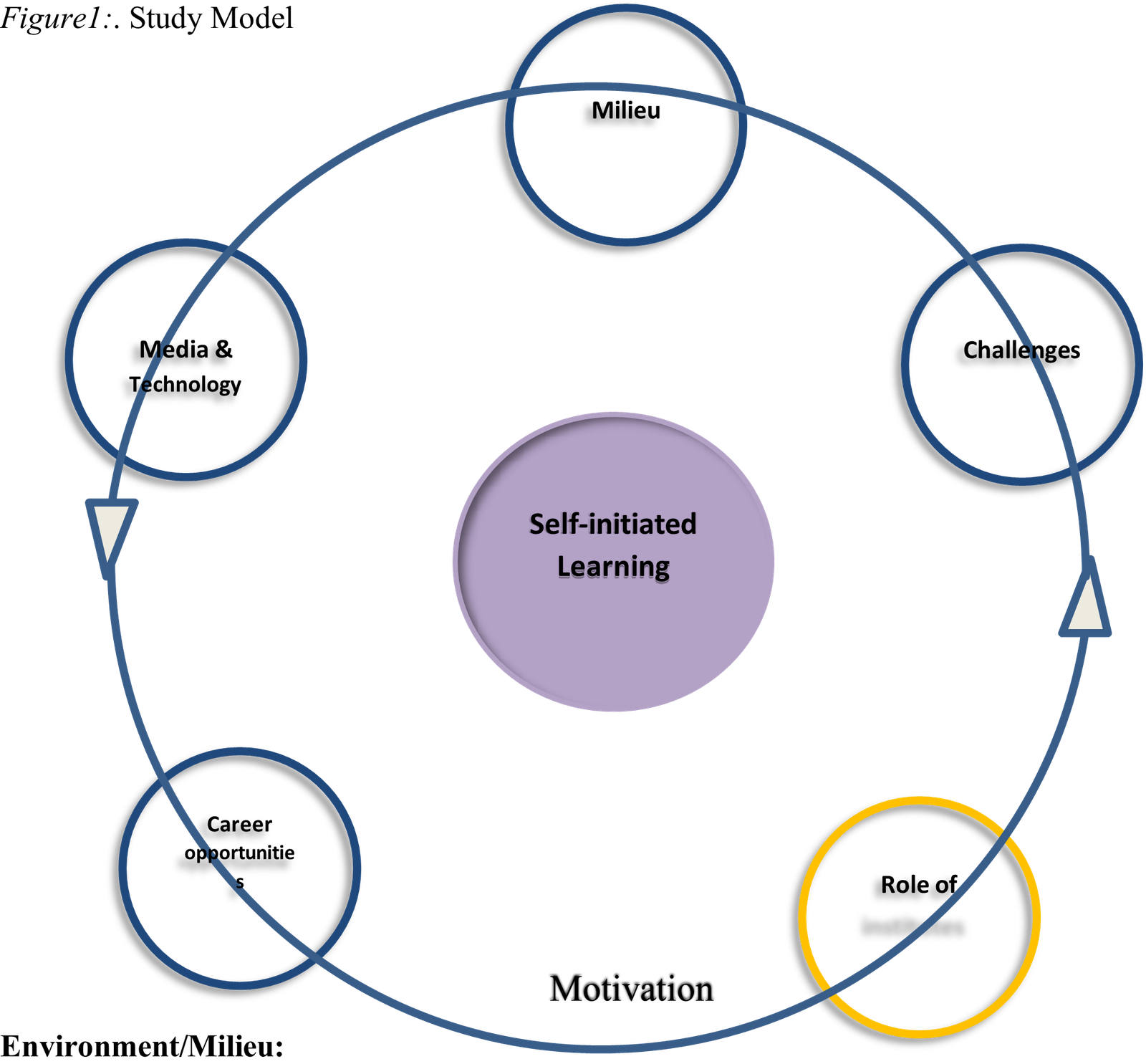
Six major themes emerged from the analysis of the fifteen narratives. First is the environment/milieu in which the teachers dwell, gained education or worked. Second, are the challenges they face during their teaching careers due to insufficient knowledge of teaching methodologies and weak language skills. The third factor that helps teachers to take initiative of self-directed learning opportunities is better career opportunities or survival in the market as because of the extended competition in market, teachers are required to improve their teaching capabilities. Fourth is the role of institutes in the teaching/learning interface as the educational institutes not only encourages teachers to improve their learning but also can arrange opportunities for teachers to improve their learning methodologies and language proficiency. Fifth is the media that has greatly influenced teachers learning as print, electronic and social media have taken teaching methodologies and teachers’ capabilities under scrutiny that in turn puts immense pressure upon teachers’ performance. Last but not the least is the most crucial factor; as it surrounds all the above five factors and yet instigates teachers continuous learning; the motivation. Self-initiated learning can only evolve if the teacher is motivated enough to improve its teaching capabilities through various sources available in his/her milieu. However, as it could be seen in the study model that the five factors responsible for teachers learning are encircled by the motivation but a part of each factor is out of the circle of motivation. This shows the adverse roles of all these components to demotivate teachers from improving themselves as teachers and learners. The narrative inquiries further revealed the positive and negative roles of
these components in the teachers’ learning journeys. The next part of the chapter explores each component and its role in teachers’ self-initiated learning experiences with examples from the data.
| Table 4: Participants’ background knowledge and interests | ||
| Names | Academic interests | Sources of learning |
| Ahad | Reading Quran’s interpretation in English, visiting language learning websites-specifically speaking and reading | Libraries, websites, training institutes |
| Anila | Learning task based language teaching and collecting activity ideas from various websites, reading storybooks and getting ideas for writing | SPELT library, training institutes, websites |
| Asma | Improving speaking skills through training programs and practicing, watching English feature programs to improve accent | Movies, training programs offered by various institutes, member of SPELT |
| Fareeda | Material development and collecting pictures for designing language activities, watching movies with sub titles | Websites, training institutes, movies |
| Fareed | Web based learning, collecting and developing resources for training programs, developing training programs for specific areas of interest | SPELT and TDC member, online books and websites |
| Hamid | Sharing TESOL experience with peers, involved in mentoring programs, learning web-based learning | Educational projects, web based learning programs |
| Kanta | Attending monthly academic sessions, reading books, member of peer mentoring program | SPELT member, books and educational programs |
| Khalid | Learning to teach English in English through online resources | Online sources |
| Mustafa | Regularly attending teachers skill enhancement programs, reading books and emphasizing in improving writing skills | Reading books, using CDs for improving writing skills |
| Qudsia | Reading books, improving IT skills, extensive work on communicative language teaching | Web-based programs, books, teachers training programs |
| Rashida | book reading, collecting resources, developing activities material and uploading it on various websites | Various websites and audio/visual aids, books |
| Sualiha | Faster reading strategies and vocabulary building, | Books, websites, movies and |
| watching movies and practicing shadow listening to improve her accent | electronic resources available through internet, training programs | |
| Tahir | Improving speaking skills through practice, involved in public speaking and presentation skills courses | Teachers training institutes |
| Tasneem | Book reading, developing material for communicative language teaching | Training programs, IT skills and electronic resources |
| Zakir | Improving reading skills through reading storybooks and listening skills through self-help activities | Books, training programs |
| SPELT = Society of Pakistan English Language Teachers | ||
| TDC = Teachers’ Development Centre | ||
Pakistan is a place where different people from different cultures live together each having cultural distinctions, different languages and rural-urban divide. Karachi is a cosmopolitan city where people from all over Pakistan have settled down for a better standard of living as it has greater trade and commerce opportunities as compared to other parts of the country. Though the city has its own culture and a modernized way of living yet the families dwelling here have restored their native culture in their own ways and definitions. Another factor is the income level and the living standard of people living here as people from the poorest to the richest sects happen to live in the same city. However, the teachers mostly belong to middle or lower middle class white-collar families who seek work for their survival. Furthermore, the family backgrounds also have variations as some teachers belong to well-educated families where from the ancestors to the current generation are well educated and have been related to white collar jobs. On the other hand, some belong to the families who are the first generation to gain education amongst their families. Teachers’ stories reveal how the environment plays an important role in teachers learning. Teachers coming from well-educated families are motivated
to improve themselves as learners and teachers because of their home environment. Qudsia (Matric system) can be a substantial example as she belongs to a family where one of her parents was related to education and the rest of the family was also well-educated. As she revealed:
Seeing my parents reading books and enjoying sharing with each other made me learn more about it and by the age of thirteen I started reading Agatha Christy. I am a keen reader ever since my childhood and I have inherited this habit from my parents and grandparents. My students know how I encourage them to read books.
Book reading has helped me not only during my student life but more when I became a teacher.
The environment also includes the schools and colleges where they have gained basic education and the friends, families and teachers who helped them to become better learners. Fortunate people like Qudsia who have environment conducive to learning helps them throughout their lives to be self-directed learners. She has been actively involved in participating in-service trainings offered by the school and she has been cascading various training sessions in her school which she has gained from other sources on her own expense. Qudsia has also developed a Speaking skill development program for the novice language teachers of her school. She also gives credit of her skill development priorities to her school teachers who helped and encouraged her reading skills as she is famous for her faster reading skills amongst her peers and teachers. The encouragement from her teachers motivated her to read more and more and she gives the credit of her improved writing skills to her reading habits which surely a result of her teachers’ encouragement and her family’s literary environment. The similar story was shared by Hamid (O-Level system) who gives credit of his TESOL degree to his parents as his father is a foreign
qualified doctor and the mother is a journalist along with the neighbours who happened to be an American family. He as a child was friends with his neighbor’s children and played with them in their house. He gives the credit for building his interest towards learning English by his school as communication in English was mandatory for every child with the teachers and the peers. Hamid gives the credit to his neighbors for the improved accent of his L2.
My aunt [neighbor] always corrected my mistakes by recasting them with a Politeness in her eyes and smile on her face. That was the time when I acquired fluency in my speech and I was quite confident in talking in English. My parents were very fluent in English and we mostly conversed in it at home or otherwise. Because of
my fluency in English I was quite popular in my school as well.
Hamid was fortunate to have motivation from his milieu that resulted in his inclination towards learning more about language teaching and further helping others to learn it. Zakir (Madrassah system) had a different story to tell as he is from a rural background where the weak educational system of the public sector along with incompetent teachers never gave him a good foundation. Being from a humble religious background his parents preferred to put him in a Madrasah where he was able to complete his eight levels of ‘Dars-e-Nizami’ along with completing matriculation and higher secondary as a private candidate. He ended up being a teacher because of lack of other opportunities of employment. He easily got a job in a Madrasah for his knowledge of English due to his higher secondary qualification. His initial experience of becoming a language teacher was quite challenging as he had immense pressure from the management to perform well and his own weak language skills became the major hindrance in his effectiveness as a teacher. His motivation for improving himself as a language teacher was never a result of his environment but from the challenges he had to face as a teacher.
Discussing teaching capabilities, skill development, meeting goals and overcoming challenges regarding teaching profession is considered easier said than done. The ground reality is that teachers have multiple layers of challenges which they have to face on every single step they take. Teachers had so much to share when they were asked about the in-service challenges they had to face. Multiple responses were recorded as different teachers came up with the challenges they encountered according to their education system, school environment and learning/teaching experiences. Due to lack of pre-service education, it was challenging for the teachers to understand classroom dynamics, time management, and importance of planning and over planning along with taking English as a subject instead of a set of skills. Moreover, their pedagogical limitations became a major hindrance for them to be affective teachers. Almost all
the teachers shared their experiences regarding the problems they faced for not having enough knowledge of the pedagogy or the command over the various new approaches in language teaching. They meant to bring a marked improvement in their learners during the year but somehow could not achieve it. Feedback from the parents became a major indicator of their lack of effectiveness as language teachers. As English language acquisition in the developing countries like Pakistan is a prime focus of the parents as it is considered a key to success in any field of life. Moreover, high expectations are built around the teachers for helping their learners to gain fluency in speech and command over writing skills. Teachers rated these challenges as the major motivation for them bring improvement in their teaching style by learning about different approaches of language teaching, classroom dynamics, learning styles and multiple intelligences.
Tahir (Madrasah system) shared his harsh experiences of early days of his teaching career as he felt a major gap between his ability to teach L2 to his learners and the subject knowledge he had. He found himself using rote learning and grammar translation method to teach language but comparing his learners’ with others from different schooling systems made him assess his style of teaching and realized that the learners did not lack the capacity to learn English as a second language; it was actually his teaching methodology that had serious gaps which were to be bridged by improving himself as a language teacher.
Teaching in a Madrasah where English language was only a formality to be fulfilled as the prime focus of this schooling system is to teach religion, I found my learners to be quite weak in the subject as they were only taught
about few grammar rules through isolated sentences and few comprehension texts for which they only had to memorize the answers and reproduce them in the final test. Above all to my surprise when I attended a training program
where teachers from other schools also participated, I found them to be fluent in English and talked about various new strategies they used in their language classes. I first time came to know that reading classes could be a fun through jigsaw reading and a boring English class could turn into a meaningful,
result oriented 40 minutes by materializing speaking activities like Picture differences and other information gap activities.
In Tahir’s case his first experience of a training program made him realize the gaps he had in his teaching methodology that resulted in the form of his learners who could never have learnt L2 as learners learning from other approaches would have learnt. His constant comparison of his teaching methodology with new pedagogies motivated him to find out more about it and he started to look for online teaching material and other teachers training programs. He became the pioneer in bringing reforms in his school for language teaching as he kept sharing his views and
concerns about language teaching with his subject coordinator and later with the school administration. It was the result of his efforts that the Madrasah he then worked for commenced a teachers training program for their ELTs.
Similar stories from other teachers were shared regarding finding serious gaps in their teaching styles, lack of knowledge of how to be effective language teachers and learners outcome. These challenges became the motivation for teachers to improve themselves on their own. They found online resources to be a major source of information and improvement. Fareeda (O-Level system) has a vast experience of material development and she has been a part of training programs specifically for this purpose. She shared that when she started as a language teacher she did not know much about material development and relied upon the material readily available in the staffroom for language teachers. She found the worksheets collection to be boring and old fashioned and decided to look for new material. As she discussed her reservations with other teachers in the staffroom, one of them advised her to look for online material. That was the time when computers, internet and online services were not very common amongst teachers (in Pakistan). She decided to search language learning resources online and to her amazement she found substantial ready to use material for various levels. She was overwhelmed to discover fresh material for her learners and started using it.
I had no idea what I was getting into as the free online material available was much qualitative and attractive! My learners enjoyed doing those activities and parents were full of praises for my efforts by listening to their children’s stories
of fun they had in doing those activities. My fellow teachers also started taking interest in my work and I encouraged them to use the material for their language classes as well.
While using this material she noticed that the similar type of material development could be done on her own and it was not something which she could not do. She started looking for the language skills development programs specifically developed for material development and found several of them offered by teachers training institutes. She was gratified to share that her efforts in this regard resulted in improved teaching methodology and it opened new vistas for her as she now has moved on to become a trainer herself for material development.
Although the challenges faced by many teachers became a source of inspiration and motivation for teachers some found these challenges to be an extra pressure upon them along with other issues. Tasneem (Matric system) found it to be quite demoralizing for her to have multiple pressures due to overwork and underpaid. She shared her bitter experiences of trial and error during her language classes and criticized young learners to be very critical nowadays for their teachers. Fareed (Madrasah system) expressed his concerns about the pressure parents put upon teachers and administration in order to make their children fluent in speaking and writing skills. this instead demoralizes teachers and results into anxiety and stress.
Schools are to nurture the intellect of not only the learners but of teachers as well. The schools happen to be a place for learning for all and therefore, have the responsibility to prepare learners for life and teachers for the future of this life. The multiple roles of the educational institutes happen to carry a great responsibility upon their shoulders as the society trusts them for their bright future. Unfortunately, that has not been the case in developing countries scenario as it has been quantified that the role of these institutes instead of being positive has been negative. As shown in the study model, the role of the institute is being portrayed in red colour that shows its adverse role in the improvement of their teachers. Most of the teachers have an experience of working in different educational institutes over the period of their teaching career and most of them were of the opinion that the systems they worked with had a very little contribution in their skills development and rather the teachers had to face criticism from the school administration for applying new pedagogies, approaches of learning and trying new material in their language classes. Some of the school principals even ridiculed teachers for being innovative and emphasized only upon completing the syllabus on time as their prime focus was only in achieving their academic targets. Some quarreled about the noisy speaking classes and found them to be disturbing for other classes on the same floor. Except for a few cases most teachers were not very satisfied with the role of institutes in encouraging them to become better teachers.
Teachers who have worked with O-Level system were of the opinion that this system somehow supports and endorse teachers skills development as it has a much challenging curriculum to follow and it needs qualitative teachers to cover it so they put substantial efforts in improving the quality of their teachers through rigorous training sessions and ongoing teachers’ training programs. The rest of the two systems have not made substantial efforts in upgrading their teachers by equipping them with new pedagogies or language proficiency.
Kanta (O-Level system) shared her experience of working in five different schools where she worked as a language teacher and four out of five were completely uninterested in either planning an in-house teachers training programs or hiring the services of teachers’ training institutes for the skills development of their teachers. One of her principals once had an argument with her as she reported that:
My immediate boss, the principal condemned my efforts for introducing interactive language classes and the proposal for sharing my knowledge of communicative language teaching with my peers through a 40 hours training program. She forced me to follow the syllabus as it was made and avoid noisy activities in my planner for the language classes.
She urged to have ‘pin-drop-silence’ in the class.
Many teachers including Sualiha (O-Level system), Ahad (Madrasah system) and Asma (Matric system) shared similar experiences of schools to be uninterested in the improvement in language teaching by adopting new pedagogies and in improving the level of their language teachers. Although the negative attitude of the schools towards teachers training and skills development program of teachers has been demoralizing for many teachers, some teachers found it motivating them to rely upon their own resources and improve themselves as teachers. Mustafa (Matric system) found motivated to opt for a summer teachers’ training program for language teachers in Karachi when he found his school completely uninterested in planning any language teaching program for the ELTs. He values his decision for improving himself as a language teacher as the 100 hours’ course helped him to learn dynamics of ELT and its validity. He further tells:
It was an experience of a lifetime as I entered into a new world of learning by attending the Master Teachers Course for language learning. I do not know about others but instead of getting disappointed by my school’s policy, I found it to be motivation for me to be self-reliant and put an effort to be a better teacher.
Analyzing these stories and seeing the role of the educational institutes seems to be negative and demoralizing as the study model paints it to be red, that shows its negative role but the motivation circle cutting it through shows how some teachers have taken motivation from it and adopted self-reliance in improving themselves as language teachers.
English language teachers are in high demand all across the world and have been valued as an asset in the institutes where they work. Modern educational arena has created new career opportunities for many language teachers. In countries like Pakistan a vast majority of students are opting for higher studies in foreign countries need to gain Band 7 or above in IELTS. Language teachers have several other opportunities to teach English in various other capacities and IELTS preparation is just one example out of many in this context. English proficiency is highly in demand as adult learning for better career opportunities and English language teachers are in great demand by several language learning institutes. School teachers now have various other opportunities to enhance their careers as language teachers where they can utilize their expertise and earn more. Fareed (Madrasah system) works as a visiting faculty in Madrasah as he happens to train Madrasah teachers and teach students as well. He is also an IELTS trainer and has prepared more than 8000 IELTS learners through in-house and online training sessions. His earnings have increased five folds after becoming an IELTS teacher.
Starting my career as an IELTS trainer has given me extra earning but has
also helped me to gain confidence in myself. I look forward to encourage more teachers to be interested in becoming IELTS trainer as it is highly in demand and yet very few professionals are available in fulfilling the demand.
Another example is of Fareeda (O-Level system) who is a successful trainer for material development. She has been hired by different teachers training institutes to share her expertise with other novice teachers. She confirms a substantial increase in her earnings by her training career. Fareeda now aspires to develop an online course for material development to reach thousands of other language teachers to gain technical knowledge of material development.
Media nowadays has single handedly altered the dynamics of many aspects of life. Media has evolved to be an eye of an eagle that soars high and have a bird eye view of things happening on the ground. As media has taken a driving seat in covering almost everything happening around, it has never divided its attention from the learning/teaching interface. Media has been actively writing about the challenges learners and teachers face and the role of modern ways of learning that has been introduced in the world. There have been rigorous news coverage and articles written upon various issues in the field of education. As neoliberalism has pushed immense pressure upon teachers to prepare learners for the new socio-economic world, media has played a role of a watch dog to evaluate the outcomes in the support of having prepared experts for to be adjusted in the capitalist system. These were the opinions shared by the teachers who hold themselves vigilantly safeguarding their integrity by performing at their level best to be endorsed by the media. Rashida (Matric system) recorded her negative remarks for media as to be critical and highly judgmental in the case of teachers. She expressed her grievances as:
Does the media [journalist and anchor person of Television talk shows]
think of us as human beings or robots who happen to be machines which are always right and can never go wrong!
As Pakistan has experienced the evolution of a fast track media in the form of more than eighty channels out of which 35 to 40 are the news channels. These channels have been actively involved in covering any small and big event or incident in order to increase their viewership. Teachers shared their fears and concerns regarding media activation and unprecedented scrutiny upon teachers and school administrations.
Many teachers shared their experiences of media men approaching them for petty internal issues of school administration or parents’ hostile reactions upon calling media personnel to cover some
unjust (in their opinion) done by a teacher or school authorities. The print media has also been active in writing continuously about new and old teaching methodologies and the learning outcomes in the form of test results. Teachers feel themselves under an unseen surveillance. Nevertheless, the teachers have found it to be their source of inspiration and motivation in order to improve their performance and enhance their skills. As Tasneem (Matric system) has said:
Why should I be worried of being under scrutiny of media when I know that substantial coverage is given to the teachers who have performed well, have multidimensional capabilities and have high achievements. I think we should not mourn about it rather be more motivated to improve ourselves as teachers
to gain their positive attention.
Technological growth and introduction of technology has also become an inspiration and motivation for the language teachers to improve themselves. Teachers merrily rate themselves as digital immigrants and call their students as digital natives. Most of them were of the opinion that having the most difficult audience – their students they have to be extra careful in providing any information because the students happen to double check the information through Google or other search engines. Almost all the teachers endorsed technological integration into language learning as they consider it to be a helping hand rather than a problem.
Self-initiated learning experiences of the language teachers are worth mentioning as they are not only the experiences and ways of learning that have been shared but could also become a guideline for other aspiring teachers looking for ideas to improve themselves as teachers. Therefore, the researcher was able to develop another addition to the model study by mentioning the center circle into different types of learning sources and activities these teachers were involved in order to improve their learning and teaching capacities. The sources and means shared by the teachers that helped them to learn are mentioned in figure 2- The Sources of Learning.
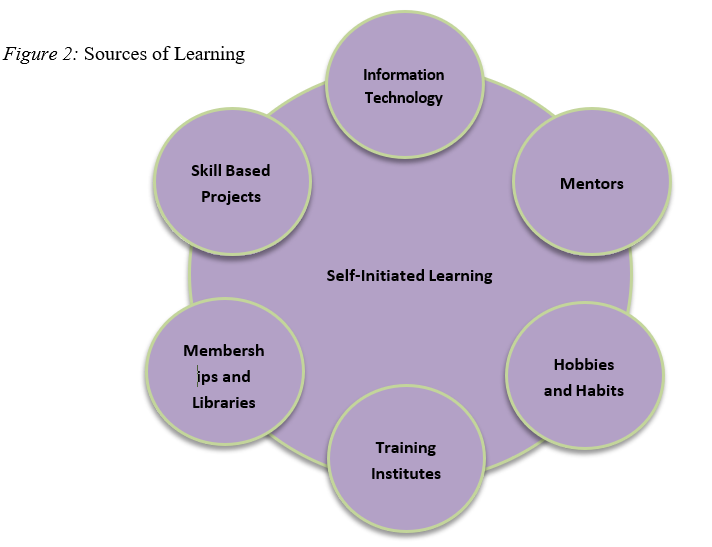
Most teachers gave credit to IT based resources helping them to learn more about international standards of English language teaching and Communicative language teaching approach. Teachers like Fareed (Madrasah system), Hamid and Anila (O-Level system) and Qudsia (Matric system) have even a collection of books that they have either bought online or have saved them a soft copy in a pdf file of books and teaching resources in their personal collection. Since Fareed works in various capacities in different institutes as an ELT for young Madrasah learners, English language teachers and IELTS learners, it makes his work easier to use the soft copies of these resources to develop handouts and worksheets for his interactive sessions. Moreover teachers have used various websites to improve their language proficiency and have found websites specifically designed for particular language skills. Tahir (Madrasah system) shared that he improved his speaking skills by using various websites in his own leisure time.
Teachers have endorsed the role of their mentors and teachers for not only inspiring them to improve their learning/teaching capacities but also gave them professional guidance either casually or under the officially organized programs. Several teachers shared their experience of Mentoring and peer support programs initiated by the training institutes and identified them as a substantial learning experience. Fareed (Madrasah system) had great regard for his mentor who happens to run a leading training institute in guiding him to become a teacher trainer and helped him to be a part of various training programs of national and international level.
Teachers identified several personal habbits and hobbies that helped them to improve their language proficiency and they also gained teaching ideas from them. Interest in book reading, Hollywood movies, and English feature programs helped them to improve their listening, speaking, reading and writing skills. Sualiha (Matric system) and Asma (O-Level system) shared their experience of improving their grammar skills through cloze passages. They both mentioned this practice of doing a cloze passage every weekend to be their hobby.
Teachers spoke high about the availability of training institutes in their city and placed themselves fortunate to dwell in a modern city where they were able to opt for these institutes as outhouse training facility. Some of them gave credit to their previous and current schools to outsource these institutes in order to build the capacity of their teachers. Teachers who were a part of the training programs being run by either the schools or any other training institutes confirmed a marked improvement in them after being a part of such programs. Many teachers have shown their improvement through the role of Society of Pakistan English Language Teachers (SPELT) that holds an international ELT conference along with a complete teacher training program covering various aspects of ELT. It has its affiliation with Cambridge University and it offers a degree of In-service Certificate of English Language Teaching (ICELT) every year along with in-house training programs for ELTs round the year. It also possesses a vast collection of Books, audio/visual resources and multiple teaching resources in its library that is available for the members. It also holds a monthly academic session in sharing the knowledge of experienced ELTs and guidelines for aspiring novice teachers. It is considered to be one of the greatest contributions of the stalwart ELTs who structured it 29 years ago and has now the membership of more than 2000 ELTs all across Pakistan. Another training institute that has brought ELT programs for novice and experienced teachers is Teachers’ Development Centre. The institute has grown into an academy for teachers to learn new pedagogies, develop their own language skills and improve their ELT methodologies. It offers comprehensive courses on language teaching, pedagogy, andragogy, soft skills and professional ethics each included in a 100 hours course or split into short courses specific to various topics. Its library has a vast collection of more than 35000 books along with audio/visual aid and most modern teaching resources for teachers and teacher trainers that are available to its members. The inspiring leadership of these two renowned institutes has eminent contribution to English Language Teaching. Almost every teacher in the research spoke praises for the contribution of these two distinguished sources of learning and look forward to be a permanent part of their ongoing programs. The researcher herself is a life member of both SPELT and Teachers’ Development Centre and has personally witnessed their outstanding role in helping ELTs in their capacity building. Teachers also held various skill based projects conducted by various foreign funded donor agencies responsible in improving their capacity as teachers and learners. Donor agencies including the contribution of British Council for successfully running international programs such as Connecting Classrooms, English for Teaching, Teaching for English (ETTE), along with
several online resources and websites specifically designed for ELTs have substantially contributed in improving the level of ELTs in Pakistan.
Teachers learning experiences have made the study model more comprehensive in understanding the factors that motivated teachers in improving themselves as self-initiated learners and the sources and activities that contributed in their self-initiated learning. Therefore, a new study model is shown in Figure 3 that completely depicts the learning journeys and experiences of self- initiated learner/teachers in Pakistan. It also shows the self-reliance of ELTs in finding means and sources appropriate for them to improve their learning process.
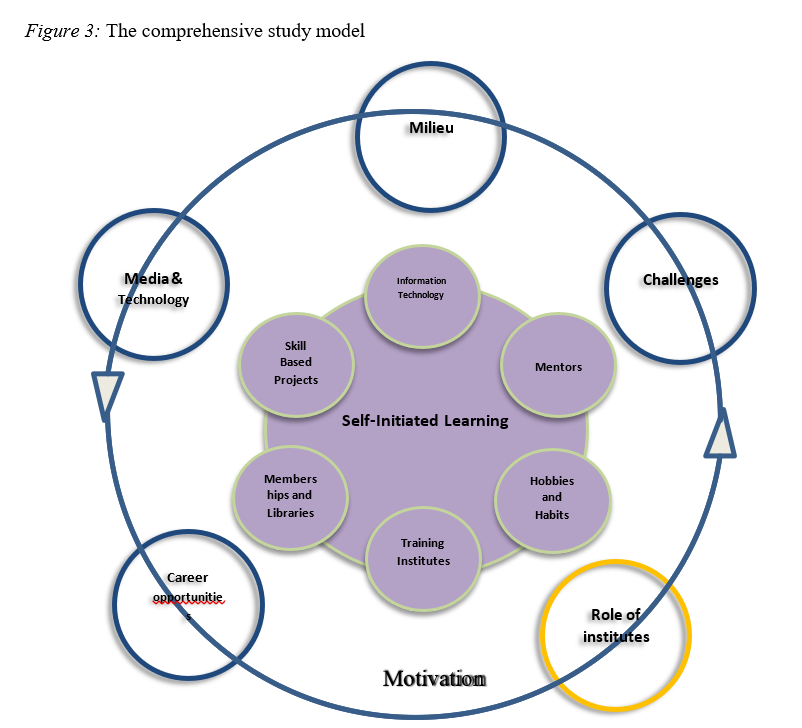
This chapter discusses the findings of the study in the light of theoretical issues presented in chapter 2 (literature review). The narratives of the teachers helped building a study model (Figure 1in chapter 4) that displays six factors that helped language teachers towards self- initiated learning. The findings evolving from the narratives endorse many theories and hypotheses developed by various language scholars and experts over the period of time. The discussion highlights the similarities found between self-initiated learning assumptions presented by Pintrich (2004) and the teachers’ perspective on self-regulated learning. Furthermore, Freeman’s (2009) scope of SLTE along with developing guidelines given by Graves (2009) are weighed with the findings and analyzed to be authentic in the case of these teachers. Reflective practices and social pressures upon teachers are also critically evaluated in the light of the findings of the study. In the end the study conclusions are drawn by giving a guideline of further research that could be done taking up the same line and moving along to probe deeper the implications of self-initiated learning experiences in retrospect.
Comparing the findings from the narratives seems to be matching with Pintrich’s (2004) four assumptions in most self-initiated learning models. The first assumption says that self-regulated learners show keen interest in improving themselves and autonomously take decisions for their learning struggle. It could easily be seen in all the mentioned learning experiences of Fareed and Tahir (Madrasah system), Mustafa (Matric system) and Fareeda (O-Level system) that they self- motivated themselves to improve their learning through various sources. The second assumption explains the attributes of self-directed learners to set their goals according to their learning features, circumstances and requirements and then safe-guard them through monitoring and evaluation of their own learning. This attribute could be seen in the learning experiences of almost every participant as they structured their own area and framework of learning according to their own preferences and then kept evaluating themselves to be on the right track. The second assumption reflects clearly in Fareeda’s (O-Level) choice of material development as a specific field of expertise and then continuing to excel in the particular field. The third attribute is about autonomy in setting learning targets by the learners and regulating themselves for the pace adjustment and decisions for continuation of the targets achievement. This is clearly a case in this study as the teachers set their own learning targets and regulated themselves according to their needs and circumstances. The fourth and the last attribute define self-directed learning initiatives to become mediators between personal and contextual achievements and
performances. The learning outcomes expressed by the teachers in this study indicate their ongoing reflection upon their own learning/teaching improvement.
As Freeman (2009) has explained SLTE in three different aspects; (1) design of SLTE, (2) engagement of teachers in SLTE through its design and (3) the outcomes of SLTE.
/|\
Seeing the learning experiences shared by the teachers in the study clearly indicates this pattern to be followed as self-initiated learning experiences of fifteen different teachers were self- designed and were executed in different circumstances and were achieved in dissimilar spans of time but yet were designed and developed by the teachers themselves followed by engagement in the learning process due to various reasons and motivations and finally, the outcomes were experienced in the form of effective teaching methodologies, improved confidence and career enhancements.
As Graves (2009) has emphasized upon the design of the learning curriculum – pattern and area of learning to be based upon teachers’ schema and need analysis, the teachers stories show high emphasis upon the weak areas and shortcomings, prior knowledge they had and the areas of their interest. The need analysis of their own learning requirement supported them in developing a guideline for themselves later to be followed by engaging into the learning process and finally achieving their targets by seeing a positive outcome in their teaching and learning.
The teachers shared their stories of self-initiated learning in the context of their dissatisfaction to their teaching practices and urge to improve themselves as teachers and learners of language. Their critical reflection upon their own teaching practices, language proficiency and modernization in language teaching became the reason for their self-directed skills enhancement struggle. Their critical analysis of their own teaching practices, shortcomings and struggle for the improvement actually endorses the idea of reflective practice (Ashraf & Rarieya, 2008; Farrell, 2007 and McKay, 2009). As in the case of Tahir (Madrasah system), his dissatisfaction for his
own teaching practices compelled him to look for options of learning and his continues struggle resulted as a marked improvement in his language proficiency and teaching methodologies.
As mentioned in chapter 1, the researcher’s concern regarding the social pressures media, civil society, educational institutes and neolibralists have put upon the teachers and how teachers deal with it was a major aspect to explore. Comparing teachers concern related to the social pressures they have upon them that in turn motivated them to revisit their academic qualifications, skills they possess and gaps they have as teachers, the narratives endorsed the social pressures upon teachers through media, civil society and school administrations where they work. The researcher could see the reflection of this virtual pressure upon the teachers through their stories and can synthesize it with the concept of neoliberalism where teachers are indirectly compelled to prepare efficient corporate workers for the capitalist market. As most teachers were quite unaware of the hegemony of the ruling class or the capitalist market strategies, accept for two, Fareed (Madrasah system) and Rashida (Matric system) who talked about their idea of the unseen pressure through various sources such as media, parents and school administration upon the teachers.
The study engaged fifteen language teachers from three different education systems operational in Pakistan to share their self-initiated learning experiences along with the factors that compelled them to take the initiative in improving themselves as language teachers and the crust and turf they faced during their journeys.
A study model emerged comprising of six findings that become the indicators of inspiration and motivation for their learning initiatives. These indicators are expressed in a diagram Figure 1as; milieu in which teachers dwell, challenges language teachers face during their teaching careers, role of their institutes in their professional lives, career opportunities they can opt after enhancing their teaching and language skills and the pressure they face from the media and technology integration in learning/teaching interface and motivation that has emerged from these factors and have inspired the teachers to improve their learning/teaching skills and turn into professional teachers.
The teachers showed enthusiasm in being part of the study and were positive to share their learning experiences in order to set a guideline and encouragement for their fellow teachers to get inspired from their experiences and take an initiative on a personal level to improve themselves in the capacity of a teacher and a learner. Though they rate their learning journeys to be a substantial achievements nevertheless, they express their concerns regarding a passive role
of the policy makers and implementers to be absent in improving the capacity of teachers in Pakistan.
The study has explored the learning experiences of the language teachers in order to find out how language teachers survive pressures upon them through various sources, the initiatives they have taken as self-directed learners and how far these initiatives have helped them in their teaching careers. The further step taken to carry on this study from here onwards could be to see the outcomes of these learning initiatives upon the three different education systems, as the emphasis on the learning/teaching priorities might be dissimilar due to their distinct operational features and characteristics, the effect on peer teachers and colleagues and on the overall performance of their learners. The perspective of their school administration regarding their efforts for improving themselves as teacher learner could also be an area of interest for researchers in the future.
References:
Ahmed, S. Y., Aziz, S. A. (2012). Quality in teacher education: A situational analysis of quality assurance strategies of teacher education institutions in Pakistan. Interdisciplinary journal of contemporary research in business, 4, 173-182.
Ahmed, Z. S. (2009). Madrasa Education in the Pakistani Context: Challenges, reforms and future discussions. Peace Prints: South Asian Journal of Peacebuilding, 2(1).
Ashraf, H. and Rarieya, J., 2008. Teacher development through reflective conversations – possibilities and tensions: a Pakistan case. Reflective practice, 9(3), 269–279.
Bakkenes, I., Vermunt, J. D., & Wubbels, T. (2010). Teacher learning in the context of educational innovation: Learning activities and learning outcomes of experienced teachers. Learning and Instruction, 20(6), 533-548.
Baldauf, R. B. Jr. (2012). Language planning: Where have we been? Where might we be going?
Revista Brasileira de Linguistica Aplicada, 12(2), 331-348.
Baldauf Jr, R. B., & Nguyen, H. T. M. (2012). Language policy in Asia and the Pacific.
Bashiruddin, A., 2009. Learning English and learning to teach English: the case of two teachers of English in Pakistan. In: S. Mansoor, et al., eds. Emerging issues in TEFL: challenges for South Asia. Karachi: Oxford University Press, 155–180.
Bednarz, S., 2003. Nine years on: examining implementation of the national standards. The journal of geography, 102 (3), 99–109.
Bell, J. (2002). Narrative research in TESOL. TESOL Quarterly, 36, 207 – 213.
Black, R. W. (2009). English‐Language Learners, Fan Communities, and 21st‐Century Skills.
Journal of Adolescent & Adult Literacy, 52(8), 688-697.
British Council. (2013). Retrieved from http://www.britishcouncil.org/pakistan-teaching-english ette2.htm
Bruner, J. S. (1990). Acts of meaning: Cambridge, MA: Harvard University Press.
Burns, A. (2009). Doing action research in English language teaching: A guide for practitioners: Routledge.
Burns, A. 2010. Doing action research in English language teaching. A Guide for Practitioners. New York: Routledge
Burns, A., & Richards, J. C. (2009). Cambridge Guide to Second Language Teacher Education.
Retrieved from http://UQL.eblib.com.au/patron/FullRecord.aspx?p=674629
Chaitanya, E. K., & Bavani, K. D.(2012). Continuous professional development for ESL teachers of professional courses. Language in India, 12, 65-70
Cole, A. L., & Knowles, J. G. (2001). Lives in context: The art of life history research: AltaMira Press.
Dayoub, R., & Bashiruddin, A. (2012). Exploring English-language teachers’ professional development in developing countries: cases from Syria and Pakistan. Professional Development in Education, 38(4), 589-611.
Dörnyei, Z. (2007). Research methods in applied linguistics: Oxford University Press Oxford.
El-Deghaidy, H., & Nouby, A. (2008). Effectiveness of a blended e-learning cooperative approach in an Egyptian teacher education programme. Computers & Education, 51(3), 988-1006.
Evans, H. (1993). The choice of teaching as a career. Social and Economic Studies, 225-242. Evans, S., & Morrison, B. (2011). Meeting the challenges of English-medium higher education:
The first-year experience in Hong Kong. English for Specific Purposes, 30(3), 198-208.
Farrell, T. S. C. (2007). Reflective language teaching: From research to practice: Cambridge University Press.
Freeman, D. (2009). The scope of second language teacher education. In A. Burns & J. C.
Richards (Eds.), The Cambridge guide to second language teacher education (pp. 11-19). USA: Cambridge University Press.
Glaser, B. G., & Strauss, A. L. (1967). The discovery of grounded theory: Strategies for qualitative research: Aldine de Gruyter.
Government of Pakistan. (2009). National Professional Standards for Teachers in Pakistan. (NPST-2009). Islamabad: Ministry of Education
Graves, K. (2008). The language curriculum: A social contextual perspective. Language Teaching, 41:2, 149-183.
Halai, A., 2001. On becoming a ‘professional development teacher’: a case from Pakistan.
Mathematics education review, 14 (1), 31–43
Halai, N., 2011. How teachers become action researchers in Pakistan: emerging patterns from a qualitative metasynthesis. Educational action research, 19 (2), 201–214.
Hamid, M. O., 2004. Seeing oneself in another practitioner: The ploughman pulling the plough.
The Dhaka University Studies, 61(1), 1-14
Hamid, M. O., & Baldauf, R. B. (2008). Will CLT bail out the bogged down ELT in Bangladesh? English Today, 24(03), 16-24.
Hamid, M. O., & Honan, E. (2012). Communicative English in the primary classroom: implications for English-in-education policy and practice in Bangladesh. Language, Culture and Curriculum, 25(2), 139-156.
Heigham, J., & SAKUI, K. (2009). Ethnography. J. Heigham; R.A. Croker (Eds.), Qualitative research in Applied Linguistics: a practical introduction. (pp. 91 – 111)Great Britain: Palgrave Macmilian.
Hood, M., (2009). Case Study. In J. Heigham & R. A. Croker (Eds.), Qualitative research in Applied Linguistics: a practical introduction. (pp. 66 – 90). Great Britain: Palgrave Macmillan Huimin, Z. 2010 ‘EFL Teacher Development A Reflective Model’. Modern English Teacher, 19/2: 60-63
Johnson, K. E. (2006). The sociocultural turn and its challenges for second language teacher education. Tesol Quarterly, 40(1), 235-257.
Kaplan,R. B., Baldauf, R. B., Jr. & Kamwangamalu, N. (2012). Why educational language plans
Sometimes fail. In R. B. Baldauf Jr, R. B. Kaplan, N. K. Kamwangamalu & P. Bryant (Eds.), Language planning in primary schools in Asia (pp. 1-20). USA and Canada: Routledge
Kaplan, R. B., & Baldauf. Jr. R. B. (2005). Language and language-in-education policy and Planning. In E. Hinkel (Ed.), Handbook of research in second language teaching and learning (pp. 1013-1034). Mahwah, NJ: Laurance Erlbaum Associates.
Kaplan, R. B., & Baldauf Jr, R. B. (2003). Language and language-in-education planning in the Pacific Basin (Vol. 2): Springer.
Kasi, F., 2010. Collaborative action research: an alternative model for EFL teacher professional development in Pakistan. Asian EFL journal, 12 (3), 98–117.
Keown, P., 2009. The tale of two virtual teacher professional development modules.
International research in geographical and environmental education, 18 (4), 295–303.
Lieblich, A., Tuval-Mashiach, R., & Zilber, T. (1998). Narrative research: Reading, analysis, and interpretation (Vol. 47): SAGE Publications, Incorporated.
Li, M. (2008). English language-in-education policy and planning in schools in the PRC: Teachers as actors or implementers.
Lohman, M. C., & Woolf, N. H. (2001). Self-initiated learning activities of experienced public school teachers: methods, sources, and relevant organizational influences. Teachers and Teaching: theory and practice, 7(1), 59-74.
Maaranen, K., Kynäslahti, H., & Krokfors, L. (2008). Learning a teacher’s work. Journal of Workplace Learning, 20(2), 133-145.
McKay, S. L. (2009). Second language classroom research. In A. Burns & J. C.
Richards (Eds.), The Cambridge guide to second language teacher education (pp. 281- 288). USA: Cambridge University Press.
McPherson, S., Wang, S.-K., Hsu, H.-Y., & Tsuei, M. (2007). New literacies instruction in teacher education. TechTrends, 51(5), 24-31.
Merriam, S. B. (1988). Case Study Research in Education. A Qualitative Approach: ERIC.
Mouza, C., 2009. Does research-based professional development make a difference? A longitudinal investigation of teacher learning in technology integration. Teachers college record, 111 (5), 1195–1241.
Murray, G., (2009). Narrative Inquiry. In J. Heigham & R. A. Croker (Eds.), (pp. 45 -65).
Great Britain: Palgrave Macmillan
Olasehinde, M. O. (1972). An analytical study of the motives of primary school teachers for choosing teaching as a career. Journal of Teacher Education, 23(2), 207-210.
Pintrich, P. R. (2004). A conceptual framework for assessing motivation and self-regulated learning in college students. Educational psychology review, 16(4), 385-407.
Rahman, K., & Bukhari, S. R. (2006). Pakistan: religious education and institutions. The Muslim World, 96(2), 323-339.
Rarieya, J., 2005. Promoting and investigating students’ uptake of reflective practice. A Pakistan case. Reflective practice, 6 (2), 285–294.
Shamim, F. (2008). Trends, issues and challenges in English language education in Pakistan.
Asia Pacific Journal of Education, 28(3), 235-249.
Sharif, A. (2009). Exploring a principal’s decision-making processes with regard to
professional development of teachers, engendering a culture of professional development in the school. Unpublished master dissertation. Aga Khan University Institute for Educational Development, Karachi.
Sleeter, C. (2008). Equity, democracy, and neoliberal assaults on teacher education. Teaching and teacher education, 24(8), 1947-1957.
Song, G. (2005), “The theories and application of e-learning”, Comparative Education Review, Vol. 5, pp. 13-17.
Stake, R. E. (1995). The art of case study research. Thousand Oaks, CA: Sage Publications.
Torres, C. A. (2002). The State, Privatisation and Educational Policy: a critique of neo-liberalism in Latin America and some ethical and political implications. Comparative Education, 38(4), 365-385.
Tribble, C. and Shamim, F., 2005. Current provisions for English language teaching in higher education in Pakistan. Islamabad: Higher Education Commission.
Vazir, N., & Wheeler, A. (2004). Increasing the angle of educational reform in Pakistan: Through professional development. Brock Education: A Journal of Educational Research and Practice, 14(1), 85.
Wang, J. (2002), “Online learning in China: current status, technology and development strategies”, Journal of Minjiang University, Vol. 23 No. 2, pp. 16-20.
Wang, S. (2003), “E-learning: a completely new teaching approach”, Sci/Tech Information Development & Economy, Vol. 13 No. 2, pp. 80-1.
Wing-Lai, K., et al., 2006. Literature review and synthesis: online communities of practice.
Wellington, New Zealand: Ministry of Education.
Zafar, M., 2009. English language teaching at the tertiary level in Pakistan: a case for English for specific purposes. In: N. Hussain, A. Ahmad, and M. Zafar, (Eds.) English and empowerment in the developing world. Cambridge: Cambridge Scholars Publishing, 151–164.
Zaidi, S. M. A. (2013). Madrassa Education in Pakistan. Retrieved from http://strategiskanalyse.no/publikasjoner%202013/2013-03
04 SISA3_Madrassa_Education_-_Syed_Manzar_Abbas_Zaidi.pdf
Zhang, J. and Yu, S. (2003), “Development trends of e-learning in Chinese enterprise”, Chinese Journal of Distance Education, Vol. 3, pp. 55-7.
Zhao, J., McConnell, D., & Jiang, Y. (2009). Teachers’ conceptions of e-learning in Chinese higher education: A phenomenographic analysis. Campus-Wide Information Systems, 26(2), 90-97.