This report presents the impact assessment of the project titled, ‘Enhancing Access and Quality for Girls Education in Pakistan, executed by Oxfam Great Britain in collaboration with Indus Resource Centre in district Kamber-Shahdadkot, Sindh. The project is multi-tiered, involves various stakeholders and uses a range of strategies to improve the enrolment rate of girls in schools, rehabilitate flood effected schools, build capacity of teachers, create awareness amongst school going children for health and hygiene and amongst communities for Right to Education law and prepare them for advocating their rights in Kamber-Shahdadkot. This report is based on field visits with stakeholders and recording their perceptions through Focus Group Discussions (FGD), and individual interviews. The improvement and rehabilitation of the schools have been recorded through field visits and observations.
The purpose of the evaluation was to assess the overall success/failure and impact of the project in meeting its objectives; determine its ability in accessing the target population, its advancement in inducting and creating attitudinal and communicative improvement within the targeted groups including young learners, parents, teachers and communities, review the effectiveness, significance, and sustainability of the project, and identify the limitations and enabling factors for the future replication and improvement. The evaluation was carried out and documented over a period of three months (October 2013 – December 2013).
The evaluation is predominantly qualitative. The report identifies successes and gaps as per the objectives mentioned above, and describes the process of implementation as it affected the project outcomes. A series of recommendations in the context of project’s sustainability and replication have also been discussed.
Developing countries are said to be in the process of development because of their economic and social, moral and cultural, educational and industrial achievements do not match the levels of international indicators that define ‘development’ in its true sense (Harris, 2000). Of all the other reasons, women suppression and taking them as children of a lesser God could be the prime reasons for being in the state of underdevelopment. Keeping half of the country’s population deprived of their basic rights, education, decision making process, basic health requirement and having a status of an individual with equal rights, in itself is a reason enough for the underdevelopment of a country.
Pakistan is a country that has been enlisted in the developing countries. Enriched with natural resources, human power as being the 6th largest country in the world in terms of its population, Pakistan still exists into the category of developing countries because of the absence of rule of law and weak implementation of the policies.
Since Pakistan is an agricultural based country, therefore more than 80 percent of the population dwells in the rural areas and less than 20 percent in the urban areas (Rijsberman, 2006; Banerjee & Duflo 2007). The fact that more than 50 percent of the population in Pakistan is of women (Population Census Organization), who have a potential to work, learn and be useful in any possible field have been deprived to be useful on the basis of religious, cultural, political and social barriers. However, women in Pakistan have been utilized in various activities such as fetching water from distant places, menial labour in the fields and household errands. The
women dwelling specifically in the rural areas are required to be aware of their basic rights and should be facilitated with education and skills to become a part of the global world.
The Government of Pakistan has been working on girls’ education and improved health practices for women but has not succeeded in achieving a commendable target that can indicate a better future for women. Amongst various non-government organizations that have been operational in extending their services in order to help the Pakistan Government to improve the livelihood of the underprivileged communities, IRC and Oxfam GB have been actively involved in working for disadvantaged people living in the remote areas of Pakistan. This project; Enhancing Access and Quality for Girls’ Education in Pakistan is one of the many initiatives that have been initiated by IRC and Oxfam GB for creating awareness regarding the importance of female education and its implications in their lives. This project is also an attempt to reduce gender inequality amongst local communities, giving women equal rights for education and using their potential for their families and communities. The other core purposes of the project are, giving exposure to the young girls of the villages of the urban world and its dynamics, creating awareness of health and hygiene, generating enthusiasm and awareness of the importance of education, conveying information about the recent law of Right to Education that is aimed at providing free and compulsory education to every child aged 5 to 16. Enhancing Access and Quality for Girls Education in Pakistan is a project initiated in Kamber-Shahdadkot, Sindh by Oxfam GB in collaboration with IRC and this study is an effort to analyze the impact of this project and observe, how far has this intervention made by IRC and Oxfam been successful.
Enhancing Access and Quality for Girls Education in Pakistan is a project of Oxfam GB implemented in collaboration with Indus Resource Centre (IRC) over a period of 18 months commencing from October 2012 and ending in March 2014. Its geographical outreach comprises of 50 government primary schools in three tehsils of district Kamber-Shahdadkot. Out of 50 schools, three schools were reconstructed and equipped with furniture and playing facilities and rest of the 47 were improved in providing guidance to teachers through training sessions, improving enrolment rate of girls in the school, introducing health and hygiene program and regular monitoring of the schools. The three schools have been reconstructed according to the requirement as it varied from school to school. Out of the three reconstructed schools, two were girls’ primary schools and one was a co-education school. The core team assigned for the project includes three members; project manager, education coordinator and a field officer.
The prime aim of the project is to work upon the girls’ education of the underprivileged communities of Kamber-Shahdadkot and create awareness regarding the right to education. Its purpose within this goal is to develop and integrate a model of girls’ education with the objective for further replication of this model in various areas of Sindh and Pakistan. There have been several components under this project that have worked in an interconnected manner so as to enhance the impact of the project.
The district Kamber-Shahdadkot has been affected with floods twice in the last four years and has been the second largest district amongst other districts regarding flood affected schools in Sindh. It has never been a regular feature of this area to experience calamities but this was the first time that Kamber-Shahdadkot was hit by such calamity that forced the population to migrate in other areas of Sindh to look for alternative livelihood sources. Due to the consecutive two floods hitting the area, it is now known for a disaster prone district. Indus Resource Centre with
the support of Oxfam GB in 2011 initiated this project to retain school children especially girls in the schools by reconstructing flood affected school buildings and building the capacity of teachers, SMCs and district government officials through school improvement and advocacy initiatives.
The prime components of the project are to improve the enrolment rate of female children in schools, rehabilitating flood effected schools in Kamber-Shahdadkot, capacity building of teachers, creating awareness amongst school going children for health and hygiene and creating awareness amongst communities for Right to Education law and preparing them for advocating their rights in this regard. In order to fulfill these objectives, following are the components that were materialized:
Construction Committees have been formed to monitor the construction and rehabilitation of the selected schools under this project. These committees were formed in every school where the construction had to be executed. Women’s participation was ensured in these committees and a positive response was observed from the local women regarding their role in the committees. Interested women became the members of these committees and they played a very active and strong role in fulfilling their responsibilities in this regard. Their responsibilities included monitoring the progress of the construction work of the three schools, quality of the material supplied for the construction, and reporting with regular intervals to the head office about the progress or any issues. Since the construction committees had a very strong role in monitoring the construction proceedings, the committee members were quite particular about the quality of the material used for the construction. 25 female and five male construction committee members were trained to monitor the construction work.
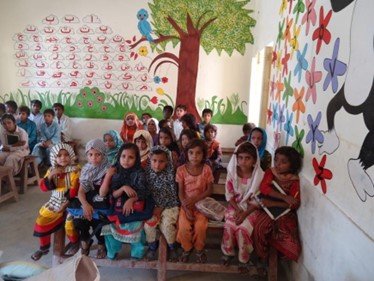
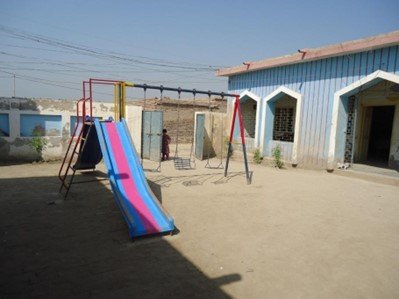
Reconstruction of three schools is being done under this program. Out of these three schools, two are girls’ primary schools and one is a co-ed. These schools have been not only reconstructed but have been painted and refurnished.
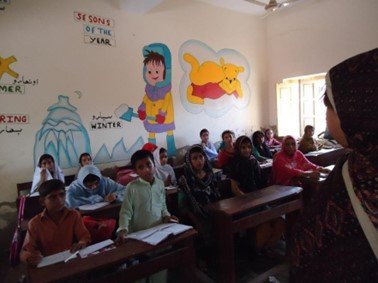
Playing equipment has also been installed in the school for children to play in their recess time. This playing equipment includes swings and slides; they have been installed in the play areas inside the schools. The playing equipment are installed as an added attraction for the children to be encouraged to join school. Wall chalking is an additional activity as the project management team decided to use the left over funds from the construction budget for beautifying the newly reconstructed schools. Classrooms and schools’ outer and inner walls were painted with thematic pictures, alphabets, and life size trees and cartoon characters not only for beautification but for visual learning. The team used various websites as a resource for the wall chalking thematic ideas.
Capacity building of teachers is an important component of this project in order to improve the quality of education provided in the schools of Kamber-Shahdadkot. The outcome of the need analysis showed that content knowledge of teachers in some subjects was weak, therefore it was most essential to first improve the subject knowledge and then further look for the pedagogical skills. The specific subjects that were recommended for the training program were Science and Mathematics. A training program comprised of six days workshops; three days each for two subjects was arranged in which 34 male and nine female teachers participated. According to the program, one teacher was selected
from each of the 50 schools. By the end of this training program, all the teaching material that was being used during the training sessions was provided to all the teachers to be further used in their classrooms.
SMCs have been formed and have been trained regarding the project details and their role in it. School linkages have also been formed by taking two members from each school bringing it to the total of 100 members. These members are linked or connected to the District Development Committee (DDC) to identify the education related issues at the district level and then convey them to the DDC. For this the SMCs were given two days training for the TORs, documentation, election and selection process of the members and orientation of the project. 47 male SMC members, 13 male students, 22 female SMC members, and eight female students attended the training in which they were to identify the problems and issues, prioritize them and further formulate a plan to be put forward to DDC. These plans are to be negotiated and addressed with the DDC. Another important feature of SMC training was that the training sessions not only included general secretaries and chairpersons but also the children. From each school an active member of the children’s club was selected to be included in these training sessions so that they would be able to know the role of SMCs in the schools. This was also done to involve students in the planning of school plan as a major stakeholder so that their voice should be heard in the SMC meetings where their issues have been discussed. The training sessions were to enable children to understand the role of SMCs and how their involvement will be able to affect the efficacy of the SMCs. These children are now the ambassadors to convey the information to their fellow students in order to develop their understanding regarding the role of SMCs.
A WASH program included health and hygiene sessions were arranged in the schools for developing awareness amongst the children regarding cleanliness and personal hygiene. As the project’s core team was not enough in numbers to introduce and run WASH program in 50 schools a team of locals was hired and trained for this purpose. These teams were further sent into the schools where they conducted sessions having various activities regarding health and hygiene with the school staff and the children. Follow up sessions have also been planned for all 50 schools and this time it has been decided to include parents. According to a survey done by the team, it is anticipated that by including parents, WASH program will be more successful in conveying its message amongst communities and children could be reinforced with the concept of cleanliness by the teachers and the parents.
RTE is a major component of this project as it is related to children’s right to free and compulsory education and it has to be conveyed to everyone. Under the project, a training session was arranged for the government officials during June 2013 that was attended by 36 male and 10 female government officials. The participants of the training included SDOs, supervisors and all the members at the district level who attended the day long training in which they were furnished with information regarding the Article 25-A, its
subsections and details about its components. They were explained what this law would mean and what benefits would accrue to stakeholders, the responsibilities government has put upon parents and the private schools under this law.
JLC has been a component directly related to children and their exposure of the world beyond Shahdadkot. These JLCs were structured to take selective youth to big cities such as Karachi and Islamabad where these children were placed in hotels and were arranged to attend interactive training sessions, activities and fun tours. The prime reason of the JLC is to give leadership skills to children and to expose them to urban settings and learn more about moderate and modern living so that they may gain confidence and be vocal about their rights. For all the JLCs a facilitator accompanied these children for the trip and addressed their needs and issues during their travel and stay. So far, four JLCs have been conducted and the strength of each JLC varies from 25 to 30 students for each. Up till now, 35 male students, 41 female students, six male teachers and six female teachers have participated in four of the junior leader conferences. The next step is that children will be trained through a series of sessions done with regular time intervals to identify their own issues and present them in public with confidence and conviction in order to achieve and practice their rights.
The strategic approaches used for the successful execution of the project are as follows:
The key stakeholders and beneficiaries related to the project include:
School Children are the key stakeholders of the project as the prime purpose of the project is to improve the enrolment of female children in the schools and sustain the rate of enrolment. Of 50 schools in three tehsils of Kamber-Shahdadkot that are chosen for the intervention most are primary schools for girls and some are co- education. These children are primarily from humble backgrounds where child labour is a common practice as parents have many children to feed and are usually unemployed, therefore the male child is responsible to earn money by doing menial labour in the community market areas, or help his father in his work or extend his services in the agricultural fields. The girl child is often forced to take care of her siblings, cook food, and run household errands as the mothers are either busy in the crop fields or are fetching water from distant areas or are simply expecting another child. The parents are least motivated to send their children; specifically the girls to
school as they are responsible for many household chores. It is indeed a challenge to encourage and motivate the parents to send their children to schools. The project team has made considerable efforts in convincing parents to educate not only their sons but daughters as well.
Teachers have been a key factor in the program as they were solely responsible to sustaining the enrolments by making the classroom environment non-threatening and conducive to learning. The schools enrolments improved not only because of the hard component (reconstruction of the schools along with paint, playing equipment and wall chalking) but due to teachers’ improved teaching methodology and content knowledge. Teachers have also been a part of SMCs so as to raise the academic, administrative and domestic issues of their students and schools in the SMC meetings. Other than the academic engagements and commitments, teachers are also involved in the health and hygiene programs to spread awareness regarding the WASH program. Teachers have been actively involved in educating their students as well as their parents and community members regarding RTE.
Parents have been a prime target of the project as they are required to be convinced to consider their female child to avail all educational opportunities available in their environment. Parents who were cooperative in understanding the importance of female education and enrolled their daughters in the schools later became the allies of the project team members. They further became SMC members, took a lead in advocating education for girls, awareness regarding WASH program and RTE amongst their immediate family and communities. The project paid special attention to parents and their issues so as to understand their viewpoint regarding their children’s education and make them understand the agenda of the program. Parents have greater steaks in the project as they have been involved in monitoring the reconstruction of the three schools under the program. Mothers took a lead in volunteering themselves as a part of the construction committees and their role has been commendable due to the active participation in all the construction proceedings.
Communities of the three tehsils are directly and indirectly the beneficiaries of this project as the schools will benefit the out of school children to be enrolled and get quality education. The members of the construction committees and SMCs are also from these communities and their active involvement in the project activities has spread the word for the RTE law and health and hygiene awareness.
District Development Committees and Government officials have been an important part of the project as they will be responsible for the continuation of the project activities in the current schools and further replication of the model in other schools of the areas coming under their repertoire of authority. Government officials’ involvement in the project has made the proceedings much easier to be executed by
the core team as they have been actively involved in monitoring teachers’ punctuality, effective classroom presence, increasing rate of enrolment, strategies to sustain the enrolled children in the schools, and issues related to the management of administrative responsibilities.
This chapter gives an introduction of the methodology adopted for this evaluation. The study used the Focus Group Discussion (FGD) method with questionnaires, and interviews for the case study as the research tool.
The FGDs were conducted with diverse groups having an influence upon the project or being influenced by the project. The prime emphasis of this study is on the narratives shared by the stakeholders reflecting their perception about the endeavor, indicating their apprehensions prior the commencement of the project further transforming into their acceptance for girls education.
A series of FGDs were held by the researcher with the facilitation of the enumerators. The FGDs were conducted in two phases. FGDs’ details regarding the venues they were conducted at and the groups who participated are mentioned in Table 1.1.
| Table 1.1: Focus Group Discussions | ||
| S.No. | FGD Group | Number of participants |
| 1 | Teachers | 6 |
| 2 | SMC Members | 6 |
| 3 | Teachers | 6 |
| 4 | SMC Members | 6 |
| 5 | Enrolled Students | 7 |
| 6 | Out of School Children | 10 |
| 7 | Parents of out of school children | 6 |
| 8 | Teachers | 6 |
| 9 | SMC Members | 6 |
| 10 | Community Members/Parents/Teachers | 8 |
| 11 | Faith Based Organization | 3 |
| 12 | District Official SDO & supervisors | 5 |
| 13 | Govt. Officials (supervisors) | 4 |
| 14 | Religious Minorities | 15 |
| 15 | District Development Committee | 4 |
FGDs were conducted at five different venues:
Questionnaires were developed specifically for each group. (see Appendix).
Interviews with the selected participants were conducted to collect individual perceptions, observations attitude and knowledge regarding the impact of the project. These individual responses were further developed into case studies. Four of the participants who were interviewed were the beneficiaries of the project as their individual perceptions report the effectiveness of the project in Kamber-Shahdadkot.
Field visits to observe the reconstruction of the schools were carried out. The researcher along with the facilitating team visited all three schools where reconstruction along with paint, wall chalking and playing equipment was installed.
FGDs were conducted with all the stakeholders directly or indirectly involved with the project. The total number of FGDs conducted were fifteen with the groups including; enrolled students, dropout students, un-enrolled children, parents of the enrolled students, dropouts and students who have never been enrolled to schools, community members, teaching staff, administration staff, SMCs, government officials including ADOs, EDOs, school supervisors, religious minorities, representative of the faith based organization. The total number of stakeholders who participated in the research were 92 (33 males and 59 females).
The research has been conducted by Saira Shahab along with the team of facilitators and enumerators. The research team was coached by the researcher in order to have a smooth data collection process. The research team comprised of the residents of district Kamber-Shahdadkot, having a detailed knowledge of the cast creed and cultural norms of the communities dwelling in the area.
The study tried to cover almost all the aspects of the projects by taking into account a large number of stakeholders who was available at the time of the visit. Although many areas were covered and all available participants were reached but not all the project stakeholders could be covered due to the distance, time and security issues of the area.
The locals of Kamber-Shahdadkot were reluctant to reveal many issues which exist in the way of girls’ education and future of women empowerment in their society as they feared its negative consequences for their professional position or social standing amongst the communities. They were also tongue tied due the presence of an outsider amongst them; especially the male members of the FGDs who shied away from talking comfortably with the researcher.
The researcher intended to cover more religious minorities and faith based organizations so as to take their view upon the impact of the project. Unfortunately, not many faith based organizations and religious minorities showed their keen interest in this regard.
This chapter highlights the project indicators against which the results were assessed. Some areas were also added which could be valuable for devising a replicable model for the future.
The key project indicators are mentioned below:
(school visits, interviews)
The prime motivation of the research is to evaluate the impact of the project that has worked improving the education opportunities for the female populace of Pakistan living in the remote areas. The researcher’s endeavor was to focus on the agenda of the study but the number of times researcher had a discussion with the stakeholders, details regarding several ground realities and the issues forced few themes to emerge and helped see a broader vision. These themes are discussed in detail in the Discussion chapter. The list of the emerging themes has been mentioned below:
This chapter reports the findings of the research about Enhancing Access and Quality for Girls Education in Pakistan. The responses of the stakeholders upon the intervention of the project and its effectiveness are mentioned along with the issues relate to different aspects of the context in which the project was executed. Further, the findings’ chapter compares the responses of the stakeholders and defines diverse views upon the same issues due to their variant context and circumstances. It also mentions the significance level of these interventions for different stakeholders and how they see and value them. Moreover, it explains how they vision their lives in the future in relation to the efforts of IRC and Oxfam and in what way they can contribute to improve these efforts. Lastly, it presents the success stories of a few stakeholders who have experienced personal and social improvement over the period of time.
The communities living in Kamber-Shahdadkot, belonging to different income levels, professions or faiths endorse the idea of girls’ education and want their future generation to be educated. Most community members were enthusiastic to share the success stories of the females of their village or community who were well educated and were into various professional fields such as medicine, engineering, teaching or development sector. They took these women as the source of inspiration for them and desire their own females to achieve such recognition and success in life.
Kamber-Shahdadkot is the part of Sindh where females have been actively involved in politics and have gained world recognition for being a strong political leadership in Pakistan. One such
name is of Late Benazir Bhutto, a two time prime minister, and a co-chairperson of a leading political party. Kamber-Shahdadkot locals take pride in having Benazir contesting elections from their constituency. The locals idealize her and want their women to achieve the same heights.
“We all want our daughters and sisters to get education and reach universities for higher education as they are equally intelligent and competent.
The only reason that stops us from sending them to schools and colleges is our financial constraints.” (primary school teacher)
Media has been a prime factor to give local communities the exposure of the life beyond Kamber-Shahdadkot as they see the females of Sindh on regional television and greatly regard their achievements. These media bytes and news become a source of inspiration for them and they realize the importance of education for their young daughters. Deep rooted interventions and mobility of the NGOs, has also made a visible impact upon various communities. They see women from their own communities working for such NGOs and earning great respect and recognition.
Although a vast majority of the communities endorsed girls’ education and showed keen interest in sending their daughters in the schools but a substantial number of community members showed disinterest in educating their children especially girls. Their staunch stance for not educating their female child is for her importance as a helping hand for household errands. The women are responsible for the household chores and are required to assist their men in the fields as well. In the absence of these women, their young daughters are compelled to take care of the house.
“You don’t understand how life is here, unlike urban communities, our women are only to look after the family. Education for them is of no use! Our women should rather acquire skills such as embroidery, pottery to earn money.” (male community member)
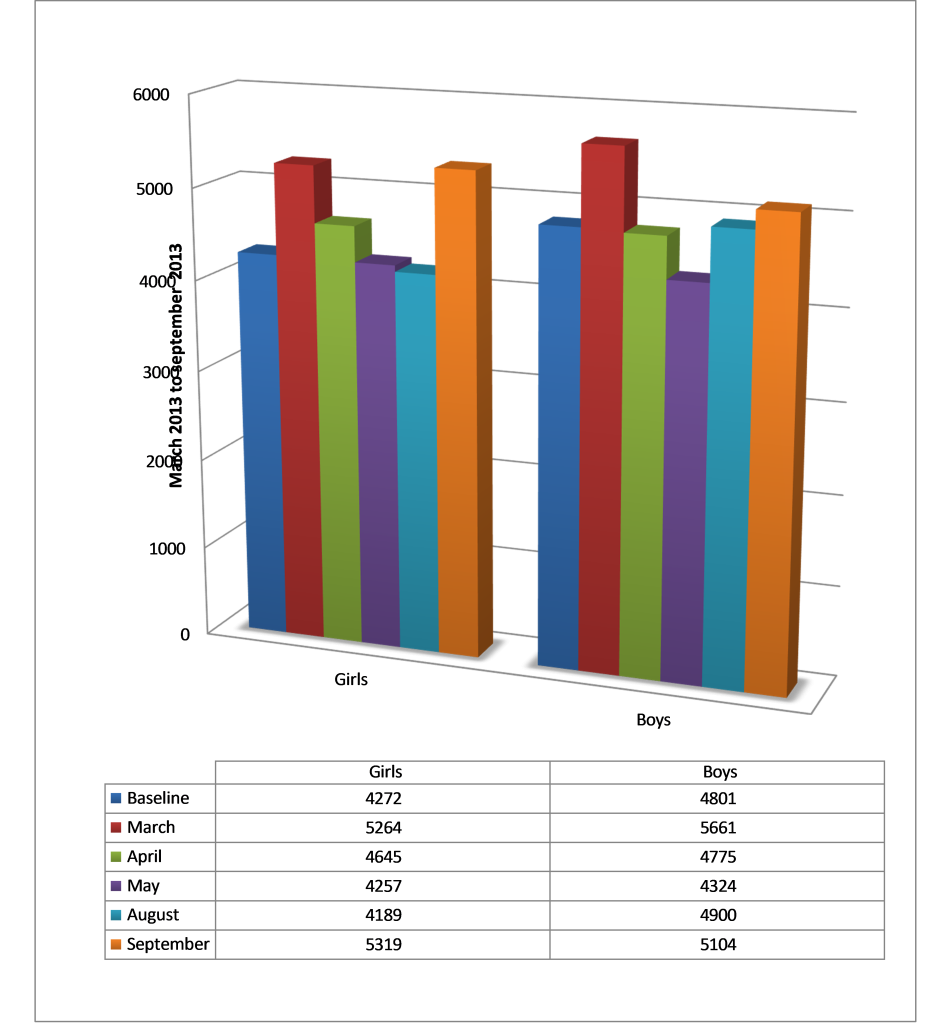
The enrolments of male and female learners have considerably increased in the schools working under this project in general as punctuality of teachers along with their improved ways of teaching has encouraged parents to send their children to school (see Figure 1). The reconstructed schools have the highest enrolment rates amongst all the other 50 schools as their improved outer look, colourfully painted walls and playing equipment has captivated the attention of the surrounding communities and thus has motivated to send their children to schools. The reconstructed schools have a proper arrangement of toilets for the students, this has saved young children the walk back home for using toilets. The schools have now a cleaner look and have neatly painted walls with pictures on. The schools also have playing equipment installed in the play area and it has become a prime attraction for not only girls but for boys as well as they are motivated to play on the swings and the marry-go-rounds.
The entire groups of stakeholders endorsed the idea of schools reconstruction and improvement. Across the board all parents admitted that due to nearby schools now being operational; it is now safer to send their female children to schools. They were initially reluctant to send their girls due to long distances between their homes and the schools.
“I am amazed to see the response of the students and their parents after the reconstruction of our school. The beautiful thematic pictures and
letters painted on the walls make the environment conducive to learning. My students are happy to have new furniture in their classroom.” (primary school teacher) The enrolments have also increased due the involvement of parents and other community members in the SMCs. Because of their active involvement in SMC meetings and other activities, they now are more informed about issues related to Kamber-Shahdadkot and the importance of education in general and girls’ education in particular. They are now able to advocate girls’ education in their own communities and convince people to send their female children to schools.
Figure 1: Enrollment Tracking Sheet
“Due to the active involvement of my relative (aunty) in SMC meetings as she is the member and is well informed about the current improvement
in the schools and teachers, she is able to convince other relatives to send their daughters to school. We can even see a visible change in her mannerism and confidence after being a part of the SMC”.
(young mother of a new enrolled child)
Community members also showed their keen interest in getting school kits, books and other perks through the project interventions. Children carrying these small rewards or free books and goodies attracted other children and their parents for sending their children and get similar incentives. The functions and entertainment programs held under this project have also encouraged local communities for sending their daughters to school.
It is indeed a substantial improvement in the perception of local communities towards girls’ education that a vast majority of the male members of the society are much interested in educating their girls. Across the board, male community members, be it from religious minorities, faith based organization, poor or affluent communities, educated or illiterate men, all strongly endorsed girls’ education and demanded more schools to be opened in the vicinities. The major apprehension in sending a female child to school is their security issue. They are of the opinion that primary going children are too young to even report any abuse if ever happened to them.
The cultural barriers regarding female liberation are quite staunch and have been non-negotiable for a long period of time. However, due to the new dimensions of the present time including role of media, NGOs’ interventions and technology, the localities are now exposed to the new world and its fancies. They now see a robust role of women in every walk of life. Moreover, they are highly impressed with the well educated women appearing on the television, seen in the newspapers and magazines, performing as good as any other man, are convinced that given a chance their daughter can also be as polished and acquire finesse as any woman of urban areas.
“I am a proud father of two young daughters and I see them to become doctor and teacher one day. When one of my daughter corrected me for a certain word she had recently learnt in the school,
I dreamt of her being a teacher one day because she rated her teacher so high and convinced me that I was wrong and her teacher was right about the word. Her confidence of speech inspired me to support her studies till the university level. There is a girl in from our
community who has made till the university level and I want my daughter to be the next one.” (father of two enrolled students)
On the other hand, in some communities, female group members especially the parents of drop out children or children who have never been enrolled showed disinterest in sending their girls to school. They reasoned it with poverty and their daughters’ utility in homes as unpaid labour that can help them with their household chores.